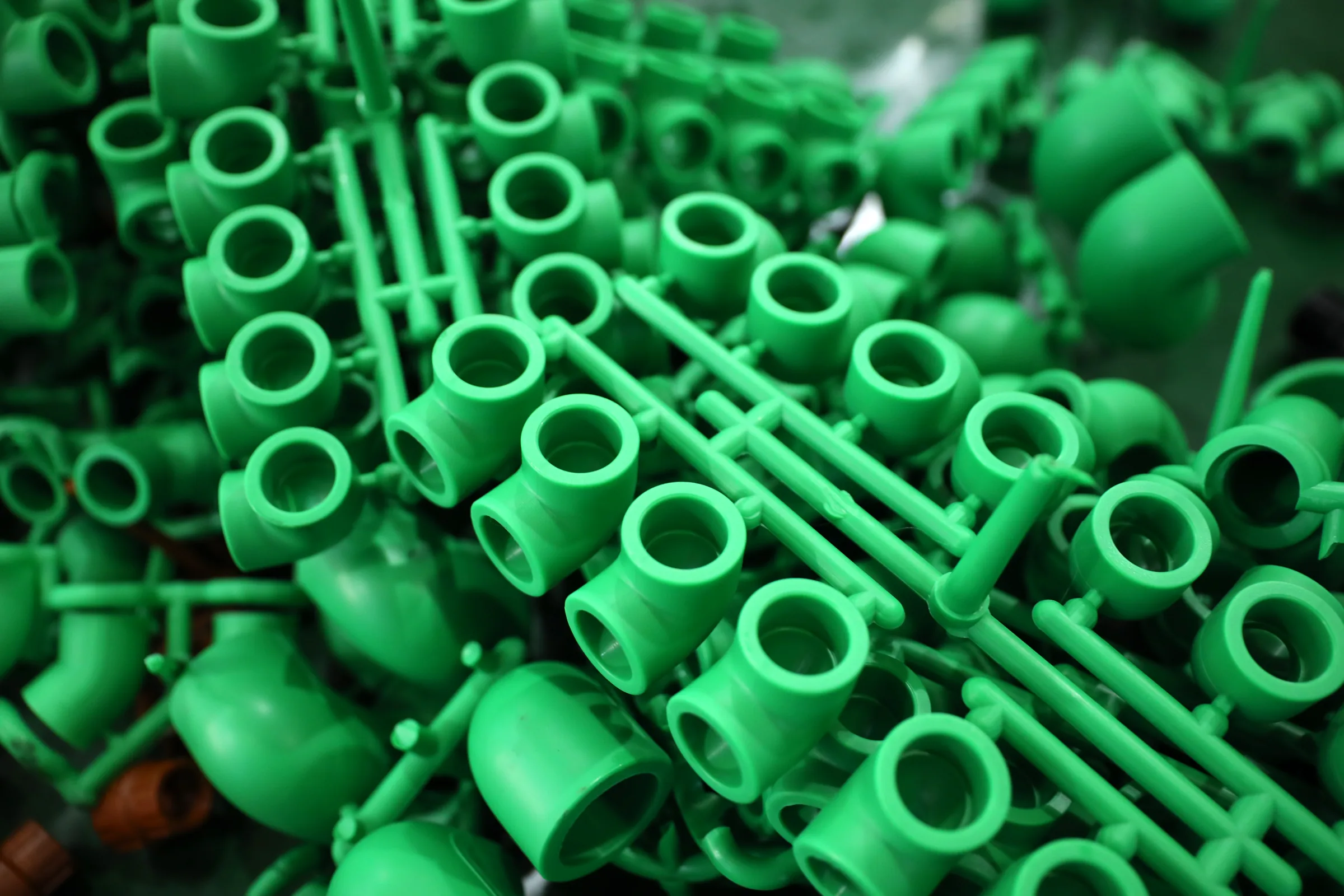
Most socket-versus-butt comparisons answer a question nobody on a live job is asking. They line up “permanent homogeneous joint” against “permanent homogeneous joint,” declare both excellent, and stop. Meanwhile the site agent has a stack of pipe in three diameters, one welding machine, a labour rate, and a hand-over date.
The real decision is settled by four things that are written down in the welding standards and almost never quoted: the diameter range each method is actually tabulated for, whether the parameters scale with diameter or with wall thickness, how long each joint occupies the crew and the machine, and what equipment and certification the method obliges you to bring on site. Those four determine your programme and your cost. The strength argument does not.
This article works through those four for thermoplastic systems (PE-HD, PP/PP-R) using DVS 2207-1 and manufacturer data, and then separately for steel, where the standards draw a completely different boundary. It ends with a straight recommendation per project type — including the cases where our own range is not the answer.
One framing correction first, because it drives a lot of bad specification writing. Socket welding and butt welding of PE-HD are not governed by two competing standards. DVS 2207-1 §1 sets its own scope as heated tool butt welding, heated tool socket welding and electro-socket welding of PE-HD pipes, fittings and tapping tees to DIN 8074/8075, DIN 16963, DIN 3543-4 and DIN 3544-1. One technical code, three methods. If a specification claims the two methods answer to separate standards, that specification has not been read against the source.
Start with what the standard tabulates, because that is the only diameter boundary you can defend in a technical submittal.
DVS 2207-1 Table 5, the heated tool socket welding guide values, covers pipe outside diameters 16 mm to 125 mm. That is the whole table. The standard does not tabulate socket welding above 125 mm. The columns are split by SDR — SDR 11 / 7.4 / 6 in one group, SDR 17 / 17.6 in another — so the parameters are conditioned on wall series, not diameter alone.
That upper bound is corroborated on the manufacturer side. Georg Fischer’s PROGEF polypropylene handbook offers socket fusion fittings in 16–110 mm (3/8 in – 4 in), while listing contact (conventional) butt fusion as an industry standard method through 500 mm (20 in). Two independent sources, the same picture: socket fusion runs out somewhere around 110–125 mm; butt fusion keeps going by a factor of four or five.
Now the boundary that matters far more for your labour plan, and that is routinely misquoted. DVS 2207-1 §6.1 states that heated tool socket welding can be performed manually — hand-held — only up to 50 mm pipe diameter. From 63 mm upward a welding device is required, because of the higher joining force.
Read that carefully, because the industry mangles it constantly. 63 mm is not where socket welding stops. It is where socket welding stops being a two-man hand operation and becomes a machine operation. The method continues to 125 mm in the table; what changes at 63 mm is your equipment list.
We should flag what we could not substantiate here, because the unsubstantiated version of this rule is everywhere. The widely repeated claim that “butt fusion is required for 63 mm and larger” does not appear in any standard we could open. It circulates in vendor and blog content as practice guidance. DVS 2207-1 says something adjacent but materially different — at 63 mm and above, socket welding needs a machine rather than a hand tool. Do not attribute a 63 mm butt-fusion threshold to a standard in a tender response; it will not survive a technical query. Equally, the claim that socket fusion has a hard 63 mm ceiling is contradicted by the primary source: the table runs to 125 mm and GF sells fittings to 110 mm.
| Boundary | What the source actually says | Source |
|---|---|---|
| Socket welding, hand-held limit | Manual welding only up to 50 mm pipe diameter; welding device required from 63 mm up, due to higher joining force | DVS 2207-1 (Aug 2007 EN translation), §6.1 |
| Socket welding, tabulated range | OD 16–125 mm only; columns split SDR 11/7.4/6 vs SDR 17/17.6 | DVS 2207-1, Table 5 |
| Socket welding, thin-wall exclusion | “Due to the low wall thickness this welding method is not recommended” — SDR 17/17.6 at OD 25, 32, 40, 50, 63 mm | DVS 2207-1, Table 5 footnote 1 |
| Socket fusion, manufacturer range (PP) | Fittings 16–110 mm (3/8 in – 4 in) | Georg Fischer PROGEF technical handbook |
| Butt fusion, manufacturer range (PP) | Industry standard method through 500 mm (20 in) | Georg Fischer PROGEF technical handbook |
| Buttwelding fittings, steel | NPS 1/2 – NPS 48 (DN 15 – DN 1200) | ASME B16.9, official standard page |
| Socket-weld fittings, steel | Size range increased to cover NPS 4 for Class 3000 in the 1966 2nd edition | ASME B16-F committee correspondence, “B16.11 History Specific to SW Fittings,” 14 Jun 2016 |
Here is the single most useful thing in this article, and it is buried in a footnote of the standard.
DVS 2207-1 Table 5 footnote 1 states that for the thin-wall SDR 17 / 17.6 series at OD 25, 32, 40, 50 and 63 mm, socket welding is not recommended, “due to the low wall thickness.”
Sit with the implication. A 50 mm pipe is comfortably inside socket welding’s diameter range and comfortably inside the hand-held limit. But at SDR 17, the standard tells you not to socket weld it. The method’s limit is set by wall thickness, not by diameter alone.
This is where specifications go wrong. A spec that says “socket fusion up to 63 mm, butt fusion above” reads as competent and is silently incorrect for every thin-wall line in that range. The correct rule needs both variables: diameter and SDR. If you are buying a lower-pressure, thinner-wall PE series and your installer plans socket joints on the 25–63 mm branches, that plan is outside the standard’s recommendation. If the relationship between DN, SDR, wall and pressure class is not yet fixed on your drawings, settle it with the DN, NPS, SDR and PN sizing charts before you write the joining method into the specification.
The two methods are parameterised on different axes altogether, and this is not cosmetic:
Practical consequence: when you change pressure class without changing diameter, socket welding parameters move along the SDR column while butt welding parameters move a long way along the wall-thickness axis. A heavier-wall pipe at the same OD lengthens every butt joint materially. That is a programme input, and it is one that estimators routinely miss because they price fusion “per joint by diameter.”
A genuinely surprising fact, and a useful one for auditing a method statement.
For PE-HD, DVS 2207-1 gives socket welding a heated tool temperature of 250 to 270 °C (Table 5 header and the §6 processing instruction), applicable to OD 16–125 mm. The same standard gives heated tool butt welding of PE-HD 200 to 220 °C (Appendix processing instruction, step 13 versus step 4).
Same material, same standard, roughly 50 °C apart. Socket welding runs hotter.
The reason is mechanical rather than mysterious: socket welding heats a short overlap through a male/female tool pair for a brief, fixed dwell, then relies on interference as the pipe is driven to insert depth. Butt welding heats two flat faces for far longer and joins under a controlled pressure. Different heat-transfer geometry, different setting.
The audit value is immediate. If a method statement quotes one heater temperature for “fusion” across both methods, it has not been written from the standard. If it quotes 250–270 °C for butt welding PE-HD, it is wrong in a way that shows up in the joint.
For PP the numbers are again method-specific: heated element socket welding at 260 ± 10 °C, heated element butt welding at 210 ± 10 °C with joining pressure p = 0.10 N/mm² ± 0.01 (SIMONA AG, “work.info Welding,” 11/2011, reproducing the DVS 2207-11 tables). PE butt welding runs at alignment and joining pressure p ≈ 0.15 N/mm² (same source, citing DVS 2207-1).
A note on what these numbers are not. They are pressures and forces, not torques. No torque specification for socket or butt fusion appears in any source we examined — DVS 2207-1 and DVS 2207-11 specify joining pressure in N/mm² and joining force. If you are handed a method statement with a torque figure for a fusion joint, treat it as confused with a threaded or mechanical connection, or as fabricated. That is our reading of the sources, not a clause we can cite.
| Parameter | Socket welding | Butt welding | Source |
|---|---|---|---|
| PE-HD heated tool temperature | 250–270 °C (OD 16–125 mm) | 200–220 °C | DVS 2207-1, Table 5 header / Appendix steps 4 & 13 |
| PP heated element temperature | 260 ± 10 °C (OD 16–125 mm) | 210 ± 10 °C | SIMONA “work.info Welding” 11/2011, citing DVS 2207-1 / 2207-11 |
| Indexed by | Diameter and SDR | Wall thickness | DVS 2207-1 Table 5; SIMONA guide value tables |
| Joining pressure | Not a pressure parameter — insert to depth against interference | PP: 0.10 N/mm² ± 0.01; PE: ≈ 0.15 N/mm² | SIMONA “work.info Welding” 11/2011 |
| Joint geometry scaling | Insert depth 13 mm (OD 16) → 23 mm (OD 50) → 27 mm (OD 63) → 41 mm (OD 110) | Face preparation across full wall | DVS 2207-1, Table 4 |
| Torque specification | None found in any source examined for either method | Our reading of DVS 2207-1 / 2207-11 via SIMONA | |
Now convert the parameters into hours, because that is where the two methods genuinely diverge.
Take one worked case the standard gives explicitly. PE-HD at OD 110 mm, SDR 11, socket welded: heating-up 50 s, change-over maximum 10 s, fixed 50 s, cooling 8 min (DVS 2207-1, Table 5 and §6.4). Note the “maximum” on change-over — that 10 s is a ceiling, not a target. Exceed it and the joint is out of specification.
Set that against butt welding on comparable material. Even at the thin end — wall up to 4.5 mm — PE butt welding wants 45 s heating-up, 5 s change-over and 6 min cooling. At wall 50–70 mm it wants 500–700 s heating-up, 20–25 s change-over and 60–80 min cooling.
The cooling column is the programme killer. A single heavy-wall butt joint can hold the machine and the pipe run for over an hour before the next operation. That is not labour time you can compress by adding welders — the pipe cools at the rate it cools.
The honest summary is that thin-wall butt welding is not dramatically slower per joint than socket welding, and at the small end the two are close. The divergence opens as wall thickness climbs. Below is what the sources support, per joint, without invented figures:
| Case | Heating-up | Change-over | Cooling | Source |
|---|---|---|---|---|
| PE-HD socket weld, OD 110 mm, SDR 11 | 50 s | max 10 s | 8 min (fixed 50 s) | DVS 2207-1, Table 5 / §6.4 |
| PP socket weld, OD 110 mm, SDR 11 | 50 s | 10 s | 8 min | SIMONA 11/2011, citing DVS 2207-1 / 2207-11 |
| PE butt weld, wall ≤ 4.5 mm | 45 s | 5 s | 6 min | SIMONA 11/2011, citing DVS 2207-1 |
| PE butt weld, wall 50–70 mm | 500–700 s | 20–25 s | 60–80 min | SIMONA 11/2011, citing DVS 2207-1 |
| PP butt weld, wall ≤ 4.5 mm | 135 s | 5 s | 6 min | SIMONA 11/2011, citing DVS 2207-11 |
| PP butt weld, wall 37–50 mm | 485–560 s | 14–17 s | 55–70 min | SIMONA 11/2011, citing DVS 2207-11 |
Two cautions on using this table for estimating. First, these are guide values under the stated conditions; site temperature, wind and the specific machine all bear on real cycle times, and the standard’s conditions are not your site’s conditions. Second — and this is the mistake we see most — do not average these into a single “minutes per joint” figure for a mixed-diameter, mixed-SDR bill of quantities. The two methods are indexed on different variables. Averaging across them produces a number that is wrong in both directions at once.
What we cannot give you is a cost per joint in currency. Labour rates, machine rental, welder day rates and consumables are all project- and market-specific, and no standard publishes them. Any article quoting a universal cost-per-joint figure has invented it. On our side, pricing: Coming soon, quoted per project against your actual line items.
Both methods carry an obligation that has nothing to do with the pipe, and it is where budgets quietly break.
DVS 2207-1 §2 requires that every welder be trained and hold a valid qualification certificate, and that welding equipment comply with DVS 2208-1. The qualification routes are named: DVS 2212-1 for industrial piping and sheet butt welding, with DVGW GW 330 applying analogously for both heated tool butt and heated tool socket welding in gas and water supply construction. Note the “both” — socket welding is not the informal method that skips certification.
The same clause states plainly: “The quality of welded joints depends on the qualification of the welder, the suitability of the utilized equipment and devices as well as on compliance with the welding standards.” Three factors, and two of them are people and kit rather than product.
Manufacturers reinforce this independently. Georg Fischer requires that upon successful completion of a test weld of the type being implemented, the installer is issued a certification card verifying they meet the manufacturer’s requirements for proper installation and testing. Note “of the type being implemented” — qualification is method-specific. A crew carded for butt fusion is not thereby carded for socket fusion.
On equipment, GF’s own installation specification is more prescriptive than most specs written from it. It distinguishes socket fusion bench machines (SG-110, SG-160) from the MSE/MSA hand tool, and directs that the bench machine be used for as many fittings as possible with “minimal use of the MSA hand tool.” For butt fusion it names SG 160, GF 160-315 and GF 160-500 butt fusion machines.
That is worth pausing on, because it cuts against the folk wisdom that socket fusion is the low-equipment option. Within socket fusion’s own size range, the manufacturer treats the hand tool as the constrained choice to be minimised — not the default. Combine that with DVS 2207-1 §6.1 requiring a welding device from 63 mm up, and the “socket welding needs no machine” assumption survives only on small-diameter work.
| Requirement | Socket welding | Butt welding | Source |
|---|---|---|---|
| Welder qualification | Required; DVGW GW 330 applies analogously | Required; DVS 2212-1 for industrial piping, DVGW GW 330 for gas/water supply | DVS 2207-1, §2 |
| Equipment compliance | Welding equipment must comply with DVS 2208-1 | DVS 2207-1, §2 | |
| Hand tool permissible | Manual only up to 50 mm; device required from 63 mm | Machine method | DVS 2207-1, §6.1 |
| Manufacturer equipment (PP) | SG-110 / SG-160 bench machine preferred; MSE/MSA hand tool use to be minimised | SG 160 / GF 160-315 / GF 160-500 butt fusion machines | Georg Fischer PROGEF technical handbook, guide specification §3.2 Installation, item B |
| Installer certification | Test weld of the type being implemented; certification card issued | Georg Fischer PROGEF technical handbook, guide specification Part 3 Execution, §3.2 Installation, item A | |
If your project is metal rather than plastic, transfer none of the above. The standards split the two methods at a different diameter and for different reasons.
ASME B16.9, covering factory-made wrought buttwelding fittings, spans NPS 1/2 through NPS 48 (DN 15 through DN 1200). ASME B16.11, covering socket-welding and threaded forged fittings, is capped at NPS 4. The upper bound on the socket-weld side is documented in ASME’s own B16-F Fittings Committee correspondence, which records that the “size range for SW fittings increased to cover NPS 4 fitting dimensions for Class 3000” in the 1966 second edition.
So on steel the split is roughly NPS 4 versus NPS 48 — a factor of twelve. On plastics it is roughly 110–125 mm versus 500 mm — a factor of four or five. Both point the same direction, but the boundary is not transferable, and a spec that migrates a plastic-system rule onto a steel system will be wrong.
Two things we deliberately are not printing, because we could not verify them against primary sources:
We also could not obtain the primary text of ISO 15494 at clause level, or DVS 2207-11 itself. The PP figures above come from SIMONA’s manual, which reproduces the DVS 2207-11 tables and cites them by number — a manufacturer-tier source, adequate for guidance but not the standard itself. We would rather label the tier than let a reader assume we read a standard we did not open.
A comparison that ends in “it depends on your application” has wasted your time. Here is the call.
Use socket welding when your line is small-bore, your diameters sit at or below 50 mm, and your wall is in the thicker SDR series. Inside that envelope the case is strong: hand-held work is permitted by DVS 2207-1 §6.1, cycle times are short, the joint self-aligns in the socket, and you avoid mobilising a butt fusion machine for branch work. Building services risers and branches, potable water distribution in small diameters, and PP-R hot and cold work are the natural home. This is exactly where our PPR pipe and fittings range lives — PN20 in 20, 25 and 32 mm, every size inside the hand-held envelope.
Use butt welding when any of four conditions is true — and treat them as disqualifying tests for socket welding, not preferences:
Use neither, and specify mechanical or compression jointing, when your crew is uncertified, the site cannot support a controlled welding operation, or the programme genuinely cannot absorb the cooling times above. DVS 2207-1 §2 makes welder qualification a requirement, not a nicety. An unqualified crew welding to a spec they cannot execute is a worse outcome than a mechanical joint. Our 603 and 604 HDPE compression fittings are the weld-free route for exactly this case (per our catalogue).
The recommendation we will not make is the one most suppliers make by default — “socket for small, butt for large, sorted.” It ignores wall thickness, which is the variable the standard itself flags in a footnote, and it converts a machine-availability boundary at 63 mm into a method boundary that does not exist.
| Your project | Our recommendation | Reasoning grounded in |
|---|---|---|
| PP-R hot/cold building services, ≤ 32 mm | Socket welding | Well inside the manual limit (50 mm) and the tabulated range; matches our PPR range (per our catalogue) |
| PE-HD branch work, 40–50 mm, thicker SDR series | Socket welding, hand-held permissible | DVS 2207-1 §6.1 manual limit 50 mm; check SDR against Table 5 footnote 1 |
| PE-HD, 25–63 mm at SDR 17 / 17.6 | Not socket welding | Table 5 footnote 1: not recommended due to low wall thickness |
| PE-HD, 63–110 mm | Either — decide on machine availability and cycle time | Socket needs a welding device from 63 mm anyway (§6.1); both methods available in range |
| Above 125 mm plastic | Butt welding | Socket welding not tabulated above 125 mm; GF butt fusion through 500 mm. Above Φ110 we do not supply — see below |
| Buried water mains | Butt welding, or compression for speed | No socket at every joint on unrecoverable runs; our 603/604 compression series is the weld-free route (per our catalogue) |
| Steel, above NPS 4 | Buttwelding fittings | ASME B16.11 capped at NPS 4; B16.9 spans NPS 1/2 – NPS 48. We do not manufacture forged steel fittings |
| Uncertified crew or no controlled welding setup | Mechanical / compression | DVS 2207-1 §2 requires valid welder qualification for both methods |
Being useful here means being explicit about our ceiling, because the diameter argument above runs well past it.
Our pressure pipe range tops out at Φ110. Every socket-versus-butt argument in this article that concerns diameters above Φ110 is written to help you specify correctly, not to sell you pipe we do not make. If your project needs DN 150–400 mains, we cannot supply them, and we would rather you learn that here than three weeks into an enquiry.
Specifically, per our catalogue:
IFANNova is a French brand. Manufacturing is by Zhuji Fengfan Piping in Zhuji, Zhejiang — we are not made in France and do not suggest otherwise. Behind the brand: 30+ years, 1000+ employees, 118+ countries served, 120,000 m² of facility. Certifications held: SKZ, CE, WRAS, DVGW, SGS, ISO 9001 and ISO 14001. Certificate numbers: Coming soon.
On wall thickness — the variable this whole article turns on — our catalogue publishes the full line-by-line table for the pressure systems, not just the endpoints. HDPE PN16 runs Φ20 × 2.3, 25 × 2.3, 32 × 3.0, 40 × 3.7, 50 × 4.6, 63 × 5.8, 75 × 6.8, 90 × 8.2, 110 × 10.0 mm. UPVC 806 PN16 runs Φ20 × 2.0, 25 × 2.0, 32 × 2.4, 40 × 3.0, 50 × 3.7, 63 × 4.7, 75 × 5.6, 90 × 6.7, 110 × 7.2 mm. So you can check your intended joining method against Table 5 footnote 1 for every size we sell, without back-calculating anything. Where we genuinely have no published wall data is PEX and brass — the catalogue gives those by diameter and thread size only, so ask us rather than assume. Lead times, MOQ and pricing are Coming soon — confirmed per project against your quantities and destination.
Is butt welding stronger than socket welding? We found no primary-source data comparing joint strength between the two methods, and we are not going to assert a winner. DVS 2207-1 §2 attributes joint quality to welder qualification, equipment suitability and compliance with the welding standards — not to method choice. A correctly executed joint of either type, within its stated range, is the standard’s expectation. Choose on diameter, wall thickness, programme and equipment.
Can I socket weld 90 mm pipe by hand? No. DVS 2207-1 §6.1 limits manual heated tool socket welding to 50 mm pipe diameter; from 63 mm upward a welding device is required because of the higher joining force. The method still applies at 90 mm — Table 5 runs to 125 mm — but not hand-held.
Why is my socket welding heater set higher than the butt welding heater? Because it should be. For PE-HD, DVS 2207-1 gives socket welding 250–270 °C and butt welding 200–220 °C. For PP the figures are 260 ± 10 °C and 210 ± 10 °C respectively (SIMONA, 11/2011, citing the DVS tables). One heater setting for both methods indicates a method statement not written from the standard.
What is the correct torque for a fusion joint? There isn’t one. No torque specification for socket or butt fusion appears in any source we examined. These methods specify joining pressure in N/mm² and joining force — PP butt welding at 0.10 N/mm² ± 0.01, PE at approximately 0.15 N/mm². A torque figure for a fusion joint has almost certainly been confused with a mechanical or threaded connection.
Does socket welding avoid needing a certified welder? No. DVS 2207-1 §2 requires a valid qualification certificate for welders, and names DVGW GW 330 as applying analogously to both heated tool butt and heated tool socket welding in gas and water supply construction. Georg Fischer separately requires a passed test weld “of the type being implemented” before issuing a certification card — so socket and butt qualification are not interchangeable.
Do socket and butt welding fall under different standards? Not for PE-HD. DVS 2207-1 §1 scopes heated tool butt welding, heated tool socket welding and electro-socket welding into a single technical code, covering pipes and fittings to DIN 8074/8075, DIN 16963, DIN 3543-4 and DIN 3544-1. On the steel side the split is real — ASME B16.9 for buttwelding fittings, ASME B16.11 for socket-welding and threaded forged fittings.
How long does a butt weld take? It depends on wall thickness, not diameter, and the range is wide. PE at wall ≤ 4.5 mm: 45 s heating-up, 5 s change-over, 6 min cooling. PE at wall 50–70 mm: 500–700 s heating-up, 20–25 s change-over, 60–80 min cooling (SIMONA, 11/2011, citing DVS 2207-1). Cooling is the part you cannot compress with more labour.
The socket-versus-butt decision cannot be made from a diameter list alone — it needs the wall series too, which is the whole point of the footnote most specifications miss. Send your diameters, pressure class or SDR per size, material, quantities and destination market, and you will get a written answer against our real range, including a straight “no” for anything above Φ110 and for PPR above 32 mm.
A PP-R puncture can be repaired in place with a fusion pin, but only if the damage is a clean hole.
A failed pressure test does not tell you where.
Plastic pipe pressure testing: how viscoelastic creep drops the gauge without a leak, the standard test methods, and how to tell relaxation from a real failure.