A specification says HDPE, PE 100, Φ110. The consultant has written SDR 11. Somebody in procurement asks whether SDR 17 would do, because it is cheaper. That question is usually answered with a pressure argument — and the pressure argument is settled elsewhere. What almost nobody puts on paper is the other half: how much cheaper, through which mechanism, and at which point in the landed-cost chain the saving stops being real.
This page is the money side of that decision. It does not re-derive what SDR means, how the pressure formula works, or why PN is a 20 °C declaration — that is all set out with the clause text on our pipe sizing and SDR reference page. Take the pressure class as already decided by your designer. What follows is what happens to the invoice, and each link is arithmetic you can check:
Scope note, stated up front. Our own HDPE pressure line runs Φ20 to Φ110, marked “GERMANY STANDARD DIN 8077/8078” (per our catalogue), with 603/604 compression fitting series (per our catalogue). If your SDR question is about a Φ250 or Φ400 transmission main, the reasoning on this page still applies to your project — but we do not manufacture that pipe and will say so rather than quote it. See the honest range statement near the end.
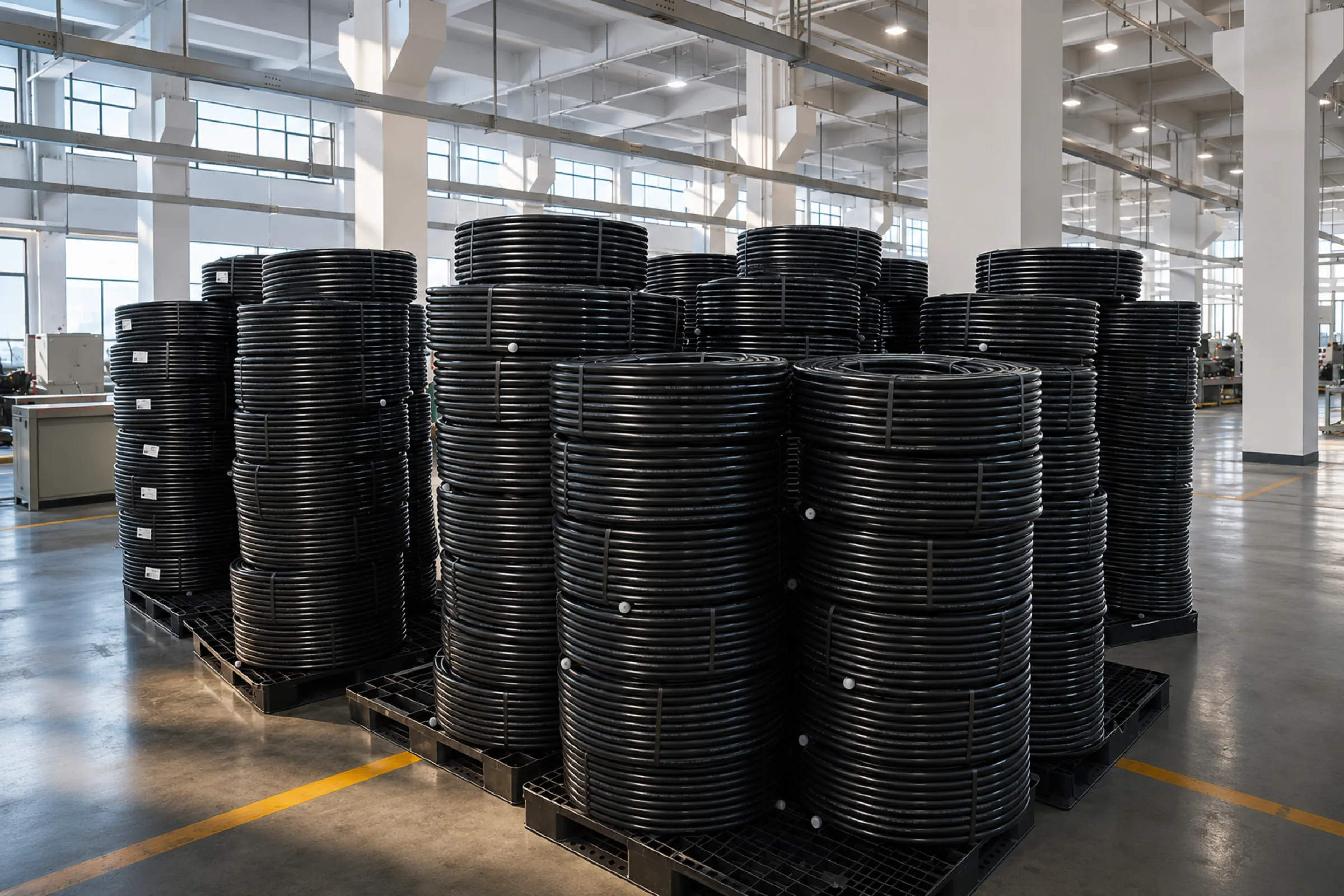
The intuitive assumption is that doubling the SDR halves the material, because the wall is half as thick. That is wrong, and knowing the true shape is what lets you price a step before the mill does.
The polymer in a plain pipe occupies an annulus, so mass per metre follows the standard annulus geometry: m = π/4 · (D² − (D − 2e)²) · ρ / 10⁶, which reduces algebraically to m = π · (D − e) · e · ρ / 10⁶ — m in kg/m, D the outside diameter in mm, e the wall in mm, ρ the density in kg/m³, and the 10⁶ converting mm²·kg/m³ to kg/m. The two forms are identical; we verified that numerically to nine decimal places (Omni Calculator, Pipe Weight, general annulus formula; identity verified independently by computation). It assumes a plain, uniform, circular annulus — no coating, no profiling, no co-extruded stripe.
Substituting e = D / SDR gives mass in terms of the ratio you are actually negotiating: m = π · ρ · D² · (SDR − 1) / SDR² / 10⁶ (derived by substitution from the SDR definition SDR = dn/en, per the PE100+ Association technical guidance; substitution verified numerically against the annulus form).
That is the commercial point of this section. At a fixed diameter everything except (SDR − 1) / SDR² is constant, and that group is not proportional to 1/SDR — it falls faster than the wall does at low SDR and more slowly at high SDR, because the mean circumference of the annulus shrinks as the wall thickens inward. In practice: SDR 11 to SDR 17 removes about 33% of the wall mass, and SDR 17 to SDR 26 removes a further 33%. Two steps, roughly a third each time — not a half, and not a fixed number of kilograms.
The table below is the mass group evaluated across the full ISO 4427-2:2007 SDR series, indexed to SDR 11 = 100. It is a geometric index, not product data: it tells you the ratio between two walls at the same diameter, and nothing about what any particular mill supplies.
| SDR (ISO 4427-2:2007 series) | Mass group (SDR − 1)/SDR² | Material index (SDR 11 = 100) | Change vs. one step heavier |
|---|---|---|---|
| SDR 6 | 0.1389 | 168.1 | — |
| SDR 7.4 | 0.1169 | 141.4 | −15.9% |
| SDR 9 | 0.0988 | 119.5 | −15.5% |
| SDR 11 | 0.0826 | 100.0 | −16.3% |
| SDR 13.6 | 0.0681 | 82.4 | −17.6% |
| SDR 17 | 0.0554 | 67.0 | −18.7% |
| SDR 21 | 0.0454 | 54.9 | −18.0% |
| SDR 26 | 0.0370 | 44.7 | −18.6% |
| SDR 33 | 0.0294 | 35.6 | −20.4% |
| SDR 41 | 0.0238 | 28.8 | −19.2% |
SDR values are the ten series members printed in ISO 4427-2:2007 Table 2. The index column is our own arithmetic from the mass group above — it is a computed ratio, not a measurement and not a catalogue figure.
Read the last column. Each step down the ISO series removes roughly 16–20% of the polymer — remarkably even across the range, which is convenient for mental arithmetic: one SDR step is worth about a fifth of the material, two steps about a third. Going the other way, SDR 11 to SDR 9 adds about 19.5% at the same diameter.
Translating that to price depends on how much of the ex-works price is resin — a split that varies with resin markets, plant loading and order size, and one we are not going to publish a percentage for. Our own price split by cost element: Coming soon. What is safe to say is directional: extruded commodity pressure pipe is resin-dominated, so the index moves ex-works price substantially but not one-for-one, because conversion, packing and margin do not scale with wall thickness. Treat the index as an upper bound on the saving, never the saving itself. That is our commercial judgement, not a sourced figure.
Ratios are safe. The moment you turn the index into an actual kilogram figure for a purchase order, you hit a problem that catches out a lot of spreadsheets: SDR is a nominal designation, not an exact arithmetic quotient. The wall thicknesses in ISO 4427-2:2007 Table 2 are not simply dn divided by SDR. We checked all 191 populated wall-thickness cells against the division and 122 deviate. Verified counter-examples:
| Size and series | dn / SDR (arithmetic) | emin in ISO 4427-2:2007 Table 2 | Deviation |
|---|---|---|---|
| dn 315, SDR 9 | 35.00 mm | 35.2 mm | +0.2 mm |
| dn 200, SDR 7.4 | 27.03 mm | 27.4 mm | +0.37 mm |
| dn 110, SDR 7.4 | 14.87 mm | 15.1 mm | +0.23 mm |
| dn 16, SDR 6 | 2.67 mm | 3.0 mm | +0.33 mm |
All emin values from ISO 4427-2:2007 Clause 6.3 and Table 2. The deviations run in both directions — the tabulated wall is usually above the quotient, but at large diameters it can fall below it, as at dn 1000 SDR 13.6, where emin is 72.5 mm against a quotient of 73.53 mm — which means a spreadsheet that computes weight from dn/SDR misstates the pipe in either direction.
Two operational rules follow, and they are the difference between a costing model that survives contact with a mill and one that does not:
We will not publish a wall schedule for our own HDPE range by back-calculating from SDR — but we do not need to, because the catalogue prints the whole PN16 line: Φ20×2.3, Φ25×2.3, Φ32×3.0, Φ40×3.7, Φ50×4.6, Φ63×5.8, Φ75×6.8, Φ90×8.2 and Φ110×10.0 mm (per our catalogue). Those are catalogue walls, not formula-derived numbers. Read against ISO 4427-2:2007 Table 2, every one of them matches the SDR 11 emin column, so our HDPE line is a single SDR 11 series — we do not offer an SDR 17 equivalent.
This is the single most useful number here for anyone building a landed-cost model, and it is a back-test rather than a claim. We ran the annulus formula at emin with ρ = 960 kg/m³ and compared it against a published manufacturer weight table — ACP Pipes’ PE 100 Series 1 catalogue to AS/NZS 4130:2018, 24 data points. The formula does not match. It is consistently low.
| Basis | SDR 11 (n = 13) | SDR 17 (n = 11) |
|---|---|---|
| Calculated at emin, ρ = 960, vs. published | Published averages 6.6% higher | Published averages 7.0% higher |
| Calculated at mid-tolerance wall (emin + emax)/2, ρ = 960 | Matches published to within ~1% | Matches published to within ~1% |
The individual points behind the averages, in kg per 100 m (ACP Pipes, PE 100 Series 1 to AS/NZS 4130:2018, back-tested computationally):
| Pipe | Calculated at emin | Calculated at mid-tolerance | Published catalogue weight |
|---|---|---|---|
| dn 110 SDR 11 | 301.6 | 316.4 | 318.0 |
| dn 160 SDR 11 | 640.2 | 671.6 | 675.1 |
| dn 110 SDR 17 | 205.8 | 217.4 | 218.5 |
The explanation is not mysterious: extrusion lines do not aim at the minimum, because aiming at the minimum means rejecting half the output. They aim into the tolerance band. So published weights track the mid-tolerance wall, and a model built on emin under-buys resin and under-books freight by roughly 5–10%.
The purchasing rule: for quoting, freight booking and BOQ weight, use the manufacturer’s catalogue kg/m for the specific product. Use the formula only to sanity-check that figure or to compare two SDRs. If a supplier’s stated kg/m sits below the emin calculation, ask why — it implies wall below the standard minimum, a different density, or an error.
Two caveats that matter when you are arguing weight with a supplier, both verified by exhaustive text search rather than assumed:
Here is where the intuitive cost model breaks. Buyers reason: thinner wall, lighter pipe, cheaper freight. For sea freight in a full container that is simply wrong, and the reason changes what you should be negotiating.
Start with how ocean freight is charged. For FCL, “the base ocean freight is usually a rate per container type (20′, 40′, 40HC), then you add local charges and surcharges” — a flat rate per box, whether or not the box is full. For LCL, chargeable W/M = max(CBM, weight in metric tons), and the shipper pays whichever is greater (both: iContainers, How to Calculate Ocean Freight Charges). The breakeven is 1,000 kg per CBM: goods denser than 1,000 kg per CBM are charged on actual weight, and goods lighter than that are charged on volume (Cogoport, How to Calculate Volume & Weight for Ocean Freight). Below that, volume governs.
Now compute where HDPE pipe sits. Stowed bulk density is the polymer density times the fraction of the bounding volume that is actually wall — the bore is air, and at high SDR most of the box is air. For square-packed straight lengths at ρ = 960 kg/m³:
| SDR | Wall fraction of bounding volume | Stowed bulk density, square pack (kg/m³) | Hexagonal pack, approx. (kg/m³) | vs. 1,000 kg/m³ W/M breakeven |
|---|---|---|---|---|
| SDR 41 | 0.075 | ~72 | ~83 | Far below |
| SDR 26 | 0.116 | ~112 | ~129 | Far below |
| SDR 17 | 0.174 | ~167 | ~193 | Far below |
| SDR 11 | 0.260 | ~249 | ~288 | Far below |
| SDR 9 | 0.310 | ~298 | ~344 | Far below |
| SDR 6 | 0.436 | ~419 | ~484 | Still below |
This table is our own arithmetic, computed from ISO 4427-2 SDR geometry and the Borealis density of 960 kg/m³. It is not a quoted figure from any source, and it assumes idealised packing of plain straight lengths — no dunnage, no bundling frames, no fittings.
Read the right-hand column. Across the entire SDR range, HDPE pipe is volumetric cargo. Even SDR 6 — the thickest wall in the ISO series, 44% solid polymer by bounding volume — stows at roughly 419–484 kg/m³, less than half the density at which weight would start to govern the charge.
Compare against the container and the same conclusion holds. A 40ft High Cube has internal dimensions of 12.03 × 2.35 × 2.70 m, giving 76 cbm (BWS, 40-foot dry high-cube specifications; cross-check 12.03 × 2.35 × 2.70 = 76.33 m³). A second source gives 12.025 × 2.352 × 2.585 m and agrees on 76 m³ (iContainers, 40ft High Cube). Payload is where they diverge, and we are not going to paper over it: BWS gives tare 3,900 kg and payload 28,620 kg; iContainers gives ~4,150 kg tare and ~26,300 kg payload, noting this “varies by route and carrier restrictions.” Do not use a single universal payload figure — read the CSC plate on the actual box.
Even on the generous figure, weighing out a 40HC needs ~377 kg/m³ (28,620 ÷ 76); on the conservative one, ~346 kg/m³. Only the very thickest walls approach that, and only under idealised packing. Conversely, a 76 cbm 40HC square-packed with SDR 11 holds on the order of 18,900 kg of polymer — inside either payload figure, with the box completely full. This is also why the 40HC is worth specifying: it gives roughly 10–12.5% more volume than a standard 40ft box at ~67.7 m³ (iContainers). For weight-limited cargo that extra height is worthless; for pipe it converts directly into metres shipped per flat FCL rate.
Put the two mechanisms side by side and the conclusion is counterintuitive but firm:
Freight is therefore a fixed cost per metre across SDR at a given diameter, and it dilutes the percentage saving. On long-haul lanes for a low-density product, a 20% ex-works saving from one SDR step lands as materially less than 20% on the delivered price. The cheaper pipe is still cheaper — just less cheaper than the mill quotation implies, and the gap widens the further the cargo travels. The actionable corollary: at a fixed diameter, the lever that moves freight cost is packing efficiency, not wall thickness.
Since the box cubes out, anything that removes air from the box is worth more per unit of effort than anything that removes polymer from the wall.
Telescoping — sliding smaller diameters inside larger ones — is standard practice: “HDPE pipes are usually shipped by 40’HQ containers, with pipes able to be telescoped to minimize ocean freight for various sizes” (SINCO PIPE product page). We flag that this is a manufacturer marketing page and the weakest source cited here; treat the practice as real, but note it corroborates rather than proves the derived finding above.
We are not going to tell you what nesting saves in percentage terms, or how many pipes fit in a box. We looked for an authoritative quantification of the nesting gain and found none, and the only manufacturer loading chart we could locate is US road-trailer loading for 40′/50′ truckloads of IPS/DIPS pipe in feet per load — not ocean container loading, and not transferable. Both quantities depend on bundle geometry, nesting scheme and dunnage, all mill-specific. Any supplier quoting “nesting saves X%” is estimating from their own packing experience, which may well be sound — ask them to show it as a packing list, not a percentage. Our own per-container loading quantities: Coming soon, as packing lists from actual shipments rather than a generic chart.
One assumption worth dislodging before you build a loading model. ISO 4427-2:2007 Clause 6.5 says, verbatim: “No requirements have been set concerning particular lengths of coiled or straight pipe or the tolerance thereon; hence, it is necessary for lengths of pipe to be supplied by agreement between purchaser and manufacturer.”
So “6 m is the standard length” is commercial convention, not a standard requirement. Length is negotiable, and on a volume-constrained shipment it is a real variable: a length that divides awkwardly into the 12.03 m internal container length (BWS) leaves paid-for volume empty at the doors.
Coiling is the alternative at small diameters, and there the standard does bind — Clause 6.4 requires the minimum internal coil diameter to be not less than 18 × dn, a geometric floor on how tightly small-bore pipe can be wound and therefore how compactly it stows. Our HDPE line runs Φ20–Φ110 (per our catalogue), squarely the band where the straight-versus-coil question is live. Which of our sizes ship coiled, at what lengths, and the resulting packed dimensions: Coming soon — answered per enquiry rather than as a chart we cannot yet source.
Everything above assumes the SDR choice is open. Usually it is only partly open, and the boundary is set by the pressure class the designer requires. The SDR-to-pressure relationship, its clause text and the full class table are on the sizing reference page — we are not repeating them. For cost purposes, only two consequences matter.
First, because material and pressure class move together, you can read the cost of pressure directly. Pairing the material index above with the PE 100 classes in ISO 4427-2:2007 Table B.1 (C = 1.25, 20 °C):
| SDR | PE 100 pressure class (ISO 4427-2:2007 Table B.1, C = 1.25, 20 °C) | Material index (SDR 11 = 100) | Material cost per bar of rating, index |
|---|---|---|---|
| SDR 41 | PN 4 | 28.8 | 7.2 |
| SDR 33 | PN 5 | 35.6 | 7.1 |
| SDR 26 | PN 6 | 44.7 | 7.5 |
| SDR 21 | PN 8 | 54.9 | 6.9 |
| SDR 17 | PN 10 | 67.0 | 6.7 |
| SDR 13.6 | PN 12.5 | 82.4 | 6.6 |
| SDR 11 | PN 16 | 100.0 | 6.3 |
| SDR 9 | PN 20 | 119.5 | 6.0 |
| SDR 7.4 | PN 25 | 141.4 | 5.7 |
PN values quoted from ISO 4427-2:2007 Table B.1; index and the per-bar column are our own arithmetic. The last column drifts downward as pressure rating rises — apart from SDR 26, where ISO rounds the PE 100 class down to PN 6 from a calculated 6,4 bar and the index therefore spikes — meaning material per bar of rating is marginally more efficient at heavy wall than at light wall. That is a direct consequence of the (SDR − 1)/SDR² shape, and it is a useful counterweight to the instinct that heavy-wall pipe is poor value. It is not: per bar of capability, it is slightly better value in material terms. What makes it expensive is simply that you are buying more bar than the light-wall option delivers.
Second, the grade is a cost lever that costs no volume at all. Because pressure depends on MRS as well as SDR, the same geometry gives a different class on a different resin. PE 100 at SDR 11 is PN 16; the same SDR on a lower-MRS grade gives a lower class (ISO 4427-2:2007 Annex B and Table B.1). So “SDR 11” on a purchase order without the resin grade stated is an incomplete instruction, and a specification that pins PN rather than SDR leaves the mill free to satisfy it with a thinner wall on a higher grade. That substitution reduces kilograms and reduces ex-works cost without changing the container fill at all — which, given everything in the freight section, is the cleanest saving available on this whole page. Whether it is acceptable is an engineering call for your designer, not a procurement call.
Putting the mechanisms in the order a buyer actually meets them. This is our recommended sequence based on how enquiries typically go wrong; it is process advice, not a sourced procedure.
The reasoning above is general. What we can supply against it is not, and it would be dishonest to run a whole cost-optimisation article without saying so.
Our HDPE pressure line is Φ20×2.3 to Φ110×10, marked “GERMANY STANDARD DIN 8077/8078”, with the 603 and 604 compression fitting series for weld-free connection (per our catalogue). The pressure ceiling is Φ110. If your SDR 11 versus SDR 17 question concerns a DN 150–400 main, we cannot supply that pipe — and we would rather say so on a public page than after a quotation round. The Φ160 that appears against our PVC 902 line is a 1902 fitting size — the 902 pipe stops at Φ110 — and the line is non-pressure drainage duty only, so it does not fill that gap. Our full range and its size limits are tabulated on the sizing reference page.
Manufacturing is by Zhuji Fengfan Piping Co., Ltd in Zhejiang, China (per our catalogue): 30+ years, 1000+ employees, exports to 118+ countries, 10,000 sets of moulds, 120,000 m² of plant. IFANNova is a French brand working to European design standards. Nothing in our range is made in France. Certifications held: SKZ, CE, WRAS, DVGW, SGS, ISO 9001 and ISO 14001; certificate numbers Coming soon.
Is SDR 17 always cheaper than SDR 11? Per metre ex-works at the same diameter, yes — about 33% less polymer. Delivered, yes but by less, because the container freight is identical. Whether it is cheaper for the project is a question for your designer, not us: the two are different pressure classes on the same resin, not interchangeable options.
How many metres of Φ110 fit in a 40HC? We are not publishing a figure. It depends on bundle geometry, nesting and dunnage, and we could not find an authoritative ocean-container loading table for PE pipe. Per-shipment loading quantities: Coming soon, from actual packing lists.
Can you give me a price per kg or per metre? Pricing, MOQ and lead time: Coming soon — quoted per enquiry.
Do you supply SDR-designated pipe? Our HDPE line is catalogued as PN16, Φ20–Φ110, marked to DIN 8077/8078 (per our catalogue). If your specification is written in ISO 4427 SDR terms, send it and we will tell you in writing whether our product satisfies it — including where it does not.
Does the 40HC payload limit ever bind on pipe? On plain PE pipe in the ISO SDR range, no. Mixed loads with fittings, valves or brass are a different calculation. Always check the CSC plate.
A cost model is only as good as the weights and packing behind it. Send your diameters, pressure class or SDR, resin grade if specified, service temperature and quantity per size, and you will get a written answer against our real range — including a straight “no” for anything above Φ110.
Same design stress, same 16 bar, different rounding convention.
ISO defines three material categories, not two: virgin, own in-house rework (permitted in pressure pipe, except PE-X), and external or post-consumer recyclate…
A pipe material selection matrix with every figure sourced: PP-R’s 95 °C is a 100-hour malfunction limit, not a rating — ISO 10508 Class 2 runs 70 °C continuous.