Written for buyers comparing local stock against direct import. Includes the conformity routes we verified, the fees that are published, and a plain list of the widely-repeated compliance claims we could not ground in any primary source.
If you have landed here after searching for an HDPE pipe supplier in the UAE, a pipe fittings supplier in the UAE, or an HDPE pipe manufacturer in the UAE, you are almost certainly trying to answer four questions before you talk to anyone: can this supplier actually cover my scope, what will it cost delivered, how long will it take, and will the paperwork survive customs. This page is written to answer those in the order a procurement engineer asks them, and to tell you plainly where our answers stop.
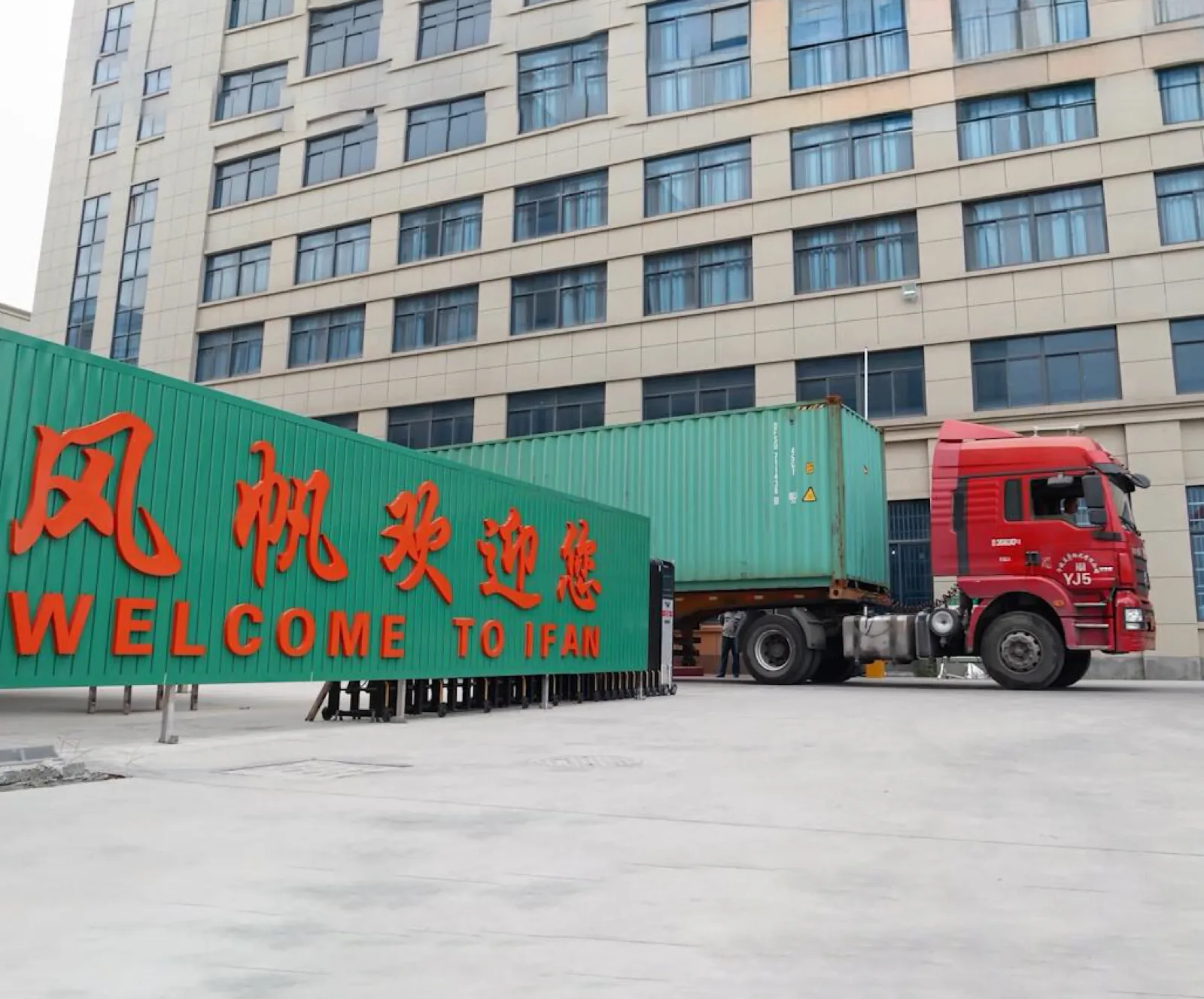
IFANNova is a French brand. Our pipes and fittings are manufactured in our own plant, Zhuji Fengfan Piping Co., Ltd, in Zhuji, Zhejiang, China (per our catalogue). We are not a UAE manufacturer and we do not have a UAE production line. If your specification requires locally manufactured material with a UAE certificate of origin, we are the wrong supplier for that line item and we would rather you know it on page one than on week six of a tender.
What we do have is a manufacturing base with 30+ years of operation, 1,000+ employees, 120,000 m² of plant area, 10,000+ moulds, exports to 118+ countries, and 24h online service (per our catalogue). Certifications held include German SKZ, CE, WRAS, DVGW, SGS, and ISO 9001 / ISO 14001 (per our catalogue). Certificate numbers, validity dates and exact scope coverage: Coming soon — we will issue the scanned certificates against your specific product list at quotation stage rather than publish a summary you cannot audit.
This is the single most important paragraph on this page, and it is the one most suppliers bury.
Our own pressure-pipe production tops out at Φ110 mm. Our HDPE PN16 pipe range is Φ20–110, our UPVC 806 PN16 range is Φ20–110, and our PPR PN20 pipe range is narrower still — only 20×2.8, 25×3.5 and 32×4.4 mm in 4 m lengths (per our catalogue). Our non-pressure PVC 902 drainage range runs Φ32–110 in pipe, with 1902 fittings to Φ160 (per our catalogue), but that is drainage, not pressure.
We cannot supply DN150–DN400 pressure mains. If your bill of quantities has a DN200 HDPE trunk main, a DN315 transmission line, or a DN400 buried water main, that scope is outside our production. We will not quote it, we will not “arrange it,” and we will not imply that being a system supplier means we can cover the full system. Anyone who tells you otherwise is quoting someone else’s factory and adding a margin.
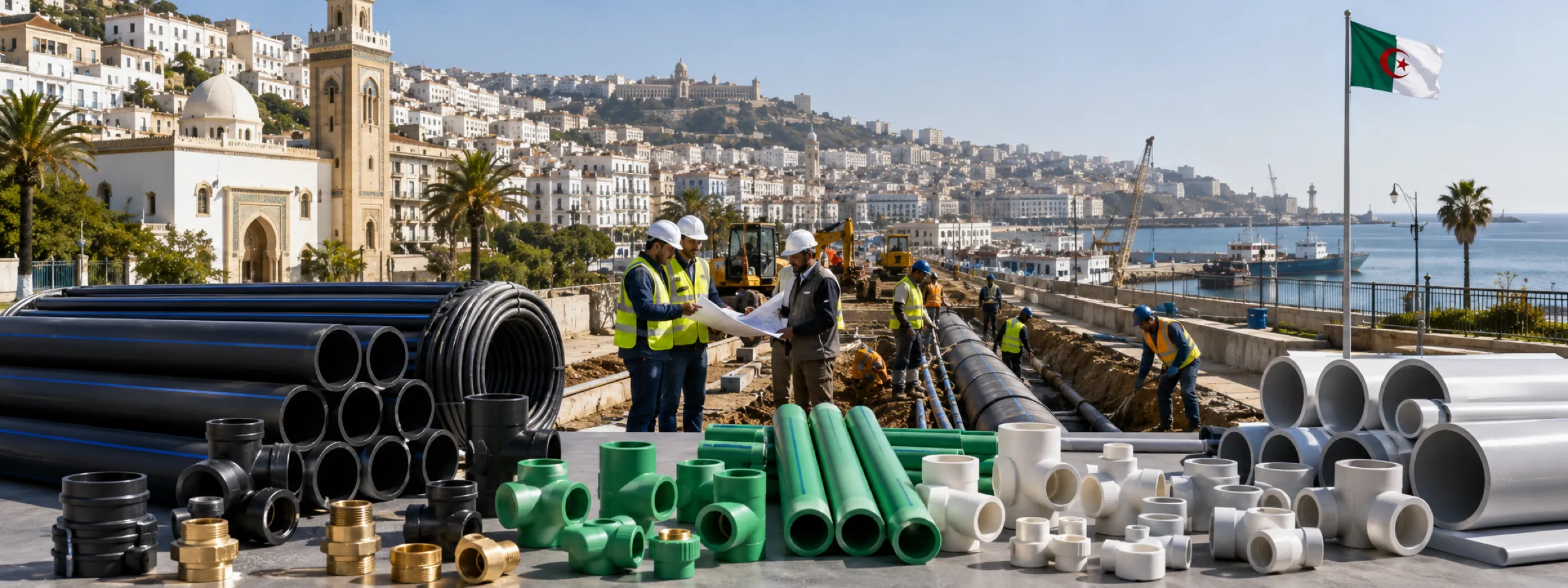
Where we are genuinely competitive is the branch, riser, in-building and terminal-connection layer: hot and cold water distribution inside buildings, small-diameter irrigation and utility runs, compression-fitted HDPE service connections, and the very large fittings and accessories count that goes with them. That is a real scope, it is a scope that generates constant reorders on a GCC project, and it is a scope where a fittings-heavy supplier matters more than a large-diameter extruder.
| System | Pipe diameter range | Pressure class | Fittings range | Can we supply? |
|---|---|---|---|---|
| PPR hot & cold water | 20, 25, 32 mm only (4 m lengths) | PN20 | Series 1138, 75 items | Yes, up to 32 mm only |
| PPR above 32 mm | — | — | — | Coming soon (not currently in range) |
| UPVC pressure (806) | Φ20–110 | PN16 | Series 1806, 203 items incl. ball valves and solvent cement | Yes |
| HDPE pressure | Φ20–110 | PN16 | Series 603/604 compression | Yes |
| HDPE / UPVC DN125–DN400 | — | — | — | No — outside our production |
| PVC drainage (902) | Pipe Φ32–110; 1902 fittings Φ32–160 | Non-pressure | Per 902 series | Yes (gravity drainage only) |
| PEX compression / press | S16/S20 (2114 insert), 16–32 mm (2121 press) | Per series | 2114 / 2121 | Yes |
| Brass fittings (2405) | 1/4″ – 1″ | Per series | 2405 | Yes |
| Pipe insulation | — | — | — | Can be supplied alongside; material/thickness Coming soon |
All ranges above are per our catalogue. Note on insulation: we can package insulation with a pipe order, but we do not currently publish a material specification, thickness table or thermal conductivity figure for it. Until we do, treat it as an unspecified accessory line, not an engineered product — Coming soon.
Most GCC buyers of small-diameter plastic pipe are choosing between three routes, and the marketing on all three is worse than the arithmetic.
Route 1 — buy from a UAE trading stockist. You get material from a Dubai or Sharjah yard, sometimes same-week, on local credit terms, in local currency, with a local entity to chase if something is wrong. You pay for that: the stockist has already paid freight, duty, certification and warehousing, plus their margin and their carrying cost on slow-moving fittings. Fittings are where this hurts most — a stockist keeps the twenty fast movers and orders the rest, so your “in stock” supplier becomes a 6-week supplier for the one elbow that holds up the riser.
Route 2 — buy from a UAE or GCC manufacturer. Genuinely local production, local certificates of origin, and a strong answer on in-country-value and local-content tender criteria. This is the right answer when your contract has local-content scoring, when your diameters are large, or when your programme cannot absorb sea freight. It is usually the wrong answer when you need a long tail of small fittings in many references at once.
Route 3 — direct import from the factory (what we are). Lowest ex-works unit cost, widest simultaneous range because you are ordering from the mould library rather than from a shelf, and one technical counterpart for both pipe and fittings. In exchange you accept ocean transit, you carry the certification and clearance workload (or pay someone to), you commit cash earlier, and you have to forecast. Direct import is a planning decision, not a purchasing decision.
| Decision factor | UAE stockist | UAE/GCC manufacturer | Direct factory import |
|---|---|---|---|
| Unit price | Highest | Middle | Lowest ex-works |
| Speed for small top-up orders | Best | Good | Poor |
| Breadth of fitting references at once | Limited to stocked lines | Limited to their moulds | Widest (10,000+ moulds, per our catalogue) |
| Who carries certification workload | Stockist | Manufacturer | Importer of record, with factory support |
| Local content / ICV scoring | Partial | Strongest | None |
| Cash commitment timing | Latest | Middle | Earliest |
| Suits large diameter mains | Yes | Yes | Not from us (Φ110 ceiling, per our catalogue) |
| Freight and transit risk | None to you | None to you | Yours to manage |
The pattern we see work best on GCC projects is hybrid: buy the large-diameter mains locally or from a regional manufacturer, and import the small-diameter distribution pipe plus the fittings tail directly. That splits the scope along the line where each route is actually cheaper, instead of forcing one supplier to be good at both.
If any part of your GCC scope crosses into Saudi Arabia, the governing document is the SASO Technical Regulation for Building Materials Part 5, covering pipes used in water, electricity and gas networks. It was approved by SASO Board Decision No. (171) on 17/10/1440 AH (20/06/2019) and published in the Official Gazette on 01/12/1440 AH (02/08/2019); Version (1) Amendment (1) was made pursuant to Decision No. (4528) dated 05/06/1442 AH and published 09/06/1442 AH (22/01/2021), document reference 02-06-19-171 (SASO, official technical regulation).
Two scope details change how you plan. First, Article (2) applies the regulation to pipes used in hot, cold and sewage water, electricity and gas connections in buildings and establishments, including pipe fittings and accessories — so your fittings are in scope, not just the pipe (SASO TR Building Materials Part 5, Article 2). Second, water pipes and fittings used in firefighting systems are explicitly excluded from this regulation (SASO TR Part 5, Article 2). If your package mixes domestic water and fire-fighting lines, they do not travel the same regulatory path. Compliance with this regulation also does not remove Saudi Building Code obligations (SASO TR Part 5, Article 2).
Article (6) is specific: the supplier placing the product on the market must obtain a certificate of conformity issued by an entity acceptable to SASO, using conformity assessment Type 3 in accordance with ISO/IEC 17067. A technical file must accompany the product containing (a) a Supplier’s Declaration of Conformity and (b) a risk assessment document. Pipes bearing the Saudi Quality Mark or equivalent are deemed to comply (SASO TR Part 5, Article 6).
That risk assessment document is the one buyers forget. It is not the test report and it is not the SDoC — it is a separate deliverable, and its absence is a documented ground for non-conformity.
There is also a plant-level obligation: Article 4/2(B) requires the supplier to provide an effective environmental management system at the plant, with ISO 14001 certification referenced as the qualifying evidence (SASO TR Part 5, Article 4/2). Our plant holds ISO 14001 (per our catalogue); the certificate number and scope wording are Coming soon.
Saudi Arabia’s SABER electronic platform is used by importers to obtain a Product Certificate of Conformity (PCoC) for regulated products and a Shipper’s/Supplier’s Declaration of Conformity (SDoC) for unregulated products, with the importer entering product details and attaching technical files; after December 2018, Saudi customs would only grant clearance to products logged through SABER (U.S. Department of Commerce, International Trade Administration).
Annex (1-b) of the SASO regulation, “List of Products and Customs Coding”, assigns customs item 3917 to five plastic pipe categories: (1) solid tubes of ethylene polymers, (2) solid tubing of propylene polymers, (3) solid PVC pipes, (4) solid pipes from other plastic material, and (5) flexible pipes that can withstand at least a pressure of 72.5 MPa. Other headings in the same annex include 7304, 7306, 7307 for steel and iron, 7411/7412 for copper, 7507 for nickel, 7608/7609/7616 for aluminium, plus 8307 and 8547 (SASO TR Part 5, Annex 1-b).
Now the precedence rule. Annex (1-b) carries an explicit note that the products and customs codes indicated in the Saber platform are the authoritative reference (SASO TR Part 5, Annex 1-b note). In practice this means a classification argument is settled against SABER, not against the PDF you printed. Do not build a clearance strategy on the annex table alone; check the code in SABER before the goods sail.
WCO Harmonized System 2022 heading 39.17 reads: “Tubes, pipes and hoses, and fittings therefor (for example, joints, elbows, flanges), of plastics” (WCO HS Nomenclature 2022, Chapter 39).
| HS subheading | Description (WCO HS 2022) | Relevant IFANNova products |
|---|---|---|
| 3917.10 | Artificial guts (sausage casings) of hardened protein or cellulosic materials | None |
| 3917.21 | Rigid tubes/pipes/hoses of polymers of ethylene | HDPE PN16 pipe Φ20–110 (per our catalogue) |
| 3917.22 | Rigid, of polymers of propylene | PPR PN20 pipe 20/25/32 mm (per our catalogue) |
| 3917.23 | Rigid, of polymers of vinyl chloride | UPVC 806 PN16 Φ20–110; PVC 902 drainage pipe Φ32–110 with 1902 fittings Φ32–160 (per our catalogue) |
| 3917.29 | Rigid, of other plastics | PEX pipe (classification to be confirmed per shipment) |
| 3917.31 | Flexible, minimum burst pressure 27.6 MPa | Not applicable to our rigid ranges |
| 3917.32 / .33 / .39 | Other flexible tubes, without / with fittings / other | Not applicable to our rigid ranges |
| 3917.40 | Fittings | PPR 1138 (75 items), UPVC 1806 (203 items), HDPE 603/604 compression (per our catalogue) |
One classification trap worth knowing: WCO HS Chapter 39 Legal Note 8 defines “tubes, pipes and hoses” as hollow products generally used for conveying, conducting or distributing gases or liquids. Except for lay-flat tubing, products whose internal cross-section is not round, oval, rectangular (length not exceeding 1.5 times the width) or a regular polygon are not regarded as pipes and are classified as profile shapes elsewhere (WCO HS Nomenclature 2022, Chapter 39, Note 8). If you are importing ducting or a profiled conduit alongside your pipe, it may not ride under 3917 at all.
Note also that the annex threshold of “at least 72.5 MPa” in the Saudi regulation and the WCO’s 3917.31 threshold of “minimum burst pressure 27.6 MPa” are different numbers in different documents. We are reporting both as they appear in their sources and are not reconciling them for you — your broker should confirm which applies to your declared item.
Annex (1-a) of the SASO regulation lists the plastic-pipe standards adopted as Saudi standards. These are Saudi-prefixed adoptions of ISO and ASTM documents, which matters because it means an internationally tested product is being assessed against a recognisable standard rather than a wholly local one.
| Standard | Subject | Source |
|---|---|---|
| SASO-ISO-15874-2 | PP pipes for hot and cold water | SASO TR Part 5, Annex 1-a |
| SASO-ISO-15877-2 | Chlorinated PVC, hot and cold water, pipes | SASO TR Part 5, Annex 1-a |
| SASO-ISO-22391-2 | PE-RT pipes, hot and cold water | SASO TR Part 5, Annex 1-a |
| SASO-ISO-21138-2 / -21138-3 | PVC-U / PP / PE non-pressure underground drainage (smooth and structured external surface) | SASO TR Part 5, Annex 1-a |
| SASO-ASTM-D3035 | PE pipe based on controlled outside diameter | SASO TR Part 5, Annex 1-a |
| SASO-ASTM-F442M | CPVC SDR-PR | SASO TR Part 5, Annex 1-a |
| SASO-ISO-11296-3 / -4 / -7 | Renovation and lining of underground non-pressure drainage and sewerage | SASO TR Part 5, Annex 1-a |
| GSO ISO 1452-1:2013 | PVC-U piping systems, Part 1 General — pipes, fittings, valves, ancillary equipment; current edition, approved 1 April 2013 | GCC Standardization Organization (GSO) Standards Store |
| GSO ISO 1452-2:2013 | PVC-U pipes for water supply and pressure drainage/sewerage; scope includes water up to and including 25 °C intended for human consumption; approved 1 April 2013 | GSO Standards Store |
| GSO ISO 4427-2:2013 | PE pipes for water supply, Part 2 Pipes; covers water for human consumption and general purposes; approved 9 September 2013 | GSO Standards Store |
The GSO standards above are Gulf-wide, not Saudi-only, which is why they are the more useful reference point when your project spans the UAE, Saudi Arabia, Oman and Qatar under one procurement.
On our side: our HDPE pipe is marked “GERMANY STANDARD DIN8077/8078” (per our catalogue). That is a German dimensional and mechanical standard, not a GSO or SASO reference. A DIN-marked pipe is not automatically a GSO-compliant pipe — the conformity route still has to be run. If your specification calls out GSO ISO 4427-2 explicitly, tell us at enquiry stage so we can confirm what can and cannot be evidenced before you write us into a submittal.
This is where we have to disappoint the internet.
Our PPR PN20 material is non-toxic and suitable for drinking water, and our recycled-material content is capped at ≤10% (per our catalogue). Our plant holds WRAS and DVGW among its certifications (per our catalogue).
What we could not verify from any primary source is whether NSF/ANSI 61, WRAS, ACS or KTW/DVGW potable-water approvals are formally accepted or recognised as a compliance route in Saudi Arabia or the UAE. No GSO, SASO, MOIAT or GCC primary document addressing recognition of foreign drinking-water-contact approvals was found. We are not going to assert it either way.
What we can report is a specific negative finding from the Saudi regulation itself: SASO TR Building Materials Part 5 contains no dedicated potable-water toxicological or migration approval requirement and no reference to NSF/ANSI 61, WRAS, KTW/DVGW or ACS. Its health clause, Article 4/1/4 “Hygiene, health and environment”, addresses toxic gas emissions, hazardous substance and VOC emissions to air, hazardous radiation and moisture — that is, airborne and building-level hazards, not leaching into drinking water. The only “potable water” mentions in the entire regulation relate to copper-alloy and stainless steel valves (SASO EN 1213, SASO EN 13828). Drinking-water suitability for plastic pipes is instead carried implicitly by the adopted product standards, whose scopes cover water for human consumption — GSO/SASO ISO 1452 and ISO 4427 (SASO TR Part 5, Article 4/1/4 and full-text search of the regulation).
Practical reading for a specifier: do not assume a WRAS or DVGW certificate discharges a GCC potable-water obligation, and do not assume it is worthless either. Ask the client’s engineer which evidence they will accept in the submittal, in writing, before the order. We will supply what we hold; we will not tell you it is sufficient when no regulator has said so.
ECAS, the Emirates Conformity Assessment Scheme, is a mandatory UAE regulatory programme introduced in 2004 that monitors compliance with UAE standards for both imported and domestically produced goods. It originally covered textiles and building materials, and was expanded in June 2018 to agricultural products. ESMA, established in 2001, was the UAE’s sole national standardization body, and the Emirates National Accreditation System (ENAS) accredits conformity assessment bodies (U.S. Department of Commerce / export.gov, UAE Trade Standards).
An important caveat: we could verify that ECAS covers “building materials” as a category, but we could not verify a product-level confirmation that plastic pipes are explicitly named on MOIAT’s current regulated products list. MOIAT’s regulated-products sheet is a downloadable PDF whose contents we could not retrieve. Nor could we verify the specific UAE technical regulation number or Cabinet Decision covering plastic pipes. Treat “pipes need ECAS” as probable but unconfirmed, and get it confirmed by MOIAT or your notified body for your exact HS code before you budget for it. Likewise, the commonly quoted ECAS one-year validity is stated by multiple certification bodies but we found no MOIAT primary page publishing it — unconfirmed.
MOIAT does publish its fees, and these we can quote directly.
| MOIAT service | Published fees (AED) | Stated processing time | Key documents required |
|---|---|---|---|
| Conformity certificate — products subject to technical regulations | 620 technical document review + 500 issuance = 1,120 base; plus 2,500 per working day per assessor if a technical assessment is required | 1.5 working days | Valid trade licence; test report from an accredited laboratory |
| Conformity certificate — unregulated products | 620 review + 500 issuance + 600 registration in the UAE system | 6 working days | Valid trade licence; accredited-laboratory test report |
| Licence to use National Conformity Marks (Emirates Quality Mark) | 2,000 licence issuance + 670 three-year certificate; plus 2,500 per day per assessor for technical assessment | Not published on the service page | Product conformity to specified standards plus factory QMS audit |
All figures above are from MOIAT’s own official service pages. Two things are worth flagging. First, the Emirates Quality Mark licence certificate is issued for three years, not one — this contradicts the one-year claim repeated across consultancy pages, and the three-year figure is the one published by MOIAT itself. Second, MOIAT describes EQM as granted to products conforming to specified standard specifications and manufactured in factories operating an effective quality management system with comprehensive quality assurance procedures such as factory audits; MOIAT offers a 50% discount on licensing fees for manufacturers holding an industrial production licence and a full exemption for SMEs during their first product licensing cycle (MOIAT, official Emirates Quality Mark page).
The practical consequence of the assessor day-rate: a route that looks like AED 1,120 on paper becomes materially more expensive the moment a technical assessment is triggered. Budget for the assessment, not just the certificate.
Certification failures are the visible cause of clearance problems. They are not the only one, and they are not always the most common one — no customs authority publishes rejection-frequency statistics, so anyone showing you a “top 5 reasons” pie chart is guessing. What we can give you is the legally enumerated grounds.
SASO TR Building Materials Part 5, Article 9/2, lists four causes of non-conformity that Saudi market surveillance and regulatory (customs) authorities may invoke:
The enforcement powers behind those grounds are worth reading before you agree Incoterms. Under Article (7), regulatory authorities at Saudi ports verify that conformity assessment documents are included in the consignment, may randomly take samples of pipe products and send them to competent laboratories, may charge the supplier or importer for the cost of tests and associated fees, and in case of non-conformity may withdraw products from warehouses and take legal measures. Article 9/3 allows ordering withdrawal, re-export or destruction at the violating party’s expense (SASO TR Part 5, Articles 7 and 9).
Read that as a commercial clause, not a legal one: sample testing at your cost, and re-export or destruction at your cost, are real line items in the tail risk of a direct import. That risk is precisely what a local stockist’s margin is buying you.
Then there is the non-certification failure mode. Effective 8 May 2025, all containerized imports arriving at Saudi ports must be palletized, with limited exemptions for bulk goods and oversized items (U.S. Department of Commerce ITA, Saudi Arabia Country Commercial Guide). This is a physical loading condition entirely independent of product certification, and it is exactly the kind of requirement that clears a perfect technical file and still holds the box. If you are importing into Saudi Arabia, confirm palletization on the packing instruction, not in the email thread.
The Zakat, Tax and Customs Authority requires a commercial invoice, a bill of lading, and a certificate of origin. All imports must be processed through the Fasah platform, and authentication of shipping documents is performed by chambers of commerce (U.S. Department of Commerce ITA, Saudi Arabia Country Commercial Guide — Import Requirements and Documentation).
On the question of how far ahead the declaration must be filed: a specific advance-filing deadline is very widely quoted in the trade, and we previously repeated it on this page. We have since gone back to the source and could not verify it in any ZATCA announcement or published rule — it appears in freight-forwarder and consultancy material that cites itself. We are withdrawing the figure rather than restating a number we cannot ground. Ask your carrier or customs broker to confirm the actual submission cut-off for your specific vessel and port of entry; in practice the binding deadline is set by the carrier’s manifest and the terminal, not by a single national number you can plan against in advance.
| Document / step | Who produces it | When it must exist | Source |
|---|---|---|---|
| Commercial invoice | Supplier (us) | Before Fasah submission | ITA Saudi Arabia CCG |
| Bill of lading | Carrier / forwarder | On shipment | ITA Saudi Arabia CCG |
| Certificate of origin | Supplier, authenticated by chamber of commerce | Before Fasah submission | ITA Saudi Arabia CCG |
| Fasah declaration | Importer / broker | At least 48 h before arrival | ITA Saudi Arabia CCG |
| SABER product registration (PCoC or SDoC) | Importer, using supplier technical file | Before clearance | ITA, Saudi Arabia Testing, Inspection and Certification |
| Certificate of conformity, ISO/IEC 17067 Type 3 | Entity acceptable to SASO | Accompanying the product | SASO TR Part 5, Article 6 |
| Supplier’s Declaration of Conformity | Supplier (us) | In the technical file | SASO TR Part 5, Article 6 |
| Risk assessment document | Supplier (us) | In the technical file | SASO TR Part 5, Article 6 |
| Palletization of containerized cargo | Supplier / packer | At loading, from 8 May 2025 | ITA Saudi Arabia CCG |
We deliberately do not publish SABER PCoC or SCoC fee figures, or a PCoC validity period. Those numbers circulate widely on consultancy and certification-body pages, but SASO’s official certificates page does not publish validity periods or fee schedules, and the SABER importer pages we checked returned HTTP 404. Unverifiable from a primary source, so we leave them out rather than repeat them. Similarly, the claim that from 1 January 2025 all shipments to Saudi Arabia require both a PCoC and an SCoC appears only on freight-forwarder and consultancy blogs, with the referenced primary alert returning 404 — we cannot confirm it and will not state it.
SASO TR Building Materials Part 5, Article (5), requires that labelling on product packaging complies with the technical requirements of the regulation and the standards in Annex (1); that it includes warnings and instructions for use in clear writing that is difficult to remove; that all information is correct and proved; and that images and expressions do not contravene public order, morals and Islamic values (SASO TR Part 5, Article 5).
Note what is not in Article (5): an Arabic-language mandate. The frequently repeated claim that industrial product labels must include Arabic could not be grounded in any primary source applicable to pipes. GSO 9 exists and is real, but it is the standard for labelling of pre-packaged foods and does not apply to pipes. If your client or consultant requires bilingual marking, that is a contractual requirement we can accommodate at print stage — but we are not going to tell you it is a legal one when we cannot show you the law.
What we can mark on the pipe today is what is already in production: our HDPE pipe carries “GERMANY STANDARD DIN8077/8078” (per our catalogue). Custom print legends, batch coding formats and additional standard references on the pipe wall: Coming soon — technically feasible, but we will not publish a specification until it is a documented option rather than a case-by-case agreement.
Saudi Arabia, as a GCC member, applies the GCC common external tariff of at least five percent on most goods imported from outside the GCC, and adopted a 2022 HS-based 12-digit tariff system in January 2025, with rates varying by product and requiring confirmation via ZATCA’s tariff portal (U.S. Department of Commerce ITA, Saudi Arabia Country Commercial Guide — Import Tariffs).
We are not going to convert that into a landed cost for you, and here is why. The exact Saudi (ZATCA) or UAE applied duty rate for HS 3917 plastic pipes could not be confirmed from a primary source — ZATCA’s tariff search is an interactive lookup we could not query, and Saudi Arabia amended its tariff schedule in 2025. The 5% GCC baseline is verified as a baseline; it must not be treated as the applied 3917 rate. Any supplier who quotes you “5% duty on pipes” is quoting a floor, not your number.
| Landed cost component | Status | Notes |
|---|---|---|
| Ex-works unit price | Coming soon | Quoted per enquiry against your actual reference list; we do not publish price lists |
| Minimum order quantity | Coming soon | Confirmed at quotation |
| Production lead time | Coming soon | Confirmed at quotation |
| Ocean freight and local charges | Coming soon | Route- and rate-dependent; we will not publish a stale number |
| Customs duty, HS 3917 | Not confirmed | GCC baseline “at least 5%” verified (ITA); applied 3917 rate must be confirmed via ZATCA / UAE customs |
| UAE MOIAT conformity certificate | Published | AED 1,120 base for regulated products; +AED 2,500/day/assessor if assessment required (MOIAT) |
| UAE EQM licence (if required) | Published | AED 2,000 + AED 670 for three years; +AED 2,500/day/assessor (MOIAT) |
| SABER PCoC / SCoC fees | Not published by SASO | Circulating figures are consultancy-sourced only; excluded deliberately |
| Port sampling and testing | Contingent | Authorities may charge supplier/importer for tests and fees (SASO TR Part 5, Article 7) |
We know the four Coming soon entries at the top of that table are exactly what you came here for. We would rather lose the click than publish an MOQ we cannot honour or a lead time that was true two quarters ago. Send the enquiry and you will get real numbers with your name on them.
The difference between a two-day quote and a two-week quote is almost always the completeness of the enquiry. Here is the input list, in the order it affects our answer.
| Input | Why it changes the quote | If you omit it |
|---|---|---|
| Destination country and port | Determines certification route (SASO/SABER vs UAE MOIAT/ECAS) and packing rules | We cannot tell you which documents you need |
| Full BOQ with diameters and quantities | Tells us immediately what falls outside Φ110 and cannot be quoted | Risk of quoting a partial scope you assume is complete |
| Material system required (PPR / UPVC / HDPE / PVC drainage / PEX / brass) | Different series, different fitting counts, different standards | Wrong series quoted |
| Pressure class and operating temperature | Our pressure ranges are PN20 (PPR) and PN16 (UPVC, HDPE) per our catalogue | Mis-specification risk |
| Application: potable water / irrigation / drainage / industrial | Drives which standard your consultant will demand in the submittal | Certification mismatch discovered late |
| Named standard in the specification (e.g. GSO ISO 4427-2, DIN 8077/8078) | Lets us confirm up front what we can and cannot evidence | Submittal rejection after order |
| Buried, exposed or UV-exposed installation | Our HDPE is UV-resistant and suitable for outdoor use (per our catalogue) | Wrong material recommended |
| Jointing method available on site | PPR uses hot-melt and electrofusion; HDPE 603/604 is compression, weld-free quick connect; UPVC uses solvent cement (per our catalogue) | Fittings supplied that your crew cannot install |
| Whether insulation is in scope | We can supply alongside, but material and thickness are Coming soon | Scope gap at delivery |
| Incoterm and whether you are importer of record | Determines who carries sampling, testing and re-export risk under SASO Article 7 | Unallocated tail risk |
| Programme dates and phasing | Drives whether direct import is viable at all versus local stock | Route recommendation may be wrong for you |
| Submittal deadline | Certification and document assembly, not production, is usually the critical path | Documents arrive after they were needed |
Everything in this section is from our own catalogue. Where a figure is disputed internally, we have removed it rather than qualify it.
The 95–120 °C heat resistance figure is quoted as it appears in our catalogue, where it describes the CPVC grade of the 806 system rather than UPVC pipe on its own, and it should be read as a material property claim, not as a continuous service rating for a pressurised potable line at PN16. Do not select UPVC 806 for a hot-water line on the strength of it. Ask us to confirm the derating basis for your operating condition before you design to it.
On a GCC building services package, the pipe is the easy part. Any competent extruder can make Φ63 HDPE. The programme risk sits in the fittings: the reducer that turns out to be a special, the ball valve that ships from a different factory on a different lead time, the solvent cement that is a dangerous-goods line item nobody planned for.
Our fittings position is 203 items in the UPVC 1806 series including ball valves and solvent cement, 75 items in the PPR 1138 series, and the HDPE 603/604 compression series, backed by 10,000+ moulds in the plant (per our catalogue). Single origin for pipe and fittings means one technical file, one set of certificates, one packing list and one counterpart when something is short.
That is the argument for buying the small-diameter layer from us. It is not an argument for buying the whole system from us, because we cannot supply the whole system.
The Saudi pipes regulation was notified under the WTO Technical Barriers to Trade framework rationale, and its preamble states that technical requirements and conformity assessment methods shall not discriminate between products on the basis of origin (SASO TR Part 5, Preamble).
Practically: a European or Chinese-manufactured product is assessed on the same technical terms as a locally produced one. Origin does not disqualify you, and it does not exempt you either. What varies in practice is not the legal standard but the operational friction — document turnaround across time zones, sample dispatch, and how quickly a factory answers a consultant’s technical query. Our answer to that is a 24h online service commitment (per our catalogue), which is a response-time commitment, not a lead-time commitment.
Are you an HDPE pipe manufacturer in the UAE? No. We are a French brand manufacturing at our own plant in Zhuji, Zhejiang, China (per our catalogue). We supply the UAE and GCC by export. If your requirement is UAE-manufactured material, we are not it.
Can you supply DN200 or DN315 HDPE? No. Our pressure pipe range ends at Φ110 (per our catalogue).
Can you supply PPR above 32 mm? Not currently. Our PPR pipe range is 20, 25 and 32 mm only (per our catalogue). Larger sizes: Coming soon.
Do you hold a SABER PCoC already? Certificate status per product family: Coming soon. SABER registration is performed by the importer, using the technical file we supply.
What is your MOQ and lead time? Coming soon — confirmed at quotation against your actual list. We will not publish a number we cannot hold.
Do you have UAE stock? No. We ship from the factory.
Can you supply insulation? Alongside a pipe order, yes. Material and thickness specification: Coming soon.
Can you provide project references in the Gulf? We are not publishing project names, tonnages or locations. We will not put a client’s name on a marketing page without their written permission, and we will not publish figures we cannot evidence. If you need referenceable experience for a prequalification, ask us during the enquiry and we will tell you honestly what we can and cannot support.
Send the BOQ, the destination port, the named standard in your specification, and your submittal deadline. You will get back: what we can supply, what falls outside Φ110 and must come from elsewhere, which documents we can issue for your certification route, and a price and lead time against your actual quantities.
What you will not get is a price list, a stock claim we cannot honour, a certificate number we have not verified, or a project case study we cannot evidence. Everything on this page marked Coming soon is a genuine gap in what we can publish today — not a negotiating tactic. When it is confirmed, it will appear here with a source.
Everything above is what we could verify. What we cannot publish — your price, your lead time, your duty rate, your accepted certification route — depends on your quantities, your port and your project’s named standard. Send the inputs listed above and you get real numbers with your name on them, or a straight “this is outside our range” within one working day.