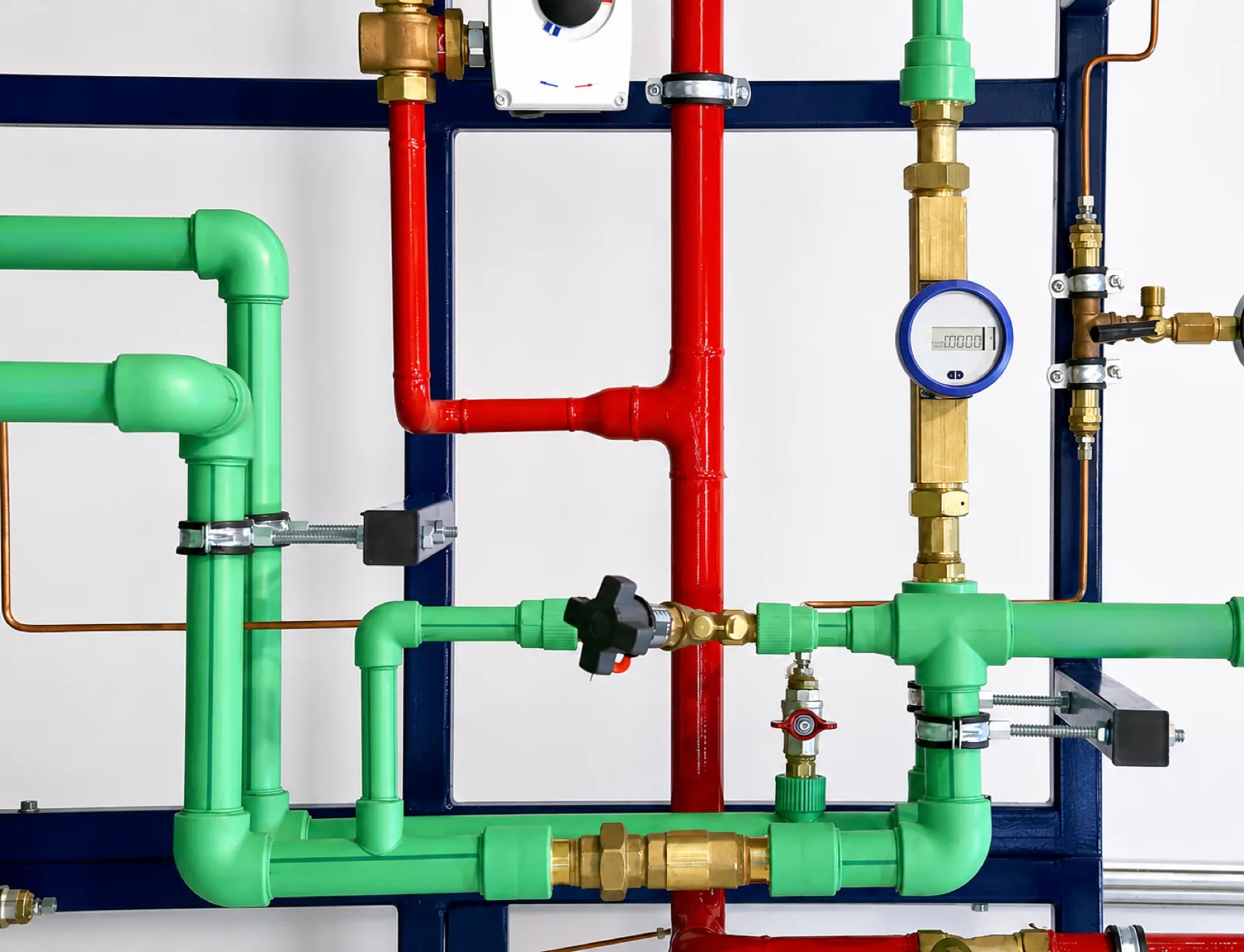
“PVC vs PPR for water supply” is written about as if it were a materials question with a materials answer. On our range it is not. It is a question that has a real answer over a 12 mm-wide band of pipe diameters, and no answer at all outside it.
Here is the reason, stated before any argument. Our PPR PN20 pipe is series 1103, manufactured in three sizes only: 20 × 2.8, 25 × 3.5 and 32 × 4.4 mm, in 4 m lengths (per our catalogue). Our UPVC 806 PN16 pressure pipe runs Φ20 × 2.0 to Φ110 × 7.2 mm across nine sizes, also 4 m (per our catalogue; the full per-size wall table is in section 6). The two ranges overlap at 20, 25 and 32 mm — three diameters — and from 40 mm to 110 mm the UPVC line is alone.
That overlap band is where this page earns its keep. Inside it you have a genuine choice, and it turns almost entirely on jointing method and site labour rather than on the pipe. Above it, PPR is not an option we can supply and the honest answer is “UPVC or nothing from us.” Above Φ110 — DN 150 to DN 400 mains — neither material is available from us in any form. That is not a soft limit we will stretch for a large order.
This page is about water supply: cold and ambient-temperature potable and service water distribution. If your line runs hot, temperature dominates everything here and you should read our CPVC vs PPR for hot water comparison instead.
How to read this article. Catalogue data is marked (per our catalogue). Judgements about site practice and procurement are labelled as opinion. Where a commonly quoted industry number could not be verified against a primary standard or first-party document, I say no citable source found and give no number. Several places below are deliberately left empty.
Temperature is the first filter people apply, and it is usually applied with the wrong numbers.
The most common error on this exact comparison is one our own catalogue makes easy to fall into, so let me disarm it first. 806 is a shared series number covering both UPVC and CPVC. Our catalogue’s 95–120 °C heat-resistance figure belongs to the CPVC side of that series — the original sentence reads that CPVC’s heat resistance “can reach 95 °C to 120 °C, far exceeding the 70 °C to 95 °C range of PPR pipes” (per our catalogue). It is not a rating for the UPVC pressure pipe, and it must not be carried across on the strength of the shared series number.
This matters commercially, not just pedantically. If you read “806 handles 120 °C” and specify the UPVC pressure pipe for a warm line, you have bought the wrong half of the series. The continuous working temperature for our UPVC 806 pressure pipe is Coming soon — we do not publish one, and I will not reverse-engineer it from the CPVC figure or from a generic derating table. For orientation only: the standard that governs UPVC pressure pipe, EN ISO 1452-2, limits its own scope to water up to and including 45 °C, which is a scope limit rather than our product’s rating, and it is the number to design against until we publish something specific.
What matters for a water-supply decision, without any derating table at all:
My position on temperature: for genuine cold and ambient water supply within 20–110 mm, treat temperature as a screening question that both materials pass, and decide on the four things that follow. Do not let a temperature comparison table make the decision for you on a duty where temperature is not the binding constraint. That is opinion, formed from how these enquiries actually arrive.
If you take one thing from this comparison, take this. On a cold-water supply line in the 20–32 mm overlap band, the pipe material is close to a coin-flip and the jointing method is the whole decision.
Our catalogue is explicit on both. PPR 1103 is jointed by heat fusion (per our catalogue). UPVC 806 is a solvent-cement system — our 1806 series comprises 203 items and includes the ball valves and the glue (per our catalogue). Those are not two ways of doing the same thing. They impose different site conditions, different failure modes and different crew requirements.
One disclosure about electrofusion, because our own pages do not agree with each other. The catalogue describes the PPR joint as “hot melt and electric melt,” which reads as heat fusion plus electrofusion. But our fittings breakdown lists electrofusion (PP) as not currently in our range, and our PPR fitting pages describe heat fusion only. I am not going to resolve that in our favour on a page whose whole argument is that jointing method decides the job. Treat heat fusion as the PPR jointing method you can rely on us for, and treat electrofusion capability as unconfirmed — Coming soon pending confirmation from the product side. If your design depends on electrofusion couplers specifically, ask before you specify, and do not take a catalogue phrase as a supply commitment. The rest of this section is written on heat fusion, which is the method that is not in doubt.
| Site variable | PPR 1103 — heat fusion | UPVC 806 — solvent cement |
|---|---|---|
| Jointing method (per our catalogue) | Heat fusion (electrofusion unconfirmed — see note above) | Solvent cement; glue supplied within the 1806 series |
| Power required on site | Yes — fusion equipment needs power | No power needed for the joint itself |
| Consumable dependency | Equipment and its maintenance; no chemical consumable | Cement — a consumable with storage and shelf-life exposure |
| What a bad joint looks like | Operator/timing dependent; a poor fusion can look acceptable externally | Cure-time dependent; under-cured joints fail on first pressurisation |
| Rework of an existing joint | Cut out and re-fuse | Cut out and re-cement |
| Suits crews that are | Trained and equipped for fusion; repeat work | Broadly available; low tool barrier |
| Our fitting range at these sizes | 1138 series — 75 items (per our catalogue) | 1806 series — 203 items, incl. ball valves and glue (per our catalogue) |
| Published cure/fusion time data | Coming soon | Coming soon |
Note the last row honestly. Cure times for solvent cement and fusion dwell times are exactly the kind of number that gets quoted freely across the industry and that I could not verify against a primary source for these specific products — no citable source found. Both are Coming soon. Anyone publishing a confident cure-time table without saying which cement, which diameter, which ambient temperature and which humidity is giving you decoration, not data.
The procurement consequence people miss. The two methods fail in opposite directions, and this is the practical heart of the comparison. Fusion concentrates risk in equipment and training — get the crew and the machine right and the joints are consistent, get them wrong and you have a systematic problem across the whole run. Solvent cement distributes risk into conditions and discipline — cure time, cleanliness, ambient conditions, and whether anyone pressurised the line early. That is a field-experience judgement, not a sourced statistic; I have no failure-rate data to offer and found none worth citing.
Which is why the honest question is not “which material is better” but “which failure mode can your site actually control?” A site with a trained fusion crew and reliable power should not be talked out of PPR. A site with intermittent power, rotating labour and a long thin run of small-diameter distribution has a real argument for solvent-weld UPVC that has nothing to do with the polymer.
You will find “X% faster” claims for both systems. I will not give you one: no citable source found — no standards body, trade association or independent study giving comparative installation rates for fusion versus solvent-weld small-diameter supply pipe. Manufacturer marketing pages carry such numbers freely; none that I checked cited a method or a sample.
What can be said without inventing a ratio comes from the structure of the two processes, and from our own catalogue:
My position on speed: stop treating it as a material property. Installation speed on these systems is a function of crew familiarity, power availability, sequencing discipline and whether the right fitting is on the pallet. Any of those four dominates the polymer choice. If someone hands you a speed comparison with a percentage in it and no stated method, that number was written by marketing.
I have no prices to publish. Pricing, MOQ and lead time are Coming soon, quoted per enquiry against quantities and destination. What follows is the structure of the cost difference, so you can price it correctly against your own quotations.
| Cost element | PPR 1103 / 1138 | UPVC 806 / 1806 | What determines it on your job |
|---|---|---|---|
| Pipe price per metre | Coming soon | Coming soon | Quoted per enquiry with quantity and destination |
| Wall thickness at 20 mm (per our catalogue) | 2.8 mm (PN20) | 2.0 mm (PN16) | More polymer per metre in the PPR wall at the same OD |
| Wall thickness at 25 mm (per our catalogue) | 3.5 mm (PN20) | 2.0 mm (PN16) | The UPVC wall holds at 2.0 mm from 20 to 25 mm; the PPR wall steps up |
| Wall thickness at 32 mm (per our catalogue) | 4.4 mm (PN20) | 2.4 mm (PN16) | Again more polymer in the PPR wall, at a higher pressure class |
| Jointing capital cost | Fusion equipment — a real up-front item | Effectively none beyond hand tools | Amortised over how much pipe your crew will fuse |
| Jointing consumable cost | None chemical | Cement, within the 1806 series (per our catalogue) | Run length, joint count, wastage |
| Labour skill premium | Trained fusion operator | Lower skill barrier | Local labour market — varies more than the pipe does |
| Range depth (fittings) | 75 items (per our catalogue) | 203 items incl. valves and glue (per our catalogue) | Complexity of the layout; risk of a stalled crew |
| Sizes above 32 mm | Not manufactured on this line | Up to Φ110 × 7.2 mm (per our catalogue) | Hard constraint — see section 5 |
| Recycled content | Recycled material ≤10%, quality unaffected (per our catalogue) | Coming soon | Relevant if your specification restricts regrind |
Three observations about that table, held as opinion informed by our product data rather than as sourced fact.
First: the wall thickness rows are the only place where the material cost difference is visible in published data. Across the whole overlap band our PPR carries the heavier wall — 2.8, 3.5 and 4.4 mm at 20, 25 and 32 mm, against 2.0, 2.0 and 2.4 mm for the UPVC (per our catalogue). Those are different pressure classes — PN20 against PN16 — so this is not a like-for-like efficiency comparison and I do not present it as one. It is simply that at every diameter where you have a choice, the PPR pipe contains more material per metre, and the gap widens as the diameter grows.
Second: the capital-versus-consumable split is the structural difference. PPR front-loads cost into equipment you buy once; UPVC spreads it into cement you buy continuously. For a distributor stocking many small jobs that matters more than the per-metre price; on a single large contract it usually washes out. Opinion.
Third: total installed cost is not a number anyone can give you without your job. I found no citable source for an independent installed-cost comparison of these two systems. Do the arithmetic on your own quotation, labour rate and joint count.
This is the section most comparison articles do not write, because it is where the supplier has to say what it cannot sell you.
Our PPR stops at 32 mm. Three sizes: 20, 25, 32 (per our catalogue). There is no 40 mm, no 63 mm, no 90 mm PPR on this line. So for any water supply distribution that needs to move up in diameter — risers, submains, anything past a branch — a PPR-only specification cannot be filled by us above 32 mm. Coming soon is the honest status, not a hint that it is nearly ready.
Our UPVC pressure range stops at Φ110 × 7.2 mm (per our catalogue). That is the top of our pressure-pipe capability in this material. It means:
One more limit belongs here, because it is the most common misread of a PVC range. Our PVC 902 drainage system is non-pressure (per our catalogue) — soil, waste and drainage duty only. And its range needs stating precisely, because it is routinely quoted wrong, including by people reading our own catalogue: the 902 pipe runs Φ32 to Φ110 mm; only the 1902 fittings reach Φ160 mm. There is no Φ160 pipe in that system, pressure or otherwise. So the number 160 appearing in a PVC catalogue is a fitting size, and it is neither a route around the Φ110 pressure ceiling nor evidence of a larger drainage pipe. That distinction — 902 is non-pressure drainage, 806 is the PN16 pressure system, and 902’s pipe and fitting ranges are not the same range — is the single most consequential thing to get right when reading any PVC range, ours included.
For a water supply comparison, potable suitability is not a footnote. Here is our position stated exactly.
Our catalogue describes the PPR as non-toxic and suitable for drinking water (per our catalogue). That is a catalogue statement about the material.
Our certifications are listed as SKZ, CE, WRAS, DVGW, SGS, ISO 9001 and ISO 14001. The certificate numbers are Coming soon. I want to be precise about what that means for you, because this is where buyers get hurt: a scheme name without a certificate number, an issue date and a stated scope is not yet evidence for a tender. Until the numbers are published, treat the list as a claim to be verified on request, not as a compliance document. Ask us for the certificate against the specific series and size you are buying, and if it does not cover that scope, the honest answer is that it does not.
I could not verify, and will not assert, whether any of those schemes is formally accepted as a compliance route in a given import market for potable plastic pipe — no citable source found. That is a market-by-market regulatory question, not a product question, and it is covered from the import side in our GCC potable water approval page.
Recycled content, since it comes up in potable specifications: our catalogue states the PPR uses recycled material at ≤10% with quality unaffected (per our catalogue). If your specification prohibits regrind entirely in potable lines, say so at enquiry stage — that is a specification conflict to resolve before an order, not after.
The full UPVC wall table, and the one thing we still will not infer from it. Because a supply comparison is worth nothing without the dimensions, here is every size we make in the UPVC 806 pressure line — all nine rows, not the endpoints (per our catalogue):
| Outside diameter Φ (mm) | Wall thickness (mm) | Pressure class | Length |
|---|---|---|---|
| 20 | 2.0 | PN16 | 4 m |
| 25 | 2.0 | PN16 | 4 m |
| 32 | 2.4 | PN16 | 4 m |
| 40 | 3.0 | PN16 | 4 m |
| 50 | 3.7 | PN16 | 4 m |
| 63 | 4.7 | PN16 | 4 m |
| 75 | 5.6 | PN16 | 4 m |
| 90 | 6.7 | PN16 | 4 m |
| 110 | 7.2 | PN16 | 4 m |
All nine rows per our catalogue. Note that Φ20 and Φ25 share the same 2.0 mm wall — the wall does not step at every diameter. Anyone generating this table from a constant-SDR formula would have produced a different number at Φ25, which is the clearest possible demonstration that a formula is not a substitute for the manufacturer’s declaration.
What we will not infer. Having the walls is not the same as having a pressure-class derivation. We are not going to tell you which S series or SDR class under EN ISO 1452-2 these dimensions correspond to, because that is a declaration the factory makes in writing against a specific order, not something to read off a table — and above Φ90 the standard changes design coefficient, so the answer is not even constant across our own range. The classification against ISO 1452-2 is Coming soon. If you need to see how DN, OD, SDR and pressure class relate to one another in the first place, our pipe sizing charts set out the relationships. If your specification calls out an S or SDR class rather than a wall in millimetres, put that in the enquiry and we will answer it against the series and size you are buying. The per-size millimetre list above is published and firm; the class mapping is the part that is genuinely open.
No fence-sitting. Here is where I come down, with the reasoning attached so you can disagree with it on your own facts.
| Your situation | My recommendation | Why |
|---|---|---|
| Cold/ambient potable distribution, 20–32 mm, trained fusion crew and reliable power | PPR 1103 / 1138 | Fusion risk is controllable on your site, and the catalogue states drinking-water suitability directly |
| Cold/ambient supply, 20–32 mm, rotating labour or unreliable site power | UPVC 806 / 1806 | No power needed at the joint; lower skill barrier; risk moves to cure discipline, which is easier to supervise |
| Any pressure water supply above 32 mm up to Φ110 | UPVC 806 — no comparison to make | PPR is not manufactured above 32 mm on this line (per our catalogue) |
| Complex layout, many branches, valves and takeoffs | UPVC 806 / 1806 (opinion) | 203-item series including ball valves and glue versus 75 PPR fitting items (per our catalogue) |
| Hot water service | Neither, on this page’s reasoning | Temperature dominates; read the CPVC vs PPR hot-water comparison instead |
| Buried site reticulation with long straight runs, ≤ Φ110 | Consider HDPE | PN16, Φ20 × 2.3–Φ110 × 10, with 603/604 compression (no-weld) series (per our catalogue) |
| Drainage — pipe Φ32–110 mm, fittings to Φ160 mm | PVC 902 — non-pressure only | Never a substitute for a pressure supply line; the Φ160 figure is a fitting size, not a pipe size (per our catalogue) |
| DN 150–400 water mains | Not us | Our pressure ceiling is Φ110 across all materials (per our catalogue) |
| Specification prohibits any recycled content in potable lines | Raise it before ordering | PPR uses ≤10% recycled material, quality unaffected (per our catalogue) |
The one-sentence version. In the 20–32 mm overlap where a real choice exists, choose by which jointing failure mode your site can supervise — fusion if you have the crew and the power, solvent-weld UPVC if you do not; above 32 mm the question dissolves because only the UPVC 806 range goes there, and above Φ110 neither of them does.
Is PVC or PPR better for cold water supply? On our range, between 20 and 32 mm, neither is categorically better for cold potable supply and I would distrust anyone who says otherwise without asking about your site. Decide on jointing method, crew capability and fitting availability. Above 32 mm the question does not arise: PPR is not manufactured there on this line (per our catalogue).
What sizes do you actually have in each? PPR PN20 (series 1103): 20 × 2.8, 25 × 3.5, 32 × 4.4 mm in 4 m lengths — three sizes, that is the whole range. UPVC 806 PN16, all nine sizes in 4 m lengths: Φ20 × 2.0, Φ25 × 2.0, Φ32 × 2.4, Φ40 × 3.0, Φ50 × 3.7, Φ63 × 4.7, Φ75 × 5.6, Φ90 × 6.7 and Φ110 × 7.2 mm (per our catalogue). What is Coming soon is not the walls but their classification against an EN ISO 1452-2 S or SDR series — ask for that against your specific order.
Can I use your PVC 902 for water supply since it goes to 160 mm? No, on two counts. The 902 range is non-pressure drainage (per our catalogue), so it is not a pressure product at any diameter. And the premise of the question is wrong: 902 pipe stops at Φ110 mm — it is the 1902 fittings that go to Φ160 (per our catalogue). There is no Φ160 pipe there to misuse.
What temperature can the UPVC take? Not 95–120 °C — that figure is frequently misapplied and it is worth being blunt about. 806 is a series number shared by UPVC and CPVC, and the 95–120 °C heat resistance in our catalogue describes the CPVC side (per our catalogue). The continuous working temperature of our UPVC 806 pressure pipe is Coming soon. We do not publish one, and I will not derive it from the CPVC number or from a generic derating table. If your line runs warm, the answer is CPVC or PPR, not UPVC — see our CPVC vs PPR hot water comparison.
Which installs faster? I have no defensible ratio to give — no citable source found for an independent comparative installation-rate study. Both systems ship in 4 m lengths, so straight-run joint count per metre is the same at a given diameter (per our catalogue) — but total joint count is not, because branches and size changes come from the fitting range and our PPR only exists in three diameters. Speed is decided by crew, power, sequencing and fitting availability.
What are the cure times and fusion times? Coming soon. These depend on cement, diameter, ambient temperature and humidity, and I did not find a first-party figure I could stand behind for these specific products.
Do you have WRAS or DVGW certificates for potable use? The schemes SKZ, CE, WRAS, DVGW, SGS, ISO 9001 and ISO 14001 are listed for us; the certificate numbers are Coming soon. Ask for the certificate covering the exact series and size you intend to buy, and treat a scheme name without a number and scope as unverified.
Can you supply DN 150 or larger supply mains? No. Our pressure range tops out at Φ110 in UPVC 806, in HDPE and — at 32 mm — in PPR (per our catalogue).
Where are these made? Is IFANNova French? IFANNova is a French brand. Manufacture is by Zhuji Fengfan Piping Co., Ltd in Zhejiang, China (per our catalogue). Nothing in our range is made in France.
What about price, MOQ and lead time? Coming soon — quoted per enquiry against quantities and destination.
If your enquiry says “PVC or PPR for water supply,” the first thing we will ask is the diameter. If any part of the run is above 32 mm, half the comparison disappears in that one answer and you will get a straight range statement the same day instead of a hopeful quotation. Send the diameters, the fluid temperature, the real ambient exposure and the site’s power and labour situation to our technical enquiry desk, and you will get a written answer against our catalogue — including the places where the answer is that we do not make it.
PEX is mechanically joined; PPR is heat-fused at 260 ± 10 C with a 4-second change-over window at 16-25 mm.
PP-R belongs indoors, PE in the ground.
Specify the wrong pipe for a hot-water or process line and it doesn’t just leak — it softens, creeps and fails at the joint under load.