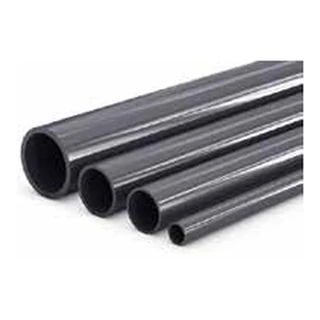
If a supplier quotes you “PVC pipe” and a competitor quotes you “UPVC pipe” for the same pressure water line, the honest position is this: for pressure water service there is only one correct material, and it is UPVC — unplasticized PVC. “PVC pipe” is not a second material competing with it. In the pressure-pipe world, “PVC” used on its own is almost always a loose shorthand for UPVC. The problem is the word “almost”.
Plasticized PVC — PVC-P, the soft flexible stuff — is a genuinely different material class under its own ISO designation standard. It is made into hose and tubing, not into pressure pipe to EN ISO 1452. So the practical risk in the “UPVC vs PVC” question is not that you will be offered soft pipe by mistake. It is subtler and it lives on your paperwork:
This page is about that gap — what the U denotes, what standards say about it, and what changes on your purchase order, incoming inspection and rejection rights when the letter is missing. Our UPVC size and wall thickness page handles dimensions and our Class 16 page handles pressure class; neither is repeated here.
UPVC is not a grade of PVC, a brand of PVC, or a marketing tier above PVC. In standards language it is a named material: unplasticized poly(vinyl chloride), abbreviated PVC-U. EN/ISO writes it PVC-U with the hyphen; the trade writes it UPVC; they are the same thing.
The pressure-pipe standard is explicit about which material it governs. ISO 1452-1:2009 states in its Clause 1 Scope, verbatim: “This part of ISO 1452 specifies the general aspects of unplasticized poly(vinyl chloride) (PVC-U) solid-wall piping systems intended for water supply and for buried and above-ground drainage and sewerage under pressure.” The series title carries the same designation, and runs Parts 1 to 5: general, pipes, fittings, valves, fitness for purpose (ISO 1452-1:2009, Clause 1 and title page).
Note what this means procedurally. There is no clause in EN ISO 1452 saying “plasticized PVC is prohibited”, and there does not need to be: the standard’s subject material is PVC-U, stated in the title and scope, so plasticized PVC is simply outside the document. A pipe made from plasticized compound is not a non-conforming EN ISO 1452 pipe — it is not an EN ISO 1452 pipe at all. That distinction matters when you are writing rejection language.
The clearest evidence that these are different materials rather than different qualities of one material: ISO gives them separate designation standards, and the two classify by completely different properties.
| Unplasticized PVC (PVC-U) | Plasticized PVC (PVC-P) | |
|---|---|---|
| ISO material designation standard | ISO 21306-1:2019, “Plastics — Unplasticized poly(vinyl chloride) (PVC-U) moulding and extrusion materials — Part 1: Designation system and basis for specifications” (superseding ISO 1163-1:1995); ISO 21306-2:2019 is the companion part on preparation of test specimens and determination of properties (superseding ISO 1163-2:1995) | ISO 24023-1:2020 / BS EN ISO 24023-1:2020, “Plastics — Plasticized poly(vinyl chloride) (PVC-P) moulding and extrusion materials — Part 1” (superseding ISO 2898-1:1996) |
| How types are classified | Rigid-material property basis (ISO 21306 series, superseding ISO 1163) | Three designatory properties reflecting softness: Shore hardness, density, torsional-stiffness temperature at 300 MPa (BS EN ISO 24023-1:2020 scope) |
| Composition scope | Unplasticized compositions | “applies to all plasticized compositions of homopolymers and copolymers that contain at least a mass percentage of 50 % of vinyl chloride”; excludes cellular plastics and plastisols (BS EN ISO 24023-1:2020 scope) |
| Used for EN ISO 1452 pressure pipe | Yes — the subject material of the standard | No — outside the document’s scope entirely |
Read the PVC-P classification basis again, because it tells you something marketing copy will not. PVC-P types are ranked by hardness and torsional stiffness — a scheme with no counterpart anywhere in rigid PVC-U pipe standards, existing because plasticizer loading is the defining variable for PVC-P. ISO itself treats “how much plasticizer” as the identifying question for one material and as a non-question for the other.
One thing we will not give you is a numeric cut-off. A widely circulated figure — a parts-per-hundred plasticizer threshold said to separate rigid from flexible PVC — traced only to a patent text in our checking, not to any ISO, EN or ASTM document. We have not found a citable published threshold, and we will not invent one. If a supplier quotes you a percentage as though it were a standards limit, ask which clause of which standard it comes from.
The mechanism explains why “add plasticizer for toughness” is not an option a pressure-pipe producer can take.
External plasticizers are not chemically bonded into the polymer. Peer-reviewed work describes, verbatim, “the absence of covalent bonds between the polymer backbone and the phthalate-based external plasticizers”. They sit between the polymer chains rather than forming part of them, so they can move. The same study describes plasticized PVC under UV exposure undergoing “photodegradation processes…that disrupt the polymer microstructure and increase free volume, thereby greatly facilitating the upward diffusion and leaching of plasticizers”, producing “yellowing, or embrittlement…loss of mechanical performance” (Rapid Communications in Mass Spectrometry, 2026, 40(10):e70048).
In engineering terms: a component whose stiffness depends on something that can migrate out has a mechanical property that drifts over service life. For a pressure pipe designed on a decades-long basis, that is disqualifying. It is why rigid pipe is rigid by formulation rather than by wall thickness alone.
What we will not tell you is how fast. We looked for quantitative migration rates or service-life reduction figures — mg/L leached, percent property loss per year — tied to a stated diameter, wall thickness, temperature and contact time, from a standards body or industry association. We did not find them, so this page gives none.
Buyers reasonably ask whether “PVC” means phthalates in their potable water. The industry position on rigid pipe is unambiguous. The Uni-Bell PVC Pipe Association states, verbatim: “No phthalates or bisphenol-A are present in PVC pipe. These substances are not used in the manufacture of PVC pipe for drinking water or wastewater systems” (Uni-Bell PVC Pipe Association, The Health, Safety, and Environmental Performance of PVC Pipe, 2024, p.3). The Vinyl Institute puts the same point as a direct Q&A: “Q: Does PVC pipe for drinking water contain phthalates? A: No. The rigid PVC pipe used to convey drinking water does not contain phthalates”, citing the 2nd Edition PVC Handbook, Chapter 18, p.892 and the Uni-Bell 2024 document (Vinyl Institute, FAQs About PVC Pipes).
Both are industry-association sources rather than standards bodies, and we label them as such. A frequently repeated related claim — that flexible PVC tubing containing phthalates is specifically tested for phthalate leaching under NSF/ANSI 61 — we could not verify against a primary source, so we do not repeat it. On the EU Drinking Water Directive 2020/2184 positive list and its treatment of specific phthalates, we reached only secondary commentary, not the underlying acts, so we assert nothing.
Now the trap — the single most useful thing on this page for anyone writing a potable-water specification.
EN ISO 1452 compliance does not by itself mean the pipe is approved for drinking water. The standard says so in its own Introduction, verbatim: “a) This part of ISO 1452 provides no information as to whether or not the products can be used without restriction. b) Existing national regulations concerning the use and/or the characteristics of these products remain in force” (ISO 1452-1:2009, Introduction).
Consistent with that, ISO 1452-1 treats drinking-water contact as an additional compound requirement rather than something covered by the general material rules. Its Clause 4 “Material” runs 4.1 general requirements for compounds or formulations; 4.2 “Special requirement for compounds or formulations for components in contact with drinking water”; 4.3 reprocessable and recyclable material; 4.4 classification and verification of materials (ISO 1452-1:2009, Clause 4).
So a certificate stating conformity to EN ISO 1452 answers “is this the right material and dimension system?” It does not answer “may this touch drinking water in my country?” That second question belongs to your national regulator or scheme, and it is a separate document you must ask for by name. Our GCC potable water approval page covers what that looks like in Gulf markets.
Everything above is background for these five line items.
| Document | What “PVC” alone lets happen | What to write instead |
|---|---|---|
| Tender / specification | Material undefined; no basis to reject a substitution | “PVC-U (unplasticized) to EN ISO 1452-2, PN __, dn __” — name the part, not just the series |
| Purchase order line | Pressure line item can be filled with a drainage-grade product; both are “PVC” | State pressure class and standard on the same line as the size, so a non-pressure product cannot satisfy it on paper — the DN, SDR and PN definitions behind those figures are worth agreeing before you write them |
| Potable water requirement | Supplier answers with an EN ISO 1452 certificate, which does not address potable approval at all (ISO 1452-1:2009, Introduction) | Two separate requirements: (a) conformity to EN ISO 1452-2, (b) the national/scheme potable approval, named explicitly |
| Pipe marking / incoming inspection | Inspector has no printed string to check against the PO | Require material designation and standard reference in the pipe print; check at goods inwards against the PO wording |
| Test certificate review | “PVC” tells you nothing about which material designation standard the compound was classified under | Require the certificate to name the material as PVC-U and cite the pipe standard with its version year |
In our experience quoting against tender documents, the most common material-side ambiguity is not a supplier trying to ship soft pipe — it is a pressure line item written loosely enough that a non-pressure product technically fits the words. That is an observation from our own quoting, offered as experience rather than as a statistic. Our tender documents page goes further into writing these line items.
Because “UPVC vs PVC” is largely a naming question, the comparison worth your time is a different one. Once the pressure pipe on offer is established as PVC-U to EN ISO 1452, the real decisions are these.
| Real question | Why it decides the order | Where the verified limit sits |
|---|---|---|
| Pressure vs non-pressure | A drainage product and a pressure product can both be called “PVC” and look similar on a packing list | EN ISO 1452 is the pressure family. Our own PVC 902 range is non-pressure drainage only — 902 pipe Φ32–Φ110, 1902 fittings to Φ160 (per our catalogue) |
| Service temperature | Where PVC-U pressure systems are most often over-specified into failure | ISO 1452-2:2009 applies “up to and including 25 °C (cold water)…as well as for waste water under pressure”, extending to 45 °C with Figure A.1 derating; above 45 °C is producer/end-user agreement case-by-case (Clause 1) |
| Diameter | Frequently the hard stop that ends a supplier conversation | Our pressure UPVC/CPVC 806 pressure system stops at Φ110 (per our catalogue) |
| Potable approval regime | A separate, country-specific document from the pipe standard | ISO 1452 “provides no information as to whether or not the products can be used without restriction”; “existing national regulations…remain in force” (ISO 1452-1:2009, Introduction) |
| Industrial vs water-supply product family | The same letters PVC-U appear on products scoped by different standards with different temperature ranges | Georg Fischer’s PVC-U industrial specification states 0–60 °C, density 1,38 g/cm³ (ISO 1183-1), Vicat B/50N ≥ 76 °C (ISO 306) — but that is GF’s industrial range per EN ISO 15493, not the EN ISO 1452 water-supply limits (GF Piping Systems, PVC-U Metric System Specification, 2015, Clauses 2.1–2.2) |
That last row is a live source of specification arguments. Two documents, both about material called PVC-U, give different temperature ceilings — 60 °C in a manufacturer’s industrial system specification written to EN ISO 15493, and 25 °C / 45 °C in the water-supply standard EN ISO 1452. Neither is wrong; they scope different product families. If a supplier answers a water-supply temperature question with an industrial-range figure, that is the substitution you are looking at — a far more likely dispute than anything involving plasticizer.
For any pressure water line: specify PVC-U to EN ISO 1452-2 with the part number, version year and pressure class written out. Do not accept “PVC” as a material description on a specification, a purchase order line, a pipe print or a test certificate. Not because you are likely to receive plasticized pipe — you are not — but because the loose word is what lets a non-pressure or wrong-temperature-family product pass three separate document checks.
Who is this actually for?
Everything in this section comes from our catalogue as printed. Nothing is derived, calculated or extrapolated — where the catalogue gives a full table we reproduce the full table, and where it genuinely gives nothing we say so instead of filling the gap.
| Item | What our catalogue states |
|---|---|
| Material | UPVC — unplasticized PVC (per our catalogue) |
| Pressure system | UPVC/CPVC 806 system, PN16, WP55 pipe (per our catalogue) |
| Pipe size range | Φ20 to Φ110, nine sizes, 4 m lengths — full wall thickness table below (per our catalogue) |
| Fittings | Series 1806, 203 items including ball valves and solvent cement (per our catalogue) — see how the fitting types are named if your bill of quantities uses different words |
| Stated heat resistance | 95–120 °C, stated for the UPVC/CPVC 806 system as a whole — the catalogue’s heat description is a CPVC-grade one (per our catalogue) — see the caution below |
| Stated weight comparison | One sixth the weight of brass, one fifth the weight of steel (per our catalogue) |
| Stated service life | 50+ years (per our catalogue) |
| Non-pressure drainage | PVC 902 pipe Φ32–Φ110; 1902 fittings to Φ160, non-pressure only (per our catalogue) |
| Pressure UPVC above Φ110 | Not manufactured — we do not offer it |
| Plasticizer content figures for our compound | Coming soon — our catalogue publishes no composition breakdown, and we will not state one we cannot source |
| Wall thickness, every size | Published in full — all nine rows are in the table below, taken from the catalogue as printed, not derived from an SDR formula |
| Certificate numbers (SKZ, CE, WRAS, DVGW, SGS, ISO 9001, ISO 14001) | Coming soon |
| Potable-water approval documents by destination country | Coming soon — the separate document described above; we will not conflate it with pipe-standard conformity |
| Project references, tonnages, pricing, MOQ, lead time | Coming soon |
The wall thickness table in full, as printed in the catalogue:
| Outside diameter | Wall thickness | Outside diameter | Wall thickness |
|---|---|---|---|
| Φ20 | 2,0 mm | Φ63 | 4,7 mm |
| Φ25 | 2,0 mm | Φ75 | 5,6 mm |
| Φ32 | 2,4 mm | Φ90 | 6,7 mm |
| Φ40 | 3,0 mm | Φ110 | 7,2 mm |
| Φ50 | 3,7 mm | UPVC/CPVC 806, PN16, 4 m lengths | |
Four points of honesty before you enquire.
On the 95–120 °C figure. That is our catalogue’s heat-resistance statement for the UPVC/CPVC 806 system, quoted as written — and the catalogue’s own wording there describes a CPVC-grade capability, so read it as a system-level statement rather than as a rating for UPVC pipe on its own. It is a material heat-resistance claim, not permission to run a PN16 UPVC line at 95 °C under pressure. ISO 1452-2:2009 scopes PVC-U pressure application to 45 °C, with Figure A.1 derating between 25 °C and 45 °C, and use above 45 °C subject to case-by-case producer/end-user agreement (Clause 1). This is the two-document mix-up described earlier, and we would rather flag it against our own catalogue than let you discover it later.
On diameter. Our pressure UPVC stops at Φ110. We cannot supply DN 150 to DN 400 pressure mains and will not imply otherwise. Our other lines do not rescue that case: PPR PN20 is made only in 20×2,8 / 25×3,5 / 32×4,4 mm, and HDPE PN16 runs nine sizes from Φ20×2,3 through Φ40×3,7 and Φ63×5,8 to Φ110×10,0 (both per our catalogue, wall thickness published for every size). Our PVC 902 range reaches Φ160 only in the 1902 fittings; the 902 pipe itself stops at Φ110, and all of it is non-pressure drainage — not a substitute for a Φ160 pressure pipe.
On what we can and cannot certify about compound. For the UPVC compound we do not publish a plasticizer statement, and we will not manufacture one to close a gap on a web page. If your specification requires a signed material declaration, ask directly and we will tell you what we can and cannot issue today.
On origin. IFANNova is a French brand; manufacturing is by Zhuji Fengfan Piping in Zhuji, Zhejiang, China. Nothing in our range is made in France. We state this plainly because a specification written to European standards sometimes carries an unspoken assumption about origin — better corrected before an order than after.
Is UPVC stronger than PVC? The comparison is malformed. UPVC is a type of PVC — the unplasticized type, PVC-U. When a supplier says “PVC pipe” for a pressure application they almost always mean PVC-U, since that is the material EN ISO 1452 governs. The useful question is not strength but which standard and which pressure class the product is made to.
Could I actually be sold plasticized PVC pipe for a water main? We have no evidence of that being a real market practice and we do not claim it is. PVC-P is a separate material class under its own designation standard (ISO 24023-1:2020), outside the scope of EN ISO 1452 entirely. The realistic risk from a vague “PVC” specification is substitution of a non-pressure product or an industrial-family product with a different temperature basis — not soft pipe.
Does UPVC pipe contain phthalates? The industry-association position is no — see the quoted Uni-Bell and Vinyl Institute statements above. These are association sources, not standards bodies. For our own compound specifically, a published composition statement is Coming soon.
How much plasticizer makes PVC “plasticized”? We could not find an authoritative numeric threshold. ISO 24023-1:2020 classifies PVC-P by Shore hardness, density and torsional-stiffness temperature rather than by a plasticizer percentage, and the parts-per-hundred figure that circulates online traced only to a patent text in our checking. We are not going to state a number we cannot cite.
Does an EN ISO 1452 certificate mean the pipe is approved for drinking water? No. ISO 1452-1:2009’s Introduction states that the standard “provides no information as to whether or not the products can be used without restriction” and that “existing national regulations concerning the use and/or the characteristics of these products remain in force”. Potable approval is a separate document under your national regime.
Is your PVC 902 drainage range an option if I only need low pressure? No. PVC 902 is non-pressure drainage — pipe Φ32–Φ110, 1902 fittings to Φ160 (per our catalogue). “Low pressure” is still pressure, and a non-pressure product carries no rating to derate from.
If you are holding a specification that says “PVC pipe” and you are not sure what you are entitled to reject, send us the wording along with four things: maximum system pressure including pump shut-off and static head, design temperature including any exposed or rooftop runs, the largest diameter in scope, and whether the line is potable and under which national regime.
We will tell you what the wording currently permits a supplier to ship, what to tighten, and whether our range can serve it at all. If we cannot — above Φ110, or a hot pressurised service — we will say so rather than quote around it. Contact IFANNova.
IFANNova is a French brand; manufacturing is by Zhuji Fengfan Piping, Zhuji, Zhejiang, China. Nothing in our range is made in France.
On our range the PVC vs PPR choice only exists at 20, 25 and 32 mm.
PEX is mechanically joined; PPR is heat-fused at 260 ± 10 C with a 4-second change-over window at 16-25 mm.
PP-R belongs indoors, PE in the ground.