PN20 PP-R is a terminal-branch material with a hard ceiling at 32 mm outside diameter: the bore behind each size, the standard condition that actually governs a cold line, and the three things that take one down.
Ask a pipe supplier whether PP-R suits a chilled water job and you will get a yes. Every page currently ranking for the question is written by someone who sells the pipe, and not one of them states a condition under which the answer changes. That is a problem for the person who has to sign the specification, because the answer does change, and it changes on a number nobody publishes.
Here is the short version. PN20 PP-R is a sound chilled water material on terminal branches and fan coil tails, and it is the wrong material for mains and risers, because the published range stops at 32 mm outside diameter. Temperature is not what rules it out. At a 6.7 °C supply the pipe sits well inside the envelope the standard writes for cold water. What actually decides a PP-R chilled line is three things its own marketing leaves out: the dew point it runs below, the movement it makes when a hot site cools down, and the diameter you can actually buy.
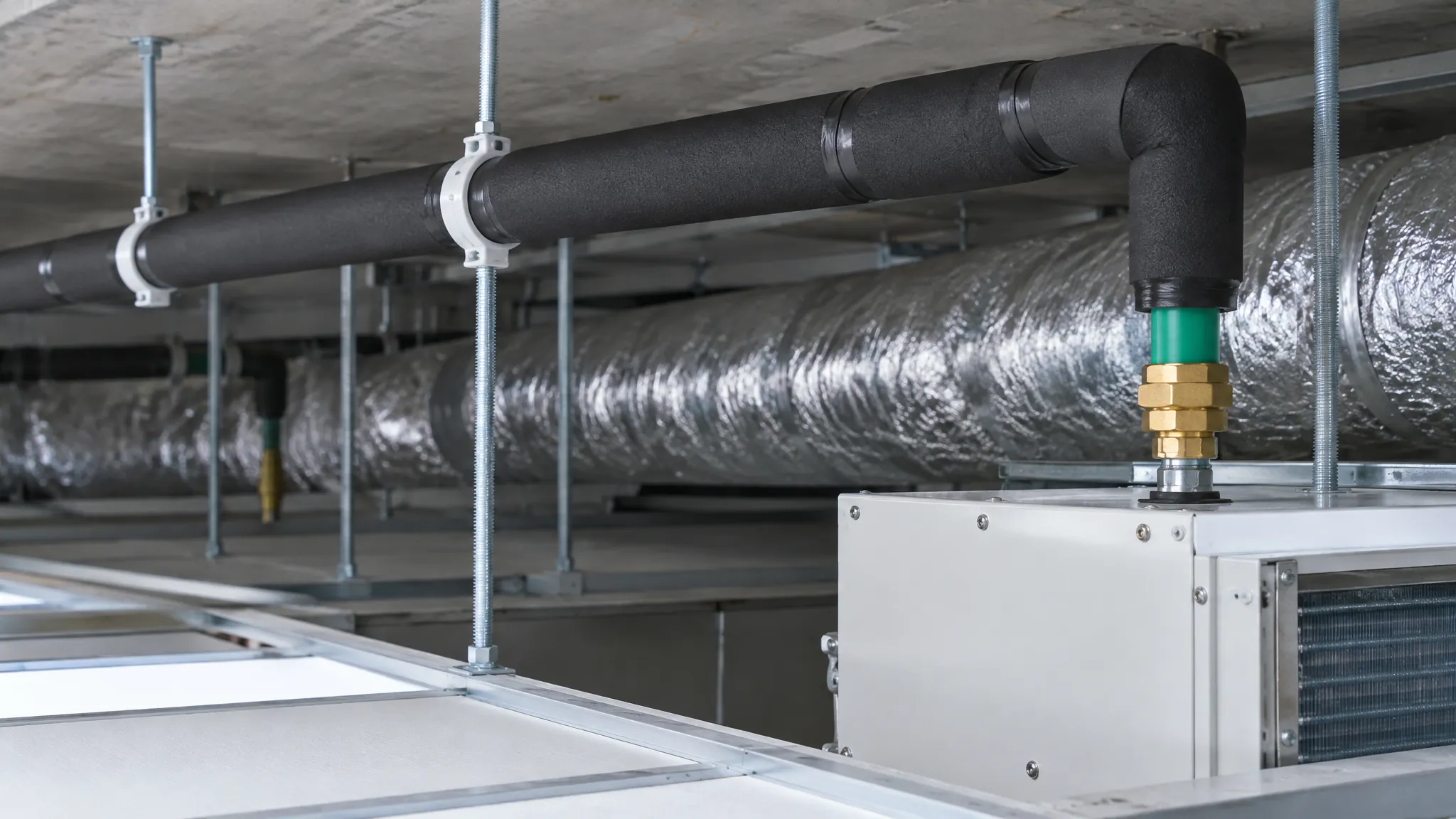
Key Takeaways
A chilled water system is not one piping duty. It is four, and they sit in different size bands. The plant room and the primary mains move the whole building’s flow. Risers carry a stack of floors. Floor mains feed a zone. Terminal branches and fan coil tails serve one or two units each. Read the question duty by duty and it answers itself, because the size band of each duty is what puts PP-R in or out.
Only the last two duties, the 20 to 32 mm bands, fall inside a PN20 PP-R range, and only the last one comfortably. Everything upstream of the floor branch is either outside the range or close enough to its ceiling that you are specifying the largest thing available rather than the right thing. For the full segment-by-segment picture of the loop, the chilled water system field guide walks the four segments in order.
| Duty on the system | Size band (mm OD) | Verdict for PN20 PP-R | Best for |
|---|---|---|---|
| Plant room and primary mains | Above 110 | No. Outside every plastics range we publish | Steel, welded and insulated on site |
| Risers and floor mains | 63 to 200 | No. Above the 32 mm PP-R ceiling | Steel above 110, HDPE PN16 below it |
| Floor branches to a zone | 40 to 63 | No. Above the 32 mm PP-R ceiling | HDPE PN16, or UPVC and CPVC 806 |
| Terminal branches to fan coils | 20 to 32 | Yes, with movement and insulation designed | PN20 PP-R, series 1103 pipe and 1138 fittings |
| Fan coil tails and single drops | 20 to 25 | Yes. This is the duty it was built for | PN20 PP-R, series 1103 pipe and 1138 fittings |
Source: IFANNova catalogue range data, September 2026. Size bands are the duties as designed, not a product claim.
When a datasheet justifies a PP-R pipe by naming a service class, check which class. ISO 10508:2006, the classification standard the EN ISO 15874 system rests on, sets out five of them in Table 1, and every one is a hot water or heating duty. Class 1 runs at a 60 °C design temperature for 49 years and Class 2 at 70 °C for 49 years; Class 3 covers low-temperature under-floor heating, Class 4 under-floor heating and low temperature radiators, Class 5 high temperature radiators. There is no cold water class. The classification system was built for the wrong direction.
Cold water is handled instead as a blanket requirement laid on top of all of them. In the standard’s own words, any system meeting one of the five classes “shall also be suitable for the transportation of cold water for a period of 50 years at a temperature of 20 °C and a design pressure of 10 bar”. That is the condition a chilled line is actually working against, and ISO 15874-5:2013 settles which one wins: Table 2 of that part carries the footnote that “the 20 °C, 10 bar, 50 years, cold water requirement, being higher, determines this value”.
Two things follow. A hot water service class is not a design basis for chilled water, and citing one to justify a chilled line is a category error, however accurately it is quoted. And at 6.7 °C the pipe is running colder than the 20 °C reference, so creep and hydrostatic performance are more conservative than the standard assumes, not less. The pressure side of this decision is the easy side.
What the class system does not cover is where the risk moved. Cold makes polypropylene notch-sensitive: published PP-R technical data states plainly that cold weather weakens its resistance to impact and it becomes fragile. The current general part of the system standard is EN ISO 15874-1:2013+A1:2022, and Amendment 1, published on 13 June 2022, is titled “Impact test”. A standards committee does not add an impact test to a mature standard for decorative reasons.
Our PP-R line is series 1103 pipe with 1138 fittings, rated PN20, supplied in 4 m lengths, in three outside diameters: 20, 25 and 32 mm. That is the whole range, and it is a real ceiling rather than a gap in the catalogue. Across every pressure system we make, the range stops at 110 mm outside diameter, and we do not make DN150 to DN400 mains. We say that rather than sub-contracting them, because a buyer who discovers the substitution at the port has lost more than the price difference.
The number that actually sizes the branch is not the outside diameter. A PN20 wall is thick, and it takes the bore with it.
| Outside diameter (mm) | Wall (mm) | Internal bore (mm) | What it serves |
|---|---|---|---|
| 20 | 2.8 | 14.4 | Fan coil tails and single terminal drops |
| 25 | 3.5 | 18.0 | Terminal branches serving one or two units |
| 32 | 4.4 | 23.2 | The largest branch this range reaches |
Source: IFANNova catalogue wall thickness, September 2026. Bore is outside diameter minus twice the wall.
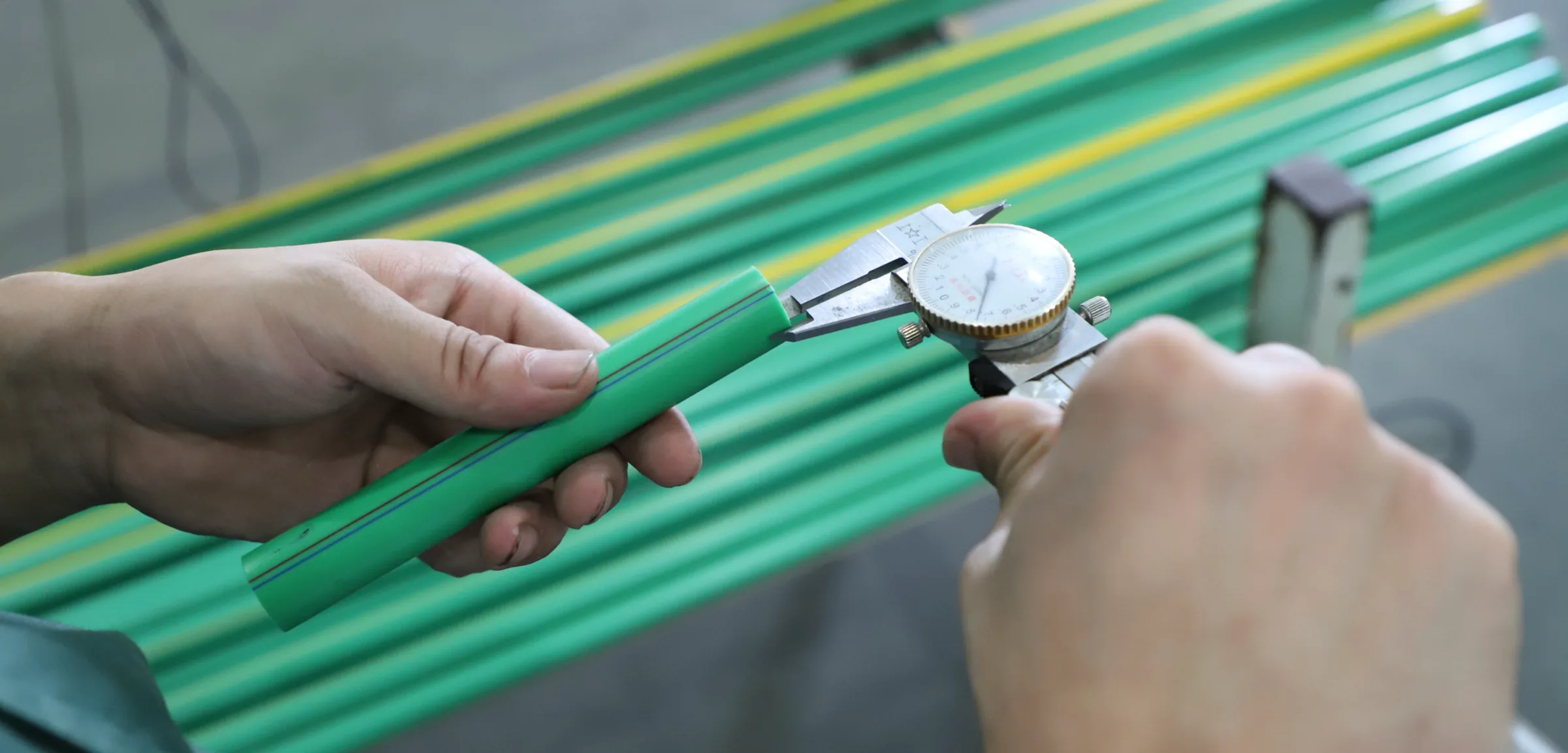
A 32 mm PP-R branch gives you 23.2 mm of water. Specify it against a steel schedule that assumed a nominal bore of 32 mm and the velocity will land where you did not put it. Work the flow against the bore column and check it on the chilled water pipe size chart; the full designation and dimension tables sit in the PP-R pipe size tables. Anything above 32 mm on a chilled system needs a different material from the same supplier, which is what our chilled water piping range, from branch fittings to insulation practice, is organised around.
Hot water piping fails slowly, by thermal ageing, and the service classes exist to predict that. Chilled water piping fails differently, and faster. The standard air conditioning design condition is 6.7 °C supply and 12.2 °C return. The comfort condition those temperatures are chosen to hold, 23.9 °C at 50% relative humidity, has a dew point of roughly 12.8 °C. A 6.7 °C line therefore runs 6.1 K below the dew point of the air around it, and bare pipe of any material will sweat.
Supplier pages like to argue that PP-R’s low thermal conductivity reduces that problem. It does not. PP-R sits at 0.23 W/m·K, which is far better than steel and roughly an order of magnitude worse than the closed-cell insulation that actually does the job. The wall is 2.8 to 4.4 mm thick; the insulation is not. Treating the pipe material as part of the thermal envelope is how a vapour barrier ends up under-specified.
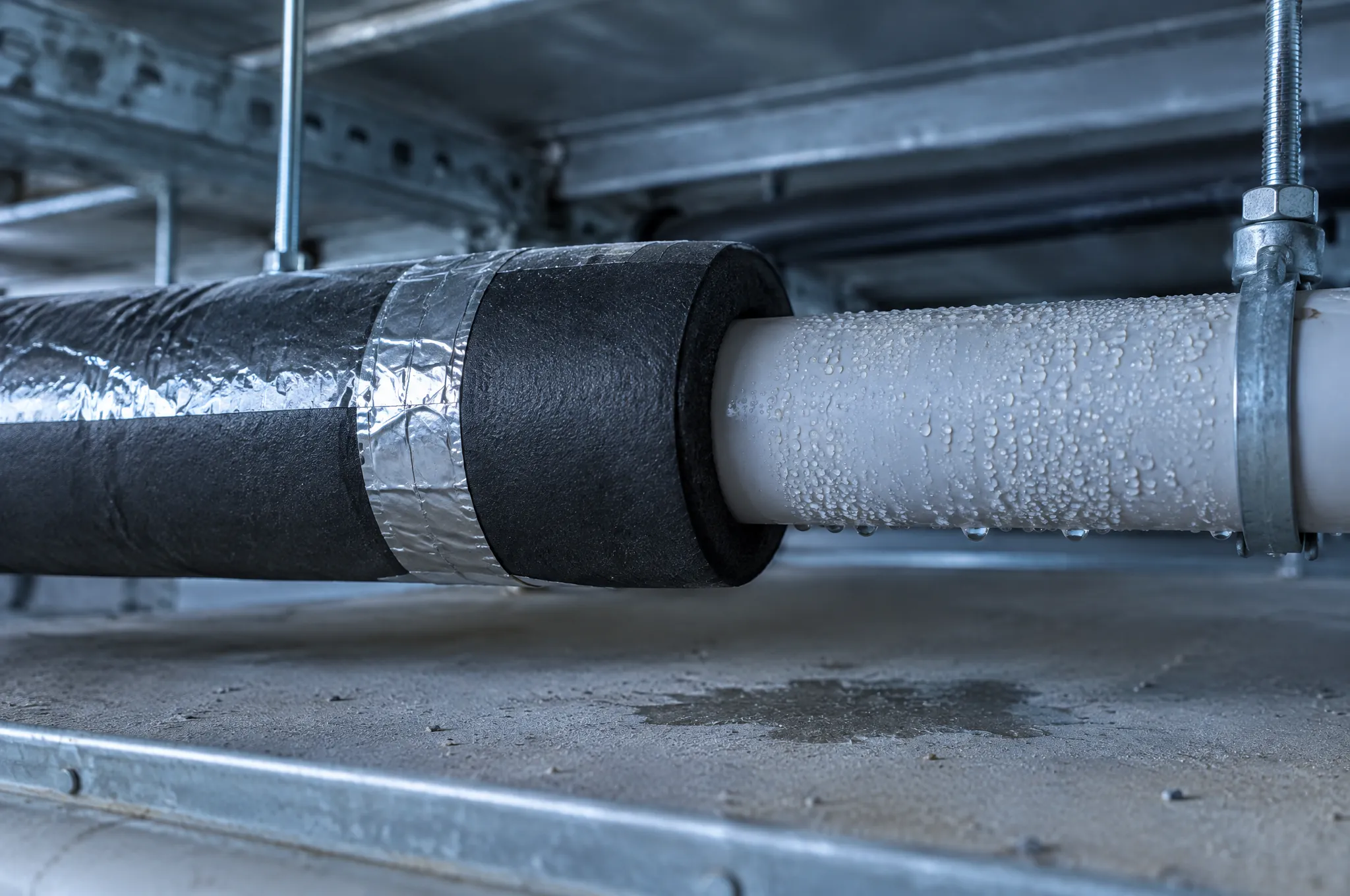
The calculation that matters is in EN ISO 12241:2022, whose clause 4.5 is titled “Prevention of surface condensation”: you size insulation so the outer surface stays above the dew point of the space it runs through. That thickness depends on the space, not on whether the pipe under it is plastic or steel. The failure that follows from getting it wrong is documented in our write-up of vapour barrier failures on chilled water lines, and it is always the barrier, never the pipe.
Thermal movement is filed under hot water problems, which is why it gets missed here. Published PP-R technical data puts the coefficient of linear thermal expansion at 1.5 × 10⁻⁴ per kelvin for plain pipe and 0.35 × 10⁻⁴ per kelvin for the glass-fibre composite version. Movement is the coefficient times the length times the temperature change, and on a Gulf site the temperature change on a chilled line is large, because the pipe is installed hot and then runs cold.
Take a 30 m run closed out at a 45 °C site ambient and then commissioned at 6.7 °C. That is a change of 38.3 K, and the run contracts.
| Pipe | Coefficient (per K) | Chilled, 45 to 6.7 °C (mm) | Hot water, 25 to 60 °C (mm) |
|---|---|---|---|
| Plain PP-R | 1.5 × 10⁻⁴ | 172 | 158 |
| Glass-fibre PP-R | 0.35 × 10⁻⁴ | 40 | 37 |
Source: computed from published PP-R coefficients. The 45 °C installation ambient is an input to this example, not a measured site value.
Plain pipe moves 172 mm on the chilled case against 158 mm on the hot one. The chilled job is the more demanding of the two, and it is the one nobody designs supports for. Substituting the glass-fibre composite drops the same run to 40 mm, which is the honest argument for the composite on chilled water, and a better one than any of the thermal claims usually made for it. Support spacing and anchor placement then follow from the number you chose, which we work through separately for thermal expansion on plastic chilled water lines.
| Run length (m) | Plain PP-R (α 1.5 × 10⁻⁴ /K) | Glass-fibre PP-R (α 0.35 × 10⁻⁴ /K) |
|---|---|---|
| 0 | 0 | 0 |
| 10 | 57 | 13 |
| 20 | 115 | 27 |
| 30 | 172 | 40 |
| 40 | 230 | 54 |
The joint is the one part of a PP-R chilled branch that is not in question, and it is still the part a crew can get wrong on site. This is the procedure they are being held to.
PP-R buys you a corrosion-free, fusion-jointed branch that a site crew can install quickly, and it charges you for it in bore, in movement and in a hard ceiling at 32 mm outside diameter. Below that ceiling the trade is a good one, and the pressure case is comfortable. Above it there is no trade to make, because the pipe does not exist in our range and we would rather say so than find you a substitute. Design the insulation and the supports as though the pipe were steel, and the material will do its job.
Can PP-R be used for chilled water?
Yes, on terminal branches and fan coil tails. It is not a mains or riser material. The published PN20 range covers 20, 25 and 32 mm outside diameter only, so any duty above 32 mm needs a different material.
Which standard condition governs PP-R on chilled water?
The cold water condition, not a hot water service class. ISO 10508:2006 Table 1 defines five service classes and every one is a hot water or heating duty; cold water is a blanket requirement of 20 °C, 10 bar, 50 years, and ISO 15874-5:2013 records it as the higher, governing condition.
Does a PP-R chilled water pipe still need insulation?
Yes. A 6.7 °C line runs 6.1 K below the 12.8 °C indoor dew point, so bare pipe of any material sweats. Insulation thickness is sized by EN ISO 12241:2022 clause 4.5 and does not change because the pipe is plastic.
How much does a PP-R chilled water line move?
A 30 m plain PP-R run closed at 45 °C and operated at 6.7 °C contracts 172 mm, more than the 158 mm the same run expands on 60 °C hot water. The glass-fibre composite version moves 40 mm over the same run.