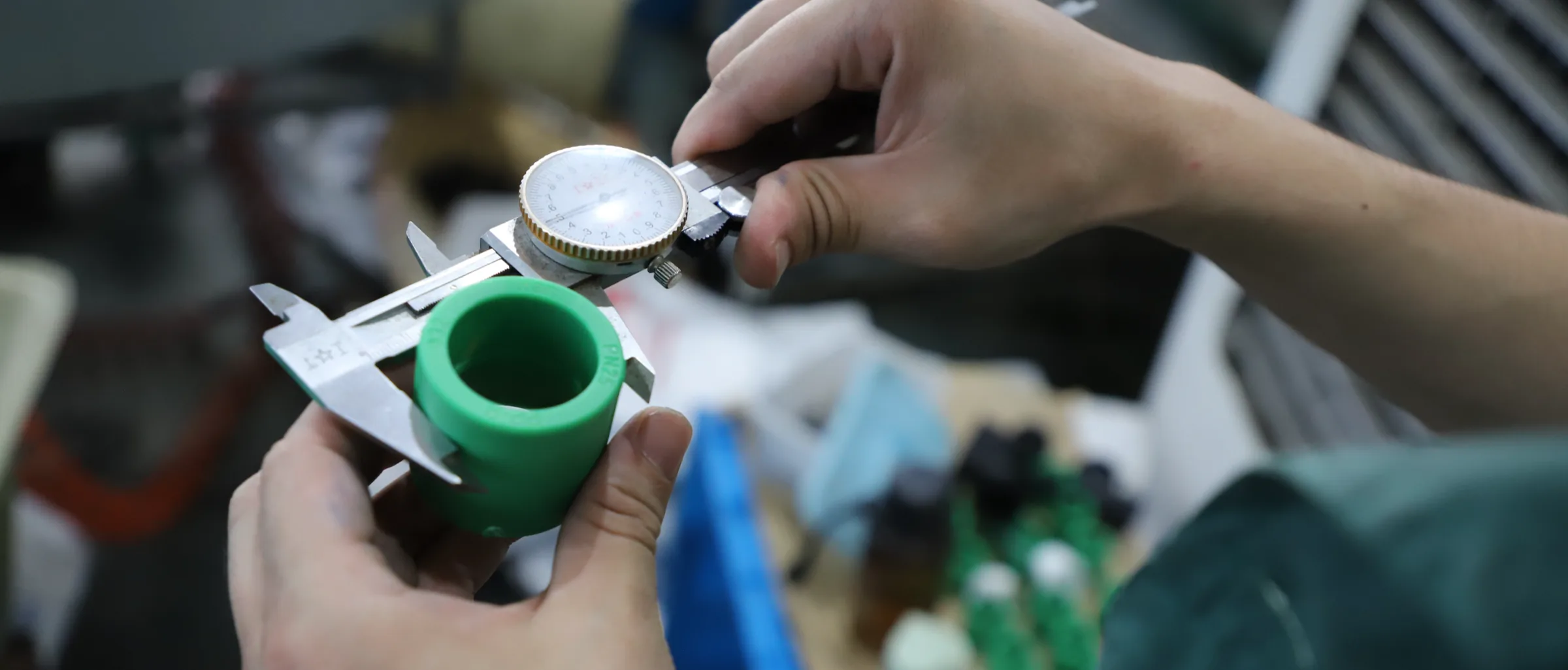
A socket fusion joint in PP-R is not glued, threaded or clamped. The heating tool melts a thin layer on the outside of the pipe and the inside of the fitting socket, and when the two melted surfaces are pushed together they become one piece of polypropylene. Done correctly, the joint is stronger than the pipe wall either side of it. Done incorrectly, it looks identical from the outside and fails months later under pressure and temperature cycling.
That is the uncomfortable part of PP-R installation: no visual inspection reliably separates a good socket weld from a cold one, so the process parameters are the quality control. Four matter — heating element temperature, heating time, change-over time, cooling time — plus insertion depth, a dimension rather than a time, but getting it wrong wastes all four.
This article gives the tabulated values by diameter, names the source for each, and flags the two places where reputable manufacturers publish different numbers.
The parameter tables that circulate in the PP-R industry nearly all trace back to one document: DVS 2207-11, “Welding of thermoplastics — Heated tool welding of pipes, piping parts and panels made of PP”, published by the German Welding Society (DVS), February 2017 edition. It covers heated-plate and socket welding of pipes, fittings and saddle connections in PP-R among other PP grades.
An honest caveat about sourcing: DVS 2207-11 is paywalled and we did not open the primary document. Every DVS-attributed number here comes from manufacturer literature that explicitly reproduces the DVS table — principally SIMONA’s work.info Welding (October 2023), whose Table 29 is headed “Heated-tool socket welding to DVS 2207-11”. Read “per DVS 2207-11” as “per DVS 2207-11 as reproduced by SIMONA”, cross-checked against two further manuals published independently of each other.
A newer American standard practice also exists: ASTM F3722-24, “Standard Practice for Heat Fusion Joining of Polypropylene (PP) Pipe and Fittings”, published November 2024, covering butt fusion, socket fusion, sidewall outlet fusion and electrofusion for pressure-rated PP pipe, fittings and valves (per the ASPE Pipeline announcement). It is likewise paywalled and we did not open its parameter tables — so no number in this article is attributed to ASTM F3722. If your specification calls it out, buy it rather than assuming it matches the DVS figures.
On fitting geometry, ISO 15874-3:2013 (Polypropylene (PP) — Part 3: Fittings, ISO/TC 138/SC 2 with CEN/TC 155) dimensions the socket itself; its second edition technically revised Tables 3 and 4 — socket length and socket fusion fitting dimensions — and added PP-RCT. We confirmed that from the official ISO preview, but the preview is front-matter only and we could not open Tables 3 and 4. The insertion depths below therefore come from manufacturer manuals.
The heated tool temperature for PP-R socket welding is 260 ± 10 °C, per DVS 2207-11 as reproduced by SIMONA (Section 3.2.2 and Table 29), applying to heated-tool socket welding of PP-H and PP-R pipes and fittings.
This is one of the better-corroborated numbers in plastics piping, because two manufacturers on different continents publish it independently:
| Source | Stated temperature | Stated tolerance | Additional condition |
|---|---|---|---|
| DVS 2207-11, via SIMONA work.info Welding 10/2023, Table 29 | 260 °C | ± 10 °C | Verify with a fast-indicating surface or infrared thermometer before welding |
| Aquatherm North America Installer Manual, Oct 2024, p. 2.12 | 500 °F (260 °C) | ± 18 °F (± 10 °C) | “The temperature for socket fusion should always be around 500 °F (+/- 18 °F)” |
| Bänninger PP-R / PP-RCT Technical Manual, “Welding Procedure”, Fig. 14 | 260 °C | ± 10 °C | Welding must not begin before the element reaches 260 °C; heating elements must comply with DVS 2208-1 |
Three independent sources, one number, one tolerance band — agreement that unusual indicates the figure is a property of the polymer, not vendor-specific tuning.
Two practical consequences, both routinely ignored on site:
Heating time is where the diameter-by-diameter table becomes unavoidable. The values below are the DVS 2207-11 figures for SDR 11 PP-H / PP-R at 20 °C outside temperature with moderate air movement and the heated tool at 260 ± 10 °C, as reproduced in SIMONA’s Table 29 (p. 42).
The Aquatherm column is their “above 40 °F (4.4 °C)” warm-weather figure from the Oct 2024 Installer Manual, Column E, p. 2.14 — included here to show it is identical across the overlapping range, not to add a second opinion:
| Pipe OD | Heating time, SDR 11 @ 20 °C (DVS 2207-11 via SIMONA) | Aquatherm, above 4.4 °C (Column E) | Heating time, SDR 17 (DVS 2207-11 via SIMONA) |
|---|---|---|---|
| d16 | 5 s | — (not tabulated) | Not recommended — wall thickness inadequate |
| d20 | 5 s | 5 s | Not recommended — wall thickness inadequate |
| d25 | 7 s | 7 s | Not recommended — wall thickness inadequate |
| d32 | 8 s | 8 s | Not recommended — wall thickness inadequate |
| d40 | 12 s | 12 s | Not recommended — wall thickness inadequate |
| d50 | 18 s | 18 s | Not recommended — wall thickness inadequate |
| d63 | 24 s | 24 s | 10 s |
| d75 | 30 s | 30 s | 15 s |
| d90 | 40 s | 40 s | 22 s |
| d110 | 50 s | 50 s | 30 s |
| d125 | 60 s | 60 s | 35 s |
Two things in that table deserve more attention than they get.
The SDR 17 column is not a shortcut you may take at will. DVS 2207-11 only tabulates SDR 17 socket welding from d63 upward. For d16 through d50 in SDR 17, the standard marks socket welding “Not to be recommended because wall thickness is inadequate” (SIMONA Table 29, footnote 2). If a job specifies SDR 17 at 32 mm with socket fusion, that is a specification conflict to raise before the first joint, not a field decision.
Heating time scales with wall thickness, not diameter as such. That is why SDR 17 times run roughly 40–60% of SDR 11 times at the same OD. It also means that switching pipe series mid-project invalidates the timings on the wall chart.
Ambient temperature changes how fast the melt forms and how fast it dissipates. Both manufacturers we checked tell you to lengthen the heating phase when it is cold — but they do not tell you to lengthen it by the same amount, and no source we found reconciles the two. Attribute your multiplier to a named manufacturer rather than treating either as universal.
| Source | Threshold | Adjustment |
|---|---|---|
| Aquatherm Installer Manual Oct 2024, Column F, p. 2.13–2.14 | Below 40 °F (4.4 °C) | Use longer tabulated times — 20 mm: 8 s; 25 mm: 11 s; 32 mm: 12 s; 40 mm: 18 s; 50 mm: 27 s; 63 mm: 36 s; 75 mm: 45 s; 90 mm: 60 s; 110 mm: 75 s; 125 mm: 90 s (roughly +50% over warm-weather values) |
| Bänninger PP-R / PP-RCT Technical Manual, Fig. 14 note | Below +5 °C | “The heating phases should be increased by up to 100%” |
The thresholds are near-identical (4.4 °C vs 5 °C). The multipliers are not: roughly +50% versus up to +100%. We found no citable basis for declaring either correct. Offered as our judgement rather than a sourced instruction: follow the manual for the system you are actually installing, since the fitting geometry and resin grade are that manufacturer’s — and note that Bänninger’s “up to 100%” is a ceiling, not a fixed factor.
At the other extreme, Aquatherm’s guidance above 100 °F (38 °C) is to reduce heating time slightly but never below 80% of the standard heat time (Oct 2024 manual, p. 2.13–2.14). For Gulf and West African projects this is the more relevant end of the range, and it is a floor worth writing into a method statement — the failure mode in extreme heat is over-melting and socket collapse, and “just count faster” has no defined limit unless you give it one.
Change-over time (also called transition time) is the interval between pulling the pipe and fitting off the heater faces and having them fully joined. DVS 2207-11 gives it as a maximum, not a target:
| Pipe OD | Change-over, max. (DVS 2207-11 via SIMONA, Table 29) | Aquatherm Column G, p. 2.14 |
|---|---|---|
| d16 – d25 | 4 s | 4 s (20 mm & 25 mm) |
| d32 – d50 | 6 s | 6 s |
| d63 – d90 | 8 s | 8 s |
| d110 – d125 | 10 s | 10 s |
Aquatherm’s Column G matches DVS 2207-11 exactly across every band. This is the least-disputed parameter in the procedure and the most frequently blown, because it is the only one that cannot be achieved by waiting — it has to be achieved by not waiting.
The reason it is a maximum is physical: the melt starts cooling the instant it leaves the heater. Exceed the change-over time and you push together two surfaces that have already skinned over, producing a joint that is mechanically located but not fused. It will hold a pressure test. It may not hold three years of thermal cycling.
Four seconds at 20 mm is short when you are on a ladder, the fitting is behind a stud, and you have to rotate the pipe to line up a branch. Offered as experience rather than sourced fact: the joints that fail this parameter are rarely the careless ones — they are the ones where geometry made a fast, straight, no-rotation insertion impossible. The fix is sequencing the assembly so awkward joints are made on the bench, not in the ceiling.
PP-R socket fusion has two cooling values per diameter, and conflating them causes real damage:
SIMONA’s footnote 1 to Table 29 puts it plainly: in manual welding, parts must be held fixed for the “Fixed” time, and the joint may only be loaded by further laying operations after the “Total” time has elapsed. Letting go is not the same as it being finished.
| Pipe OD | Fixed / hold time (DVS 2207-11 via SIMONA) | Total cooling (DVS 2207-11 via SIMONA) | Total cooling (Aquatherm Column H, p. 2.14) |
|---|---|---|---|
| d16 | 6 s | 2 min | — (not tabulated) |
| d20 | 6 s | 2 min | 2 min |
| d25 | 10 s | 2 min | 2 min |
| d32 | 10 s | 4 min | 4 min |
| d40 | 20 s | 4 min | 4 min |
| d50 | 20 s | 4 min | 4 min |
| d63 | 30 s | 6 min | 6 min |
| d75 | 30 s | 6 min | 8 min |
| d90 | 40 s | 6 min | 8 min |
| d110 | 50 s | 8 min | 8 min |
| d125 | 60 s | 8 min | 8 min |
Note the two bold cells. At 75 mm and 90 mm, DVS 2207-11 (via SIMONA) gives 6 minutes total cooling; Aquatherm’s Column H gives 8 minutes. Both documents were opened directly and both are authoritative manufacturer or standards-derived literature. We found no source that explains the divergence. Where two credible sources disagree and neither can be shown wrong, the defensible engineering choice is the conservative one — take 8 minutes at d75 and d90 — but if you are writing a method statement for approval, cite whichever document your specification references and say which one you followed.
Aquatherm additionally directs the installer to immobilise the joint for up to a quarter of the cooling time, which is a different way of expressing the hold requirement than the DVS “Fixed” column; the two are not numerically identical and we have not attempted to reconcile them.
If the pipe is not inserted to the correct depth, none of the timings above matter, because the heated length and the engaged length no longer correspond. Insertion depth is set by the socket geometry of the fitting, so it follows the outside diameter rather than the pressure class — the PPR pipe sizes in mm and inches are the reference to work from.
The values below are from Bänninger’s Fig. 15, “Bush depths for PP-R and PP-RCT fittings”, where the heading reads “Bush depth = Insertion depth”. The Aquatherm column is their “fusion depth”, Column D, p. 2.14 of the Oct 2024 Installer Manual:
| Pipe OD | Insertion depth (Bänninger, Fig. 15) | Fusion depth (Aquatherm, Column D) | Aquatherm imperial |
|---|---|---|---|
| d16 | 13.0 mm | — (not tabulated) | — |
| d20 | 14.5 mm | 14.5 mm | 9/16 in |
| d25 | 16.0 mm | 16 mm | 5/8 in |
| d32 | 18.0 mm | 18 mm | 11/16 in |
| d40 | 20.5 mm | 20.5 mm | 13/16 in |
| d50 | 23.5 mm | 23.5 mm | 15/16 in |
| d63 | 27.5 mm | 27.5 mm | 1-1/16 in |
| d75 | 30.0 mm | 30 mm | 1-3/16 in |
| d90 | 33.0 mm | 33 mm | 1-5/16 in |
| d110 | 37.0 mm | 37 mm | 1-7/16 in |
| d125 | 40.0 mm | 40 mm | 1-9/16 in |
The agreement is exact across the overlapping range — two manufacturers on different continents, same millimetre values — which indicates the depths derive from the standardised ISO 15874-3 socket geometry rather than one vendor’s tooling. To be precise about that inference: we could not open ISO 15874-3’s Tables 3 and 4, so we are reasoning from the convergence of two manuals, not the standard text. Formulas for socket length and pipe penetration circulate in search results; we did not verify them and do not reproduce them here.
The operational point: mark the insertion depth on the pipe before you heat it, as SIMONA’s weld-seam preparation guidance requires. Once the pipe is in the heater you have no reference — you cannot see the socket bottom, and “it felt like it bottomed out” is not a depth gauge.
Two preparation requirements from SIMONA’s Section 3.2.2 that are easy to skip and expensive to skip:
And one constraint that determines what equipment must be on site at all:
For PE-HD and PP pipe diameters ≥ 63 mm, an appropriate welding jig (fusion machine) must be used — hand welding is limited to smaller sizes (SIMONA, Section 3.2.2, “Basic conditions”; for PVDF the threshold is ≥ 50 mm). This is not a comfort recommendation. Above 63 mm the axial force needed to seat the joint within the change-over time exceeds what a person can apply squarely and repeatably, and off-axis insertion is exactly how you get a joint that is thick on one side and unfused on the other.
Being direct about scope, because a parameter table covering d16–d125 can imply we sell all of it: we do not.
Our PPR PN20 pipe (Series 1103) is offered in three sizes only — 20 × 2.8, 25 × 3.5 and 32 × 4.4 mm, in 4 m lengths (per our catalogue). The matching fitting family is Series 1138, a 75-item series (per our catalogue). The pipe is non-toxic and suitable for potable water, joined by socket (heat) fusion, with recycled content ≤ 10% and quality unaffected (per our catalogue).
So only d20, d25 and d32 apply to IFANNova PPR. Extracted, that is the whole job:
| Parameter | 20 × 2.8 mm | 25 × 3.5 mm | 32 × 4.4 mm | Source |
|---|---|---|---|---|
| Heater temperature | 260 ± 10 °C, verified with a surface or IR thermometer before welding | DVS 2207-11 via SIMONA; corroborated by Aquatherm and Bänninger | ||
| Heating time @ 20 °C | 5 s | 7 s | 8 s | DVS 2207-11 via SIMONA Table 29; identical in Aquatherm Column E |
| Heating time, cold ambient | 8 s | 11 s | 12 s | Aquatherm Column F, below 4.4 °C. Bänninger instead says up to +100% below 5 °C — sources differ |
| Change-over, max. | 4 s | 4 s | 6 s | DVS 2207-11 via SIMONA; Aquatherm Column G identical |
| Insertion depth | 14.5 mm | 16.0 mm | 18.0 mm | Bänninger Fig. 15; Aquatherm Column D identical |
| External chamfer | approx. 15°, 2 mm wide (all three sizes are under 50 mm) | SIMONA Section 3.2.2 | ||
| Fixed / hold time | 6 s | 10 s | 10 s | DVS 2207-11 via SIMONA Table 29 |
| Total cooling before loading | 2 min | 2 min | 4 min | DVS 2207-11 via SIMONA; Aquatherm Column H identical at these sizes |
| Welding jig required? | No — all three are below the 63 mm threshold, hand welding permitted | SIMONA Section 3.2.2 | ||
Notice what falls away at these sizes: the 75/90 mm cooling-time dispute never arises, the SDR 17 “not recommended” problem does not apply because PN20 at these diameters is thick-walled, and the 63 mm jig threshold is never reached. The three sizes we supply sit entirely inside the range where the sources agree with each other — a consequence of our range being narrow rather than a virtue of the product.
Where we cannot help: if your project needs PP-R above 32 mm — risers, plant room headers, anything in the d63–d125 band where the jig requirement and the cooling-time divergence both bite — that is outside our PPR offering. Our pressure pipe range tops out at Φ110 — in UPVC/CPVC 806 (WP55 pipe, PN16, Φ20–Φ110 wall thicknesses 2.0 to 7.2 mm) and in HDPE with 603/604 compression fittings (PN16, Φ20–Φ110, 2.3 to 10.0 mm), both tabulated size by size in our catalogue. PPR stops at 32 mm. Better said at enquiry stage than discovered at takeoff — and where a wall thickness genuinely is not printed in our catalogue, as with our PEX ranges, we say so and quote rather than back-calculating from an SDR formula and presenting the result as product data.
Three open items from our source review, so as not to overstate what is known:
None of this makes PP-R socket fusion difficult. It makes it specific. The technique is simple; the tolerance for improvisation is what is narrow.
IFANNova is a French brand; our PPR, UPVC, HDPE, PVC drainage, PEX and brass ranges are manufactured by Zhuji Fengfan Piping in Zhejiang, China (per our catalogue) — 30+ years, 1000+ employees, shipping to 118+ countries from a 120,000 m² facility. We are not a French manufacturer and do not claim to be.
For pricing, MOQ, lead times and stock position: Coming soon — these are quoted per enquiry rather than published, because they move with size mix and destination. Talk to us about your PPR requirement and tell us the sizes and quantities; if the job needs diameters above our range, we will say so rather than quote around it.
Butt fusion, electrofusion and compression compared on process windows, not joint strength: PPI TR-33 heater 204-232 C, DVS 2207-1 200-220 C with 10x wall soak, ISO…
Cold joints cause most field butt fusion failures and ultrasonic inspection cannot detect them.
DVS 2207-1 tabulates socket welding only to OD 125 mm and permits hand-held work only to 50 mm; from 63 mm a machine is required.