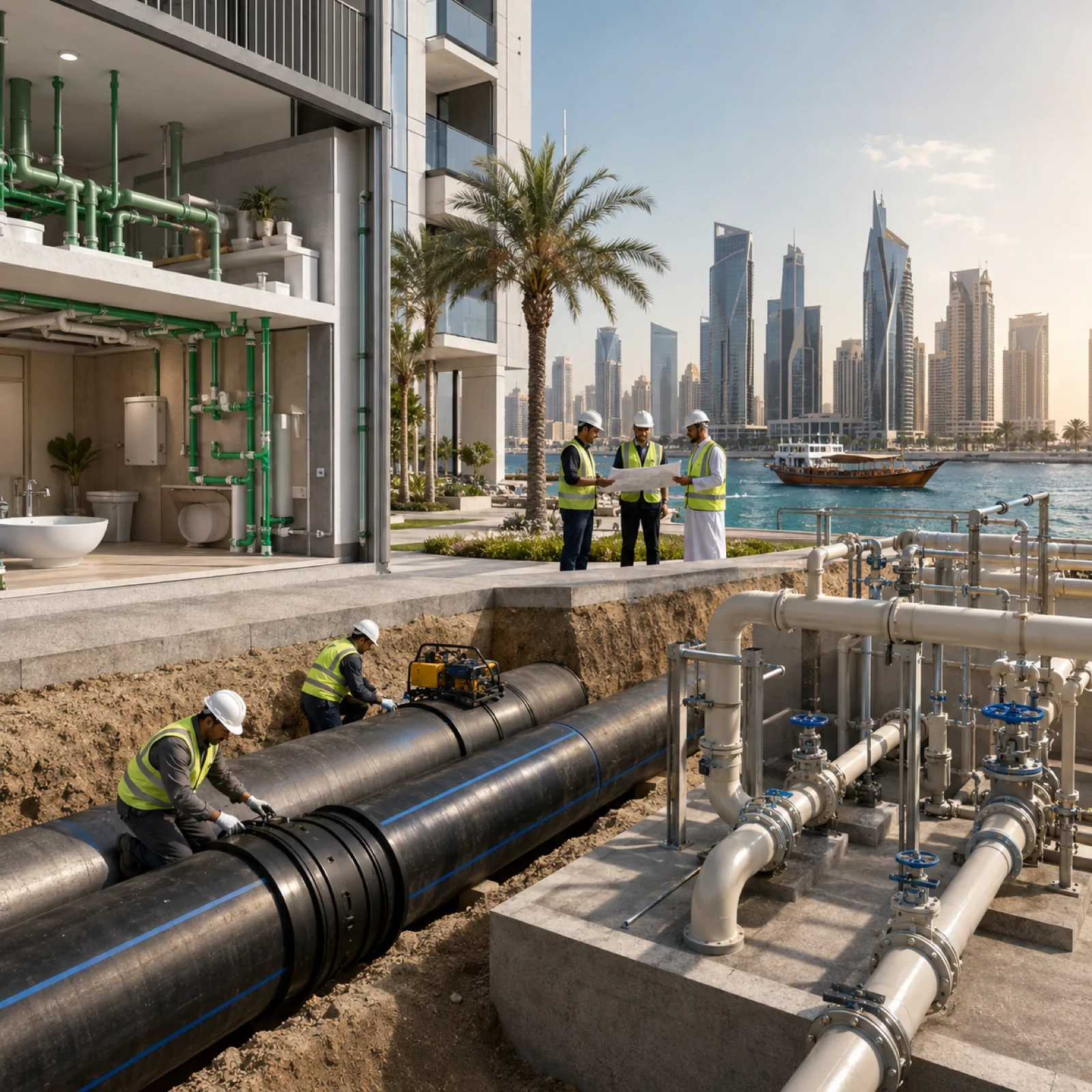
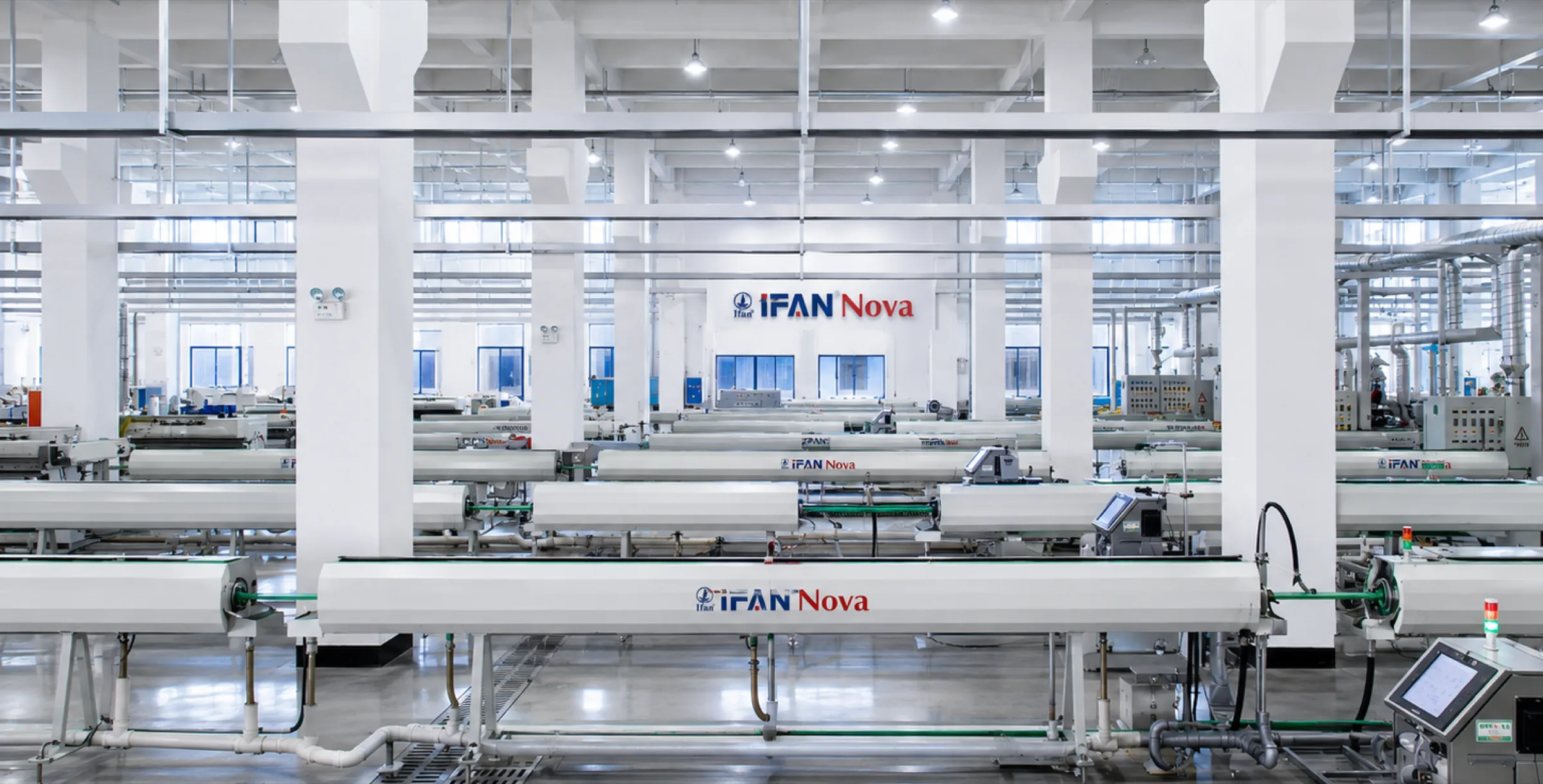
Choosing the wrong pipe material is expensive — a hot-water line that softens, a buried main that cracks, or a chemical run that corrodes means rework, warranty claims and a client you lose. This guide compares the five materials across the seven things that actually decide the choice, then recommends by application and by market. Written by the IFANNova Technical Team, a French brand that manufactures all of these systems in our own facility.
We manufacture PPR, HDPE, UPVC/CPVC and PVC drainage, and supply PEX and brass fittings — so this guide recommends the right material for the job, not the one we happen to stock.
Most piping mistakes come from comparing materials on one axis — usually price — when the choice really turns on seven. Read this table across a single row to see what a material is genuinely for, and down a column to compare like for like. Every material below is manufactured or supplied by IFANNova, so the recommendation that follows is neutral.
About the 95–120 °C figure below. That range is stated in our catalogue for the CPVC grade of the 806 system. It is a material heat-resistance property, not a continuous service rating at PN16, and it does not describe UPVC pipe on its own. Read it in that context wherever it appears on this page.
| Material | Best use | Temperature | Pressure | Jointing | Service life | Relative cost | Best-fit market |
|---|---|---|---|---|---|---|---|
| PPR (green, PN20) | Hot & cold water, underfloor heating, HVAC | 70–95°C | PN20 | Heat fusion (welded) | Long (decades) | Mid | Building water — all markets |
| PEX | Underfloor heating, flexible & tight runs | Hot & cold (flexible) | — | Mechanical / push-fit | Long | Mid–high | Heating, retrofit, cold climates |
| CPVC (grey, 806, PN16) | Hot water, chemical & industrial lines | 95–120°C | PN16 | Solvent cement | 50+ years | Mid–high | High-temp & aggressive-media lines |
| UPVC (grey, 806, PN16) | Cold pressure water, acid/alkali lines | up to 45°C (EN ISO 1452) | PN16 | Solvent cement | 50+ years | Low–mid | Cold supply, chemical resistance |
| HDPE (black, 603/604, PN16) | Buried municipal supply, irrigation | Ambient (buried) | PN16 (marked DIN 8077/8078 per our catalogue) | Compression / quick-joint (603 & 604) | 50+ years buried | Mid | Municipal, irrigation, buried networks |
| PVC drainage (902) | Drainage, waste, non-pressure | Ambient | Non-pressure | Solvent cement | Long | Low | Drainage & waste — all markets |
| Brass fittings | Metal transitions, valves, manifolds | — | — | Threaded | Long | High | Transitions between plastic & metal |
How to read it in one line: hot/cold water → PPR; underfloor heating & flexibility → PEX; hottest or most aggressive lines → CPVC; buried pressure mains & irrigation → HDPE; drainage → PVC; joining plastic to metal → brass.
The decision table tells you what each material is; this section tells you what to pick for the job in front of you. Match the application to the material — and follow the link to the range that fits.
| Application | Recommended material | Why | Range |
|---|---|---|---|
| Building hot & cold water | PPR (PN20) | Heat-fused, non-toxic, handles 70–95°C hot water | PPR Pipe & Fittings → |
| Underfloor heating | PEX or PPR | PEX flexes into tight coils; PPR for welded manifold runs | PEX → · PPR → |
| Municipal water supply (buried) | HDPE (PN16) | Marked DIN 8077/8078 (per our catalogue), compression / quick-joint fittings (603 & 604), 50-year design life | HDPE Pipe & Fittings → |
| Agricultural irrigation | HDPE | Flexible long buried runs, corrosion-free | HDPE Pipe & Fittings → |
| Drainage & waste | PVC drainage (902) | Purpose-built, low-cost, non-pressure | PVC Drainage Pipe → |
| Chemical, industrial & high-temp lines | CPVC (806) | 95–120°C, resists acids & alkalis, 50+ years | UPVC/CPVC Pipe → |
| Fire & pressure cold lines | UPVC / CPVC (806) | PN16 pressure, chemical resistance | UPVC/CPVC Pipe → |
| Metal transitions & valves | Brass fittings | Threaded plastic-to-metal joints, valves, manifolds | Brass Fittings → |
The same material behaves differently across markets. High ambient temperatures, UV exposure and buried service change what holds up. Match the material to where it will actually live.
| Market condition | Preferred materials | What to watch | Range |
|---|---|---|---|
| Hot-climate Africa (high ambient, UV) | CPVC for hot lines; HDPE buried; PPR indoors | Keep pressure lines shaded or buried; CPVC handles 95–120°C where hot water runs hotter | UPVC/CPVC → · HDPE → |
| Gulf / GCC (high heat, potable + industrial) | CPVC (industrial/hot), HDPE (municipal), PPR (building) | Specify certified potable-water materials; use CPVC for aggressive or high-temp media | UPVC/CPVC → · PPR → |
| Buried water & irrigation networks | HDPE (PN16, marked DIN 8077/8078 per our catalogue) | Compression / quick-joint fittings (603 & 604) for leak-free joints; 50-year design life | HDPE Pipe & Fittings → |
| Cooler / retrofit heating | PEX, PPR | PEX flexes for retrofit; PPR for welded permanence | PEX Pipe → · PPR → |
For hot climates specifically, the deciding axis is continuous temperature and UV, not price — which is why CPVC (95–120°C) is worth specifying for hot and aggressive lines, HDPE for anything buried, and PPR for the everyday building water it was made for.
The reason this guide can stay neutral is that IFANNova makes or supplies all of it. For an importer building a product line or a contractor sourcing a mixed-material project, that means one supplier, one set of documents, and systems engineered to match — instead of five plants and five compatibility risks.
| System | Series / spec | Explore the range |
|---|---|---|
| PPR — hot & cold water, heating | Green, PN20, heat-fused, 70–95°C | PPR Pipe & Fittings → |
| HDPE — buried supply & irrigation | 603/604 compression / quick-joint, PN16, marked DIN 8077/8078 per our catalogue | HDPE Pipe & Fittings → |
| UPVC / CPVC — hot, pressure & chemical | 806, PN16, 95–120°C, 50+ yr | UPVC/CPVC Pipe & Fittings → |
| PVC drainage — waste & non-pressure | 902, solvent-cement | PVC Drainage Pipe & Fittings → |
| PEX — flexible heating & tight runs | Flexible, system-rated | PEX Pipe → |
| Brass — valves, manifolds, transitions | Threaded metal fittings | Brass Fittings → |
PEX and brass product specifications: Coming soon — request them with your list.
The full decision table across all seven dimensions, application and market-climate recommendations, and the matching ranges — everything to specify a piping project or build a product line.
For the distributor & project buyer — PPR (PN20) is heat-fused for hot & cold water and heating to 70–95°C; PEX is flexible, ideal for underfloor heating; CPVC handles the hottest lines at 95–120°C and resists chemicals; HDPE is the buried choice for municipal supply and irrigation with a 50-year design life; PVC is for drainage. We make all five, so the pick stays neutral.
For the MEP buyer & consultant — both work. PPR (PN20) is the mainstream heat-fused choice for hot & cold building water up to 70–95°C. CPVC (806) is specified where water runs hotter or more aggressive, handling 95–120°C and resisting acids and alkalis. Because we supply both, you can spec by the line’s real operating temperature, not by what one supplier stocks.
For the municipal & irrigation buyer — HDPE. It’s corrosion-free underground, jointed with our 603 and 604 compression / quick-joint fittings, rated PN16 and marked "GERMANY STANDARD DIN 8077/8078" (per our catalogue — those are the PP standards; the PE equivalents are DIN 8074/8075, so expect your inspector to raise it), and buried HDPE networks are generally designed around a 50-year service life. PVC is used for drainage, not pressure mains. For buried pressure networks and long irrigation runs, HDPE is the durable, specified choice.
For the regional distributor & consultant — it depends on the line. Use CPVC (95–120°C) for hot and aggressive runs, HDPE for anything buried (shaded from UV, 50+ year life), and PPR for everyday building water. The deciding axis in hot climates is continuous temperature and UV exposure, not price — so specify certified, high-temp materials where heat is real.
For the importer & brand owner — yes. IFANNova manufactures PPR, UPVC/CPVC (806), PVC drainage (902) and HDPE (603/604), and supplies PEX and brass fittings, valves and manifolds. One French-brand factory covers hot & cold water, heating, buried supply, drainage and metal transitions — matched systems, European-standard certified. PEX and brass specs, MOQ and lead time are Coming soon — request them with your list.
Tell us the job — hot & cold water, underfloor heating, buried supply, irrigation, drainage or chemical lines — plus your destination market and climate. Our technical team will recommend the right material mix, send the Selection Guide PDF, and point you to the matching ranges. One factory, one neutral recommendation.
Explore the ranges directly — PPR · HDPE · UPVC/CPVC · PVC Drainage · PEX · Brass Fittings. Contact: sales03-ifan@ifangroup.com · WhatsApp / Tel +86 152 1588 7278 (full address: Coming soon).
“UPVC” and “PVC” name the same pressure material: PVC-U, the subject of EN ISO 1452.
On our range the PVC vs PPR choice only exists at 20, 25 and 32 mm.
PEX is mechanically joined; PPR is heat-fused at 260 ± 10 C with a 4-second change-over window at 16-25 mm.