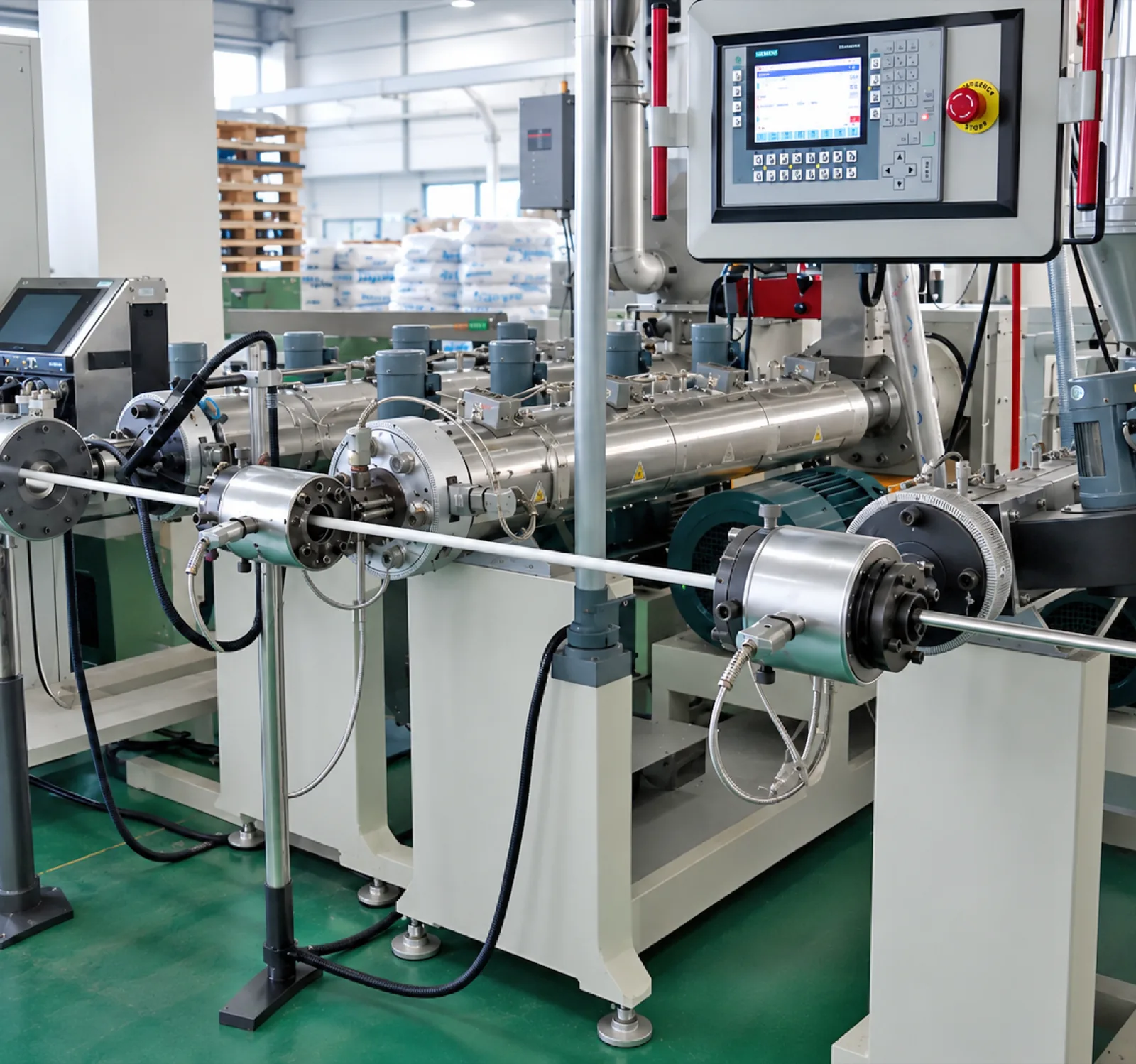
Most PEX-versus-PPR comparisons are written as a materials argument. Cross-linked polyethylene against random copolymer polypropylene. Flexibility against rigidity. Two polymers, two columns, pick one.
That framing loses money on site. On the vast majority of hot-and-cold water jobs in the 16–32 mm range, both materials will carry the water. What differs — and what actually determines whether the job finishes on schedule and passes its pressure test — is the joint. PEX and PPR are joined by two completely unrelated trades’ worth of skill:
One is a welding operation with a heat-management discipline. The other is a fastening operation with a tool-calibration discipline. They fail differently, they are inspected differently, and a crew that is excellent at one can be genuinely bad at the other.
This page takes the position that the installation method, not the polymer, should drive the choice in the small-diameter plumbing range — and works through what each method actually demands of your site, with the published parameters for both, cited to their sources. Where a number depends on a condition (diameter, SDR, ambient temperature), the condition is printed with it, because that is exactly where site errors come from.
Scope, stated up front. Our own ranges are small-bore. Our PPR PN20 pipe and fittings are catalogued in three sizes only — 20×2.8, 25×3.5 and 32×4.4 mm in 4 m lengths — with 1138 as the fitting series (75 items). Our PEX range is catalogued as two fitting systems: 2114 compression (card sleeve, S16/S20) and 2121 press/crimp (16/18/20/25/26/32 mm) (per our catalogue). If your question concerns a DN 150 riser or a DN 400 main, this page’s reasoning may still help you, but we do not make that pipe and will tell you so rather than quote it.
Before comparing crews, it is worth being precise about what each process is doing to the material, because the failure modes follow directly from it.
In socket fusion the pipe end and the fitting socket are pushed onto opposite faces of a heated tool (a male spigot and a female bush) held at a controlled temperature. The polypropylene against the tool melts to a defined depth. The parts come off, and within a very short window are pushed together to a defined depth. The melt fronts fuse, then cool. What you get is not a mechanical joint holding two parts together — it is a continuous piece of polypropylene. There is no gasket, no ring, no thread, nothing to age or relax.
Because the joint is the material, the quality of the joint is entirely the quality of the heat cycle. Under-heat and the two melt fronts never properly interpenetrate: you get a joint that holds a hydrostatic test and fails months later. Over-heat and the melt flows too far, choking the bore or producing an excessive internal bead. Miss the change-over window and the melt has already skinned over before the parts meet.
PEX starts life as polyethylene and is then cross-linked — the chains are chemically tied to one another so the material can no longer be re-melted into a homogeneous mass. That is precisely why PEX is not heat-fused like PPR: the cross-linked network is what gives it its properties, and destroying it locally would be self-defeating.
The Plastics Pipe Institute describes the three routes by which this is done, and they differ in when the cross-linking happens relative to extrusion:
The practical consequence for a buyer is simple: all of that happens in the factory, before the pipe reaches the site. The site operation is purely mechanical — deform a ring, or tighten a nut. Nothing on site changes the polymer.
You will see “PEX is 70% cross-linked” or “PEX-a is 85% cross-linked” quoted as if it were a product property. It is not. ASTM F876 sets an acceptance band: degree of cross-linking for PEX tubing material shall be from 65% to 89% inclusive (ASTM F876 §6.7, as quoted in PPI’s presentation of the AWWA C904 requirement, slide 28). Inside that band, the standard sets different minimum percentages by process — 70% by peroxides (PEX-a), 65% by electron beam (PEX-c), 65% by silane compounds (PEX-b) (ASTM F876-24 §6.7). Those are floors, not typical values. A supplier telling you their PEX-a “is 70%” is quoting you the minimum they are allowed to ship, not a performance figure.
It is also worth knowing that F876 is deliberately method-agnostic. Its scope permits tubing “crosslinked by peroxides, Azo compounds, or silane compounds in extrusion, or by electron beam after extrusion, or by other means such that the tubing meets the performance requirements” (ASTM F876-24b scope). The standard cares about performance, not chemistry route.
What we deliberately did not write here: we found no standards-body or PPI source that ranks PEX-a, -b and -c against one another on flexibility, kink resistance or “shape memory.” Those comparisons appear in manufacturer marketing from firms with a commercial position in one type. F876 imposes identical performance requirements on all three. Treat any a-versus-b-versus-c superiority claim you are shown — including from us — as unsourced unless someone puts a standard clause next to it.
This is the heart of the matter. A PPR socket weld is not “heat it until it looks shiny.” It is a five-parameter procedure, and every parameter moves with diameter.
The figures below are for heated-tool socket welding to DVS 2207-11, SDR 11, at 20 °C ambient with moderate air movement. Both the SDR and the ambient condition are part of the specification — quoting the times without them is how crews get it wrong.
| Outside dia. | Heating time | Max change-over time | Cooling: fixed | Cooling: total before load |
|---|---|---|---|---|
| 16 mm | 5 s | 4 s | 6 s | 2 min |
| 20 mm | 5 s | 4 s | 6 s | 2 min |
| 25 mm | 7 s | 4 s | 10 s | 2 min |
| 32 mm | 8 s | 6 s | 10 s | 4 min |
| 40 mm | 12 s | 6 s | 20 s | 4 min |
| 50 mm | 18 s | 6 s | 20 s | 4 min |
| 63 mm | 24 s | 8 s | 30 s | 6 min |
| 75 mm | 30 s | 8 s | 30 s | 6 min |
| 90 mm | 40 s | 8 s | 40 s | 6 min |
| 110 mm | 50 s | 10 s | 50 s | 8 min |
| 125 mm | 60 s | 10 s | 60 s | 8 min |
Source: SIMONA work.info Welding 10/2023, Table 29 (PP-H AlphaPlus / PP-H / PP-R heated-tool socket welding to DVS 2207-11), including footnote 1 for the two cooling times. Conditions: SDR 11, 20 °C ambient, moderate air movement. Our own PPR pipe range covers only the 20, 25 and 32 mm rows (per our catalogue); the rest of the table is printed because specifiers ask for it and because it shows how steeply the discipline scales.
Five things in that table deserve to be read carefully:
1. The heating iron temperature is 260 ± 10 °C for PP-H/PP-R socket welding, all diameters (SIMONA work.info Welding 10/2023, Table 29 footer and §3.2.2, per DVS 2207-11). Aquatherm, a PP-R manufacturer, states the same setpoint in Fahrenheit: socket fusion temperature “should always be around 500 °F (+/− 18 °F)” — which is 260 ± 10 °C (Aquatherm North America Installer Manual, Oct 2024). Two independent sources, same number. That is a narrow window that a cheap machine with a bimetallic thermostat and no display will not reliably hold, especially with two sets of tool faces drawing heat.
2. The change-over time is brutally short at small diameters. Four seconds at 16–25 mm to get both parts off the tool and fully home. That is not a number you meet by being careful; it is a number you meet by having the joint staged, the pipe already marked to depth, and both hands free. In a ceiling void on a ladder, it is a different proposition from a bench.
3. There are two cooling times, not one. “Fixed” is how long the joint must be held immobile. “Total” is how long before it can take load. Quoting only one is incomplete — and the gap between them is large (at 20 mm: 6 seconds versus 2 minutes). A crew that treats the 6-second figure as “done” and starts hanging the run has misread the table.
4. Ambient temperature changes the heating time substantially. This is the condition most often stripped off when the table is copied onto a site instruction sheet. Aquatherm’s manual gives two columns: above 40 °F (4.4 °C) its heating times match DVS 2207-11 exactly, but below 40 °F they are roughly 50% higher — 20 mm goes from 5 s to 8 s, 25 mm from 7 s to 11 s, 32 mm from 8 s to 12 s, 50 mm from 18 s to 27 s, 110 mm from 50 s to 75 s (Aquatherm Installer Manual Oct 2024, §2.14, Columns E and F). Welding PPR on a cold morning to the warm-weather table is a real, documented installation error.
5. Insertion depth is a separate controlled parameter from time. Aquatherm publishes fusion depth by diameter: 20 mm = 14.5 mm, 25 mm = 16 mm, 32 mm = 18 mm, 40 mm = 20.5 mm, 50 mm = 23.5 mm, 63 mm = 27.5 mm, 75 mm = 30 mm, 90 mm = 33 mm, 110 mm = 37 mm, 125 mm = 40 mm (Installer Manual Oct 2024, §2.14, Column D). Getting the time right and the depth wrong still gives you a bad joint.
A welding jig becomes mandatory above a diameter threshold. At pipe diameters ≥ 63 mm for PE-HD and PP (and ≥ 50 mm for PVDF), an appropriate welding jig must be used (SIMONA work.info Welding 10/2023, §3.2.2, per DVS 2207-1/-11/-15). Hand socket-welding a 63 mm PPR joint is outside the procedure, not merely difficult. This matters for anyone planning to weld larger PPR by hand because the small sizes went fine.
Thin-wall PPR below 63 mm is not recommended for socket welding at all. In the DVS 2207-11 table, the SDR 17 column gives no value for 16–50 mm; those cells carry a footnote reading “Not to be recommended because wall thickness is inadequate.” If you need to check what wall a given SDR actually implies at a given diameter, our pipe sizing charts set the published per-size walls out side by side. SDR 17 values begin only at 63 mm (SIMONA work.info Welding 10/2023, Table 29, footnote 2). If someone offers you cheap thin-wall PPR in small sizes for a socket-fused job, that footnote is the answer.
One further distinction worth carrying, because conflating the two ruins joints: butt fusion of PP-R uses a different, lower iron temperature than socket fusion — 410 ± 18 °F (210 ± 10 °C) for butt fusion, versus 500 °F (260 °C) for socket fusion (Aquatherm Installer Manual Oct 2024, §§2.37 and 2.42). A crew that owns one machine and one habit will get one of these wrong.
Finally, weld preparation: an external chamfer of approximately 15° is required, 2 mm wide for diameters up to 50 mm and 3 mm for larger (SIMONA work.info Welding 10/2023, §3.2.2). That is a separate tool and a separate step.
Sourcing note, in the interest of not overclaiming. We were not able to open the DVS 2207-11 document itself. The figures above come from SIMONA’s reproduction of its Tables 27–29 (marked “as at 2023”) and from Aquatherm’s own installer manual. Those two independent sources agree exactly on every heating time, which is strong corroboration — but we have not read the DVS text first-hand and are not going to pretend otherwise. If your specification is written to DVS 2207-11, buy the standard.
PEX asks for something quite different. There is no temperature, no window, no cooling time, and no weather dependency in the joint itself. What it asks for is the correct tool, correctly matched to the fitting, correctly maintained — and that the pipe be prepared and inserted to depth.
The mechanical-joint family splits into three approaches, and they are governed by different standards. This is where buyers get tangled, because “press fitting” and “compression fitting” are used loosely in the trade but are separate things in the standards. EN 1254 separates them by both connection type and pipe material:
| EN 1254 part | Covers | Relevance to a PEX/multilayer job |
|---|---|---|
| Part 2 | Compression fittings for copper tubes | Not your PEX pipe — copper only |
| Part 3 | Compression fittings for plastics and multilayer pipes | This is the one for PEX compression joints |
| Part 6 | Push-fit fittings | Tool-free, separate family |
| Part 7 | Press fittings for metallic tubes | Copper/steel press systems |
| Part 8 | Press fittings for plastics and multilayer pipes | This is the one for PEX press joints |
Source: EN 1254-2:2021 (CEN), series part listing. If a tender says “fittings to EN 1254” with no part number, it has not actually specified anything — ask which part.
A compression joint puts a nut, a ring or card sleeve and a body around the pipe; tightening the nut compresses the sleeve into a seal. It is the tool-lightest option — typically two spanners. It is also generally serviceable: a compression joint can be undone and remade, which is why it survives in service risers and where future access matters. Compression bodies in this family are usually machined from brass, which is why they sit alongside our brass fittings and valves rather than with the plastic mouldings.
EN 1254-2 gives a sense of the family’s design intent for copper: fitting ends from 6 mm to 108 mm nominal, designed for a service lifetime up to fifty years, in type A (non-manipulative, with sealing elements) and type B (manipulative, without) (EN 1254-2:2021 scope).
For plastic and multilayer pipe, the numbers are more modest and this is a genuine selection criterion, not a detail. Giacomini’s R560/R187 compression fittings, declared compliant with EN 1254-3, are rated 5–110 °C, 10 bar, sizes 16×2 to 32×3 mm (Giacomini R560AM datasheet). Compare that with a metal press system: Viega ProPress copper states a maximum operating pressure of 300 psi, applying to general operation as well as pressure transients (Viega ProPress Installation Manual IM-PP 724607, §2.5.8). Those are different classes of product for different duties. Do not let a catalogue photograph persuade you they are interchangeable.
Torque: we looked for a generic torque figure in Nm for compression fittings on plastic/multilayer pipe and did not find one we could cite. Neither the EN 1254-2/-3 scope pages nor the Giacomini EN 1254-3 datasheet publishes a torque table. Torque is manufacturer- and size-specific. We found no citable public figure — follow the fitting maker’s stated torque and nothing else. Anyone quoting you a universal number for this is guessing.
A press joint is made by a powered or manual tool that deforms a ring or the fitting body radially onto the pipe. It is fast, repeatable and does not depend on operator feel in the way a torque-controlled joint does — which is exactly why large contractors like it.
The critical insight for site management is that press connections are depth-controlled, not torque-controlled. The governed parameter is how far the tube goes into the fitting before pressing. Viega publishes minimum insertion depths for ProPress copper (no-stop couplings): 1/2″ = 19 mm, 3/4″ = 23 mm, 1″ = 23 mm, 1-1/4″ = 26 mm, 1-1/2″ = 37 mm, 2″ = 40 mm, 2-1/2″ = 43 mm, 3″ = 50 mm, 4″ = 60 mm, and requires that the tube be deburred inside and outside before pressing (IM-PP 724607, Table 1 and §4.7). That is a copper system rather than a PEX one, but it illustrates the discipline the whole press family runs on: mark the depth, check the depth, then press.
It also illustrates the parameter that catches people out on press systems generally. Operating limits are set by the sealing element, not the metal. On Viega ProPress, the same fitting body carries three different ratings depending on the elastomer: EPDM 0° to 250 °F (−18° to 120 °C), the standard for potable water and hydronic; FKM 14° to 284 °F (−10° to 140 °C) for solar, district heating and low-pressure steam; HNBR −40° to 180 °F (−40° to 82 °C) for fuel oil — and HNBR cannot be installed in drinking water applications (IM-PP 724607, §§2.4.5.3–2.4.5.5). Ordering the right fitting in the wrong seal compound is a documented way to fail a potable-water sign-off.
ASTM F1960 covers cold expansion fittings with PEX reinforcing rings, nominal sizes 3/8 to 3 in., rated 100 psi (690 kPa) at temperatures up to and including 180 °F (82 °C), for potable water distribution and sealed central heating including under-floor heating (ASTM F1960-22 scope). The pipe is expanded, the fitting inserted, and the pipe contracts back onto it.
You will very often be told that F1960 expansion fittings work only with PEX-a. We are not going to write that as a fact. The F1960 scope text we read names PEX and PE-RT generally and does not name PEX-a or exclude PEX-b or PEX-c. The “shape memory” rationale behind the claim is asserted in one manufacturer’s marketing, and at least one PEX-b maker states no such fitting restriction. The correct framing is this: F1960 requires that the tubing and ring meet the standard’s performance tests, and you should consult the specific fitting maker’s listing for which tubing types they have approved. That is a product-listing question, not a standards question — and treating a marketing position as a code requirement can lose you a legitimate bid.
Now the comparison that the polymer table cannot give you.
| Site factor | PPR (heated-tool socket fusion) | PEX (press/crimp or compression) |
|---|---|---|
| Governing parameter | Temperature + time + depth (five parameters, all diameter-dependent) | Insertion depth (press) or torque (compression) |
| Key published setpoint | Iron at 260 ± 10 °C for socket fusion; 210 ± 10 °C for butt fusion — do not conflate | Maker’s jaw profile and insertion depth; maker’s torque for compression |
| Power on site | Required — fusion machine must reach and hold temperature | Manual compression needs none; battery press tools need charging only |
| Weather sensitivity of the joint | Real. Heating times ~50% higher below 4.4 °C per Aquatherm §2.14 | None documented in the joint parameters we reviewed |
| Time pressure per joint | Severe. 4–10 s change-over window; 2–8 min before load | Low. Press cycle is seconds and self-terminating; no cooling wait |
| Skill type | Process discipline — a welding mindset | Tool discipline — calibration, jaw matching, depth marking |
| Dominant failure mode | Under-fused joint that passes test and fails later; bore choked by over-melt | Unpressed joint; wrong jaw; insufficient insertion; wrong seal compound |
| Can a bad joint be spotted? | Hard — a cold weld can look identical to a good one | Easier — an unpressed fitting typically leaks immediately on test |
| Serviceable / demountable | No. The joint is the material; repair means cut and re-weld | Compression: yes. Press: no — cut out and replace |
| Consumables at the joint | None — no gasket, nothing to age | O-rings / sleeves — an elastomer in the pressure envelope |
| Applicability limit to watch | Jig mandatory ≥ 63 mm; SDR 17 not recommended below 63 mm | Sealing-element temperature range; EN 1254 part must be specified |
| Route through structure | Rigid — every direction change is a fitting and a weld | Flexible — long runs, fewer joints, fewer failure points |
Read the last row together with the “dominant failure mode” row, because that pairing is the whole argument. Every PPR direction change is another opportunity to make a cold weld that you cannot see. Every metre of PEX that bends round a corner instead of being fitted is a joint that does not exist and therefore cannot fail.
We sell both. We are still going to give you a straight answer, because a system installed by a crew that cannot make its joints is worse than no sale.
If you cannot decide, ask one question: who is inspecting the joints, and can they tell a good one from a bad one?
If the answer is a competent supervisor who watches fusion cycles, PPR is excellent and its monolithic joint is a genuine long-term advantage. If the answer is “the pressure test will find it,” choose PEX — because a pressure test on plastic pipe reliably finds an unpressed mechanical fitting, and does not reliably find an under-fused socket weld. That asymmetry, more than any property in a polymer datasheet, is why we push mixed-labour and retrofit projects towards mechanical joints.
Two real limits, stated because you will find out anyway. Both are limits of range and of published data — not a policy of withholding numbers we hold.
Our pressure pipe stops at Φ110, and our PPR stops at 32 mm. The PPR PN20 pipe range is 20×2.8, 25×3.5 and 32×4.4 mm only; the PEX systems run 16–32 mm across 2114 compression (S16/S20) and 2121 press/crimp (16/18/20/25/26/32 mm) (per our catalogue). We cannot supply a DN 150–400 main and will not pretend to. If your scope includes both branch pipework and large mains, we can serve the branch scope and you will need another source for the mains — that is a straightforward thing to say at enquiry stage rather than at container-loading stage.
PEX is the one range where we genuinely cannot give you a wall thickness. This is worth stating precisely, because it is easy to mistake for a general evasion and it is not one. For PPR we publish wall thickness on every size we make: 20×2.8, 25×3.5 and 32×4.4 mm. Our other systems carry a complete per-size wall table too — UPVC/CPVC 806 runs Φ20×2.0 through Φ110×7.2 mm across nine sizes, HDPE Φ20×2.3 through Φ110×10.0 mm across nine, PVC 902 drainage Φ32×1.6 through Φ110×2.2 mm across nine. The PEX range is the exception: our catalogue lists the 2114 and 2121 systems by diameter only, without a wall thickness or a pressure class against them. That is a real gap in our published data, it applies to PEX alone, and we will ask the factory rather than back-calculate a figure from an SDR formula and present it as product data.
The same caution applies to PEX temperature and pressure class: our catalogue does not state one, so we will get it from the factory in writing rather than quote a class we cannot show you. A figure circulating that suggests PEX withstands 450 °C is not one we will repeat, because we cannot substantiate it and it is not consistent with the standards we can read (ASTM F1960’s rating, for example, is 100 psi at up to 180 °F / 82 °C).
Before you commit either way, answer these. Each one maps to a documented parameter above rather than a preference.
Is PEX or PPR stronger? Wrong question at this diameter range. Both are made to standards that impose performance requirements, and both will carry potable hot and cold water within their rated conditions. The difference that decides projects is joint method, not polymer strength. If someone answers this question with a single number, ask them what condition it was measured at.
Can I heat-fuse PEX like PPR? No. PEX is cross-linked — the whole point of the cross-linking is that the material can no longer be re-melted into a homogeneous mass. PEX is joined mechanically: press/crimp, compression, or cold expansion to ASTM F1960.
Which is faster to install? In our experience — and this is experience, not a sourced measurement — PEX is faster on routes with many direction changes, because bending replaces joints entirely, and because there is no cooling wait before load. PPR can be very fast on short straight bench-prefabricated runs. We have not seen a credible published time-and-motion study for either and are not going to invent one.
Is PPR’s welded joint really better than an O-ring? It has one clear structural advantage: nothing in the joint ages, because there is no separate sealing element. That is a genuine long-life argument. The counterweight is that a defective weld is much harder to detect than a defective mechanical joint. Which risk you prefer depends on your inspection regime.
Do you supply the fusion machines or press tools? Tooling availability: Coming soon — ask at enquiry and we will tell you what we can and cannot ship with an order.
What is the price difference between PEX and PPR for my job? Pricing, MOQ and lead time: Coming soon — quoted per enquiry against your actual size and quantity schedule. We do not publish price lists, and any figure you see for our range that is not on a quotation from us did not come from us.
Which PEX type do you supply — a, b or c? Ask us for the specific product and we will answer in writing. What we will not do is tell you one type outperforms another on flexibility or kink resistance, because ASTM F876 imposes identical performance requirements on all three and we found no standards source ranking them.
Are your certificates available? We hold SKZ, CE, WRAS, DVGW, SGS, ISO 9001 and ISO 14001. Certificate numbers: Coming soon. Ask and we will send what exists rather than describe what does not.
Is IFANNova pipe made in France? No. IFANNova is a French brand; manufacturing is by Zhuji Fengfan Piping in Zhuji, Zhejiang — 30+ years, 1000+ employees, 118+ countries, 120,000 m². We would rather you heard that from us than discovered it later.
If you tell us diameters and quantities, we can quote pipe. If you also tell us who is installing it, in what ambient temperature, at what height, and who inspects the joints, we can tell you which of our two systems will actually survive your site — including when the answer is that neither of our ranges covers your scope. Send us the site conditions with your enquiry and you will get that answer in writing.
PP-R belongs indoors, PE in the ground.
Specify the wrong pipe for a hot-water or process line and it doesn’t just leak — it softens, creeps and fails at the joint under load.
ISO 15874-2:2013 has no colour clause: colour is not a PP-R grade.