Every page-1 result argues these two materials on adjectives. This one argues them on the two scope clauses, the two design coefficients and the two derating annexes, and prints both wall tables at the same outside diameters.
Ask which pipe belongs in an irrigation trench and a standard number arrives within two sentences: HDPE meets ISO 4427, uPVC meets ISO 1452. Open the scope clauses and irrigation is in neither. ISO 4427-2:2019 lists drinking water, raw water, pressurised sewerage, vacuum sewers and water for other purposes. ISO 1452-2:2009 lists buried mains, above-ground conveyance and pressurised drainage. Irrigation lands in the catch-all in both, so the duty statement is yours to write.
Here is the short answer for a buried line at or below 110 mm outside diameter. Specify uPVC when the route is straight, the crew cements sockets, and you want the most bore for the pressure class: at PN 16 it leaves 9.0 percent more flow area than PE at 50 mm and 15.7 percent more at 110 mm. Specify HDPE when the ground moves, the route bends, or a joint will one day be dug up and remade wet. Heat does not decide it. At 40 °C the two derate almost identically, 0.74 against 0.71.
Key Takeaways
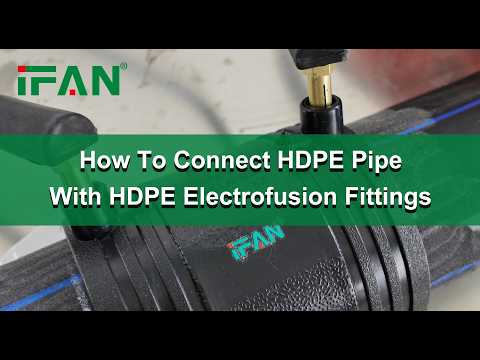
One look at what a polyethylene joint actually involves, from IFAN Group’s own bench run, opened at the 45-second mark. Watch the order — scrape, clean, mark the depth, energise — and the pass condition at the end.
The two documents behave differently past the title. ISO 4427-2:2019 covers buried and above-ground installation alike, caps the system at 25 bar allowable operating pressure, fixes 20 °C as the reference temperature, and leaves the application open with water for other purposes. ISO 1452-2:2009 also covers buried mains and above-ground conveyance. It is more explicit about temperature: the scope names 25 °C cold water for human consumption and general purposes, then specifies pipes for water and waste water up to 45 °C, with Figure A.1 applying in between.
For a farm or estate network that matters. An irrigation line carries untreated water, often sits in ground reaching 40 °C, and is usually specified from boilerplate. Write the duty yourself: medium, continuous operating pressure, maximum water temperature, and whether any of the run sees sunlight.
Most comparisons of these two materials argue on adjectives. Every row below resolves to a clause or a table in one of the two standards, so you can check it rather than believe it. The jointing row quietly decides the others. ISO 1452-2 dimensions its pipe ends for solvent-cemented sockets and ring seals. The ISO 4427 series tests butt-fusion and electrofusion assemblies and mechanical joints, and it recommends a wall of at least 3.0 mm before electrofusion is used at all.
| Decision axis | HDPE (PE 100) | uPVC (PVC-U) | Best for |
|---|---|---|---|
| Design stress at 20 °C | 8.0 MPa, from MRS 10.0 and coefficient 1.25 | 12.5 MPa above dn 90, from MRS 25 and coefficient 2.0 | uPVC, on wall used per bar carried |
| Bore at the same OD and PN 16 | Narrower: 40.8 mm at dn 50, 90.0 mm at dn 110 | Wider: 42.6 mm at dn 50, 96.8 mm at dn 110 | uPVC, on flow per metre purchased |
| Pressure retained at 40 °C | Factor 0.74, from an informative annex | Factor 0.71, from a normative annex | Close call; PE by three points |
| Jointing method the standard dimensions | Butt fusion, electrofusion, mechanical joints | Solvent-cemented sockets and ring seals | HDPE where a joint must be remade wet |
| Route bends and coiling | Coiled to a minimum 18 dn internal diameter | Straight lengths; our 806 line ships at 4 m | HDPE where the route will not run straight |
| Size available from our range | Φ20 to Φ110 | Φ20 to Φ110 | Neither, above Φ110 |
Source: ISO 4427-1 and ISO 4427-2; ISO 1452-2:2009 Tables 2 and A.1 and Annex A; IFANNova catalogue range data, September 2026.
PN 16 means sixteen bar in both materials, so buyers treat the two pipes as interchangeable. Inside the wall they are not. Design stress is minimum required strength divided by a design coefficient, and the standards set both numbers differently. PE 100 carries an MRS of 10.0 MPa and ISO 4427-1 applies a coefficient of 1.25, giving 8.0 MPa. PVC-U pipe material carries an MRS of at least 25 MPa, and ISO 1452-2 applies 2.5 up to dn 90 and 2.0 from dn 110, giving 10.0 MPa and 12.5 MPa.
The consequence sits in ISO 1452-2 Table A.1, worth knowing before a PN goes into a tender. Up to dn 90, PN 16 in PVC-U is pipe series S 6.3, equivalent to SDR 13.6. Above dn 90 the same PN 16 becomes series S 8, or SDR 17: the class label holds still while the wall steps thinner. PE has no equivalent step. SDR 11 is PN 16 in PE 100 and only PN 12.5 in PE 80.
| Outside diameter (mm) | PE 100 wall, SDR 11 (mm) | PVC-U wall, PN 16 (mm) | PE bore (mm) | PVC-U bore (mm) |
|---|---|---|---|---|
| 50 | 4.6 | 3.7 | 40.8 | 42.6 |
| 63 | 5.8 | 4.7 | 51.4 | 53.6 |
| 90 | 8.2 | 6.7 | 73.6 | 76.6 |
| 110 | 10.0 | 6.6 | 90.0 | 96.8 |
Source: ISO 4427-2 Table 2 (SDR 11) and ISO 1452-2:2009 Tables 2 and A.1. Bore is outside diameter less twice the wall. Verified 14 September 2026.
| Outside diameter, dn (mm) | PE 100 wall, SDR 11 (mm) | PVC-U wall, PN 16 (mm) |
|---|---|---|
| 20 | 2.0 | 1.5 |
| 25 | 2.3 | 1.9 |
| 32 | 3.0 | 2.4 |
| 40 | 3.7 | 3.0 |
| 50 | 4.6 | 3.7 |
| 63 | 5.8 | 4.7 |
| 75 | 6.8 | 5.6 |
| 90 | 8.2 | 6.7 |
| 110 | 10.0 | 6.6 |
Turn those bores into flow area and the gap is 9.0 percent at dn 50 and 15.7 percent at dn 110. On a sub-main sized by friction loss rather than by velocity, that is the difference between one diameter and the next one up, and the next one up costs money in pipe, fittings and trench. Our HDPE diameter, wall and SDR chart carries the full dimensional set behind these four rows.
| Nominal size | PE 100, SDR 11 (mm²) | PVC-U, PN 16 (mm²) |
|---|---|---|
| dn 50 | 1307 | 1425 |
| dn 110 | 6362 | 7359 |
The claim that uPVC cannot handle a hot climate is repeated across this search result; the standards do not support it. ISO 4427-1 Annex A gives PE 80 and PE 100 a pressure reduction coefficient of 1.00 at 20 °C, 0.87 at 30 °C and 0.74 at 40 °C. ISO 1452-2 Annex A derates between 25 °C and 45 °C, and its own worked example puts the factor at 0.71 at 40 °C: a PN 12.5 pipe is then allowed 8.88 bar in continuous use.
Three percentage points separate the two on the axis a Gulf or Sahel buyer worries about most. What separates them is where the number lives. The PVC-U derating annex is normative, so applying it is a requirement of the standard. The PE annex is informative and points to ISO 13761. One boundary is worth reading rather than quoting. ISO 1452-2 names 25 °C for cold water including human consumption, and 45 °C for conveyance of water and waste water, and its clause never says in terms which of those two duties the 25 °C to 45 °C derating band carries with it. On a drinking-water scheme running warm, ask your specifier and the compound supplier.
Both materials are sold on a fifty-year life, and the figure has a narrow meaning almost nobody states. ISO 4427-1 defines the lower confidence limit of predicted hydrostatic strength as the 97.5 percent lower confidence limit at 20 °C for 50 years under internal water pressure. Minimum required strength is that value rounded down. The prediction comes from ISO 9080:2012, a method for extrapolating long-term hydrostatic strength statistically.
So the classifications everyone quotes are extrapolations. PE 100 means an MRS of 10.0 MPa, PE 80 means 8.0 MPa, and PVC-U pressure material at least 25 MPa. Each is a curve fitted to laboratory data and projected to half a century at 20 °C. Nobody has watched a buried line for fifty years at 40 °C ground temperature. Treat it as the design basis that sets the wall, then design for what actually ends buried lines early: surge, third-party strike, and joints made badly.
Commodity pressure pipe is resin plus conversion, so the first honest question is how much polymer each pipe contains. Polymer cross-section is pi times wall times outside diameter less wall. At Φ110 the PE section is 3,142 mm² against 2,325 mm² for the uPVC, making the PE pipe 35 percent more material by volume. Then apply the density limits the standards write: PE compound at least 930 kg/m³, PVC-U pipe between 1,350 and 1,460 kg/m³.
The result inverts the claim you will read everywhere else. At Φ110 the PE pipe weighs at least 2.92 kg per metre while the uPVC weighs 3.14 to 3.39 kg per metre. At Φ50 the comparison is 0.61 against 0.73 to 0.79. The uPVC pipe is heavier at every shared diameter, because it is half again as dense and the thinner wall does not recover that. Freight does not separate them either: at equal outside diameter both occupy the same bounding volume, and a container cubes out long before it weighs out. The same arithmetic is worked through in our SDR 11 against SDR 17 cost analysis.
Mass is not price, and this is where most comparisons quietly cheat. PE 100 resin and PVC-U compound do not cost the same per kilogram, and the ratio moves with two feedstock markets. We publish no prices, MOQ or lead times until they are confirmed internally, and would rather leave the line blank than invent a range.
| Nominal size | PE 100 (floor, 930 kg/m3) | PVC-U (floor, 1350 kg/m3) |
|---|---|---|
| dn 50 | 0.61 | 0.73 |
| dn 110 | 2.92 | 3.14 |
Our uPVC 806 line is a PN 16 system with 1806 fittings, and its published walls sit exactly on the ISO 1452-2 PN 16 series from Φ32 to Φ90. At Φ20 and Φ25 the pipe carries more wall than the series requires, 2.0 mm against 1.5 mm and 1.9 mm. At Φ110 the standard’s PN 16 series drops to 6.6 mm and our pipe stays at 7.2 mm: above the class minimum, below the 8.1 mm the next class would need.
| Outside diameter (mm) | IFANNova HDPE wall (mm) | IFANNova uPVC 806 wall (mm) | ISO 1452-2 PN 16 minimum (mm) |
|---|---|---|---|
| 20 | 2.3 | 2.0 | 1.5 |
| 25 | 2.3 | 2.0 | 1.9 |
| 32 | 3.0 | 2.4 | 2.4 |
| 50 | 4.6 | 3.7 | 3.7 |
| 75 | 6.8 | 5.6 | 5.6 |
| 90 | 8.2 | 6.7 | 6.7 |
| 110 | 10.0 | 7.2 | 6.6 |
Source: IFANNova catalogue wall data, both lines published, against ISO 1452-2:2009 Tables 2 and A.1. September 2026. No PN column is shown for the HDPE line.
The HDPE line is where we have to be blunt. Its published walls sit on the SDR 11 series from Φ25 upward, matching the ISO 4427-2 minimum wall at every one of those sizes, with only Φ20 carrying extra at 2.3 mm. We will not turn that into a pressure class. SDR 11 is PN 16 in PE 100 and PN 12.5 in PE 80, so the class follows the compound grade, which is still awaiting internal confirmation. The pipe body is marked GERMANY STANDARD DIN 8077/8078, which are polypropylene standards rather than polyethylene ones, so we transcribe the marking and claim no conformity.
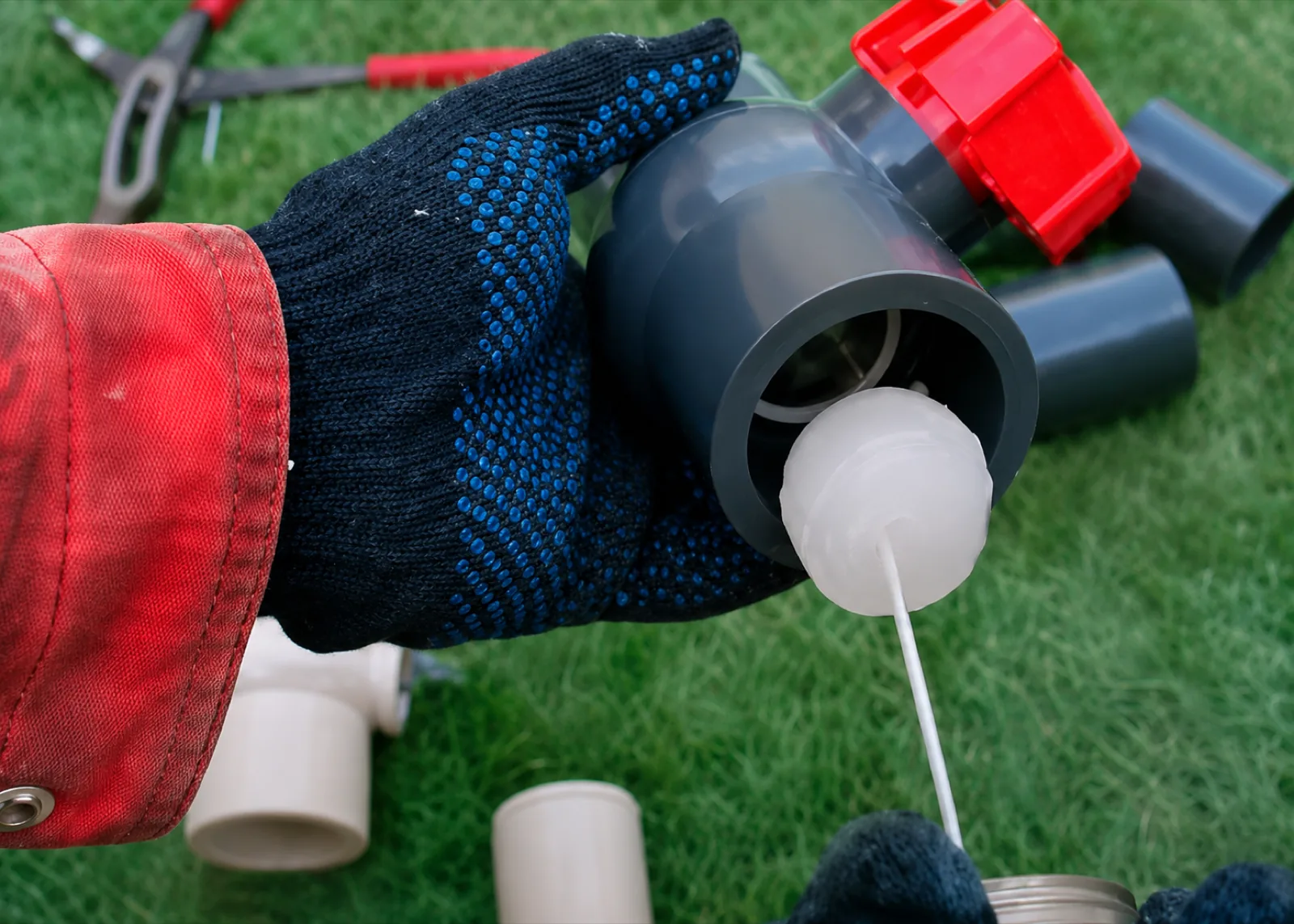
One practical note from the same table. At Φ20 and Φ25 the 2.3 mm wall sits below the 3.0 mm that ISO 4427-2 recommends for electrofusion, so compression is the jointing answer at the small end on engineering grounds, not cost. The full range sits in our HDPE pipe and compression fittings catalogue, and the uPVC side in the UPVC and CPVC 806 fittings range.
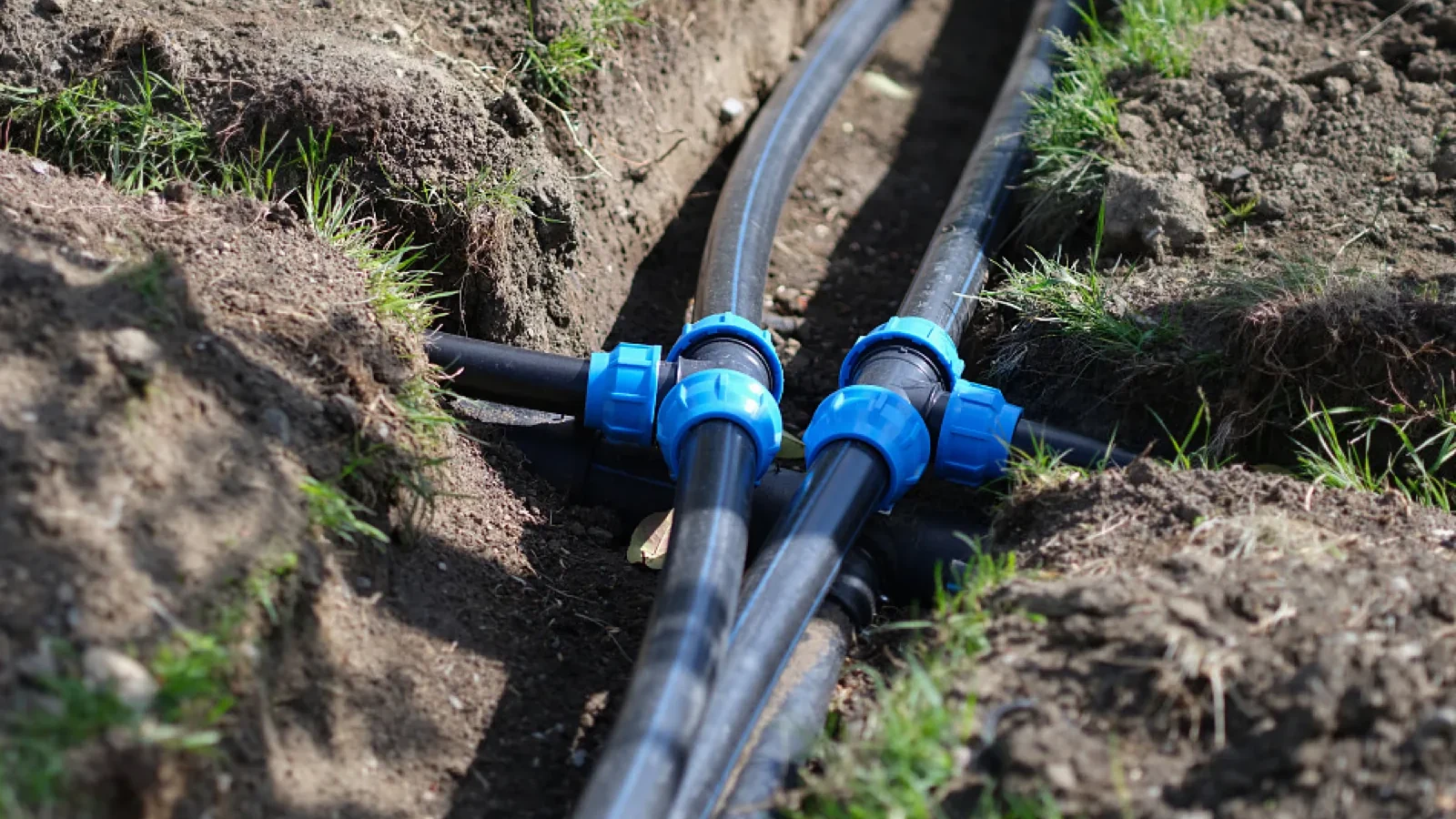
Choose by duty rather than by material, because the honest answer flips three times across one network. On a straight buried sub-main between 63 mm and 110 mm, where the trench is graded and the crew cements sockets daily, uPVC wins on bore per bar: up to 15.7 percent more flow area at the same class. Where the ground settles, the route bends, or a section will be re-made later, the polyethylene system wins. A compression joint goes back together wet, and a cemented socket needs a dry, clean, cured bond.
| Duty on the network | Choose | Why | Not if |
|---|---|---|---|
| Straight buried sub-main, Φ63 to Φ110 | uPVC 806 | Up to 15.7 percent more bore at the same class | The route bends or the ground settles |
| Buried line across moving or stony ground | HDPE | ISO 4427-2 coils it to 18 dn internal diameter | Your crew only cements and has no compression tooling |
| Section that will be dug up and re-made | HDPE | Mechanical joint, remade wet with no solvent cure | Your specification requires fusion joints throughout |
| Drinking-water duty running above 25 °C | Ask before you specify | ISO 1452-2 does not say whether potable duty extends past 25 °C | Non-potable line; ISO 1452-2 derates to 45 °C, PE only to 40 °C |
| Transmission main above Φ110 | Neither of ours | Our pressure range stops at Φ110 in both materials | No exception; we do not sub-contract the size |
Source: bore from Table 2; jointing from ISO 1452-2:2009 clauses 6.6 and 6.7 and the ISO 4427 series; range from IFANNova catalogue data, September 2026.
Send a supplier four things and the two quotations become comparable. Without the temperature, the derating is guesswork.
If part of the network sits above 110 mm, say so at the start, because that is where our range ends. The wider picture sits in our six-system material selection matrix, and network tiering in the tier-by-tier irrigation fittings specification.
The risk here is not picking the weaker material. Both are sound buried at the diameters an irrigation network uses, and their 40 °C derating factors are three points apart. The risk is inheriting a specification that names a standard which never named your application, quotes a fifty-year figure as though it were a warranty, and leaves the jointing method to whoever turns up with a trencher. Tell us the diameters, the pressure and the climate, and we will answer against the two wall tables above.
Is HDPE better than PVC for water lines?
Not as a general rule. PVC-U leaves more bore at the same outside diameter and pressure class, 15.7 percent more flow area at dn 110. HDPE handles ground movement and remade joints better. Choose by duty, not by material.
What are the disadvantages of using HDPE pipe?
Three that are measurable. It needs 35 percent more polymer section at Φ110 for the same class, it leaves a narrower bore, and below a 3.0 mm wall ISO 4427-2 does not recommend electrofusion, so small sizes need compression fittings.
Are HDPE and poly pipe the same thing?
Not reliably. The standards classify polyethylene by minimum required strength as PE 40, PE 63, PE 80 and PE 100, and the class changes what a wall is rated for. SDR 11 is PN 16 in PE 100 and PN 12.5 in PE 80. Ask for the designation.
How long will HDPE pipe last underground?
The fifty-year figure is an ISO 9080 statistical extrapolation of pressure-test data to 20 °C and 50 years, rounded down to an MRS class. It is a design basis for setting the wall, not an observed or warranted service life.
Can HDPE pipe be joined to uPVC pipe?
Only through a mechanical transition. The two standards dimension different joints: ISO 1452-2 specifies sockets for solvent cementing and ring seals, while the ISO 4427 series covers fusion and mechanical joints. The PE standard dimensions no cemented socket.
What size irrigation main can you supply?
Both pressure lines run Φ20 to Φ110 outside diameter, with 603 and 604 compression fittings on the HDPE side and 1806 fittings on the uPVC side. Above Φ110 we do not make the pipe and do not sub-contract it.