Installation & Jointing · guide
Ductile iron OD by DN (DN 100 = 118 mm) against 110 mm PE and PVC-U, and which stepped coupling, flange or gasket actually fits the tie-in.
A DN 100 ductile-iron pipe to ISO 2531:2009 has a spigot outside diameter of 118 mm. A 110 mm PE or PVC-U pipe is 8 mm smaller, so it cannot seal in the ductile-iron socket. The parts that close that gap are an EN 14525:2022 wide-tolerance coupling or flange adaptor whose gripping range covers both pipes, or a flanged transition drilled to the iron flange’s PN.
US mains use a different series: a 4 in ductile-iron pipe to AWWA C151/A21.51-23 is 4.80 in (121.9 mm) outside, and C900-22 PVC made to the cast-iron OD regime shares it. Either way, the gasket must suit drinking water and PE needs a stiffener and restraint.
Key Takeaways
Waterworks Training names the parts of a flange coupling adapter, one of the tie-in routes below: body, flange gasket, coupling gasket, end ring and bolts.
Ductile-iron pipe is made to a fixed outside diameter, DE, so spigots and sockets interchange. ISO 2531:2009 sets the rule: the positive tolerance is + 1 mm and applies to all pressure classes of pipes. The negative tolerance is left to national standards, and EN 545:2010 fills it in.
Pressure class moves the wall inward. At DN 100, a C40 pipe has a 4.4 mm wall and a K9 pipe has 6.0 mm, and both are 118 mm outside. The class on the main sets its pressure; the DN alone sets the OD the adapter must grip.
| Iron DN | Iron DE (mm) | Iron field range (mm) | Nearest plastic OD (mm) | Verdict |
|---|---|---|---|---|
| DN 80 | 98 | 95.3 to 99 | 90 (8 mm smaller) | Wide-tolerance coupling or flange |
| DN 100 | 118 | 115.2 to 119 | 110 (8 mm smaller) | Wide-tolerance coupling or flange |
| DN 150 | 170 | 167.1 to 171 | 160 (10 mm smaller) | Wide-tolerance coupling or flange |
| DN 200 | 222 | 219 to 223 | 225 (3 mm larger) | Check both ranges; plastic is the bigger side |
Source: DE from McWane’s ISO 2531:2009 C-class catalogue; field ranges from Electrosteel’s EN 545:2010 user guide (v2.2); plastic ODs from ISO 4427-2:2019 Table 1. Differences are our arithmetic, 30 September 2026.
For contractors tying a 20 to 110 mm polyethylene line into an iron main, our HDPE pipe and fittings range lists the plastic side by OD. We make no iron parts.
In the US, the PVC Pipe Association states that AWWA C900 PVC uses cast-iron pipe size ODs, compatible with both cast-iron and ductile-iron pipe (CIOD, also called DIOD or DIPS). AWWA C151/A21.51-23 runs 4 in = 4.80 in (121.9 mm) and 6 in = 6.90 in (175.3 mm); 4 in iron pipe size (IPS) PVC or PE is 114.3 mm.
An iron socket gasket is built for a spigot inside the DE band above. A 110 mm PE pipe at its largest, 110.7 mm, is still 4.5 mm below the smallest DN 100 iron spigot, 115.2 mm. For 110 mm PVC-U the band is 110.0 to 110.4 mm under ISO 1452-2:2009, so the shortfall is larger. No socket gasket is dimensioned for that gap.
| Iron DN vs nearest PE size (mm) | Iron spigot, field minimum (mm) | Iron spigot, field maximum (mm) | PE pipe, mean OD minimum (mm) | PE pipe, mean OD maximum (mm) |
|---|---|---|---|---|
| DN 80 vs 90 mm | 95.3 | 99 | 90.0 | 90.6 |
| DN 100 vs 110 mm | 115.2 | 119 | 110.0 | 110.7 |
| DN 150 vs 160 mm | 167.1 | 171 | 160.0 | 161.0 |
| DN 200 vs 225 mm | 219 | 223 | 225.0 | 226.4 |
ISO 2531:2009 expects this case: for pipelines whose external diameters do not follow its DE table, the manufacturer’s guidance should be followed as to the appropriate means of interconnection, and its example is adaptors.
The US PVC Pipe Association’s 2020 brief gives one exception: a CIOD PVC spigot can go into a DI bell once its bevel is removed and it is bottomed in the bell, ignoring its insertion line. A DI spigot in a PVC bell is not recommended: field-cut iron varies in OD.
Scenario 1: 110 mm PE line into a DN 100 EN 545:2010 main. Use a wide-tolerance coupling, stepped (reducing) if one range will not span both pipes. Read the gripping range on each side: the iron side must cover 115.2 to 119 mm and the PE side 110.0 to 110.7 mm. EN 14525:2022 covers these couplings for PVC-U, PVC-O, PE and iron, DN 40 to DN 800, PFA up to 16 bar, 0 to 25 °C (higher temperatures only with pressure derating). It sets requirements for restrained and non-restrained versions, so name one on the order.
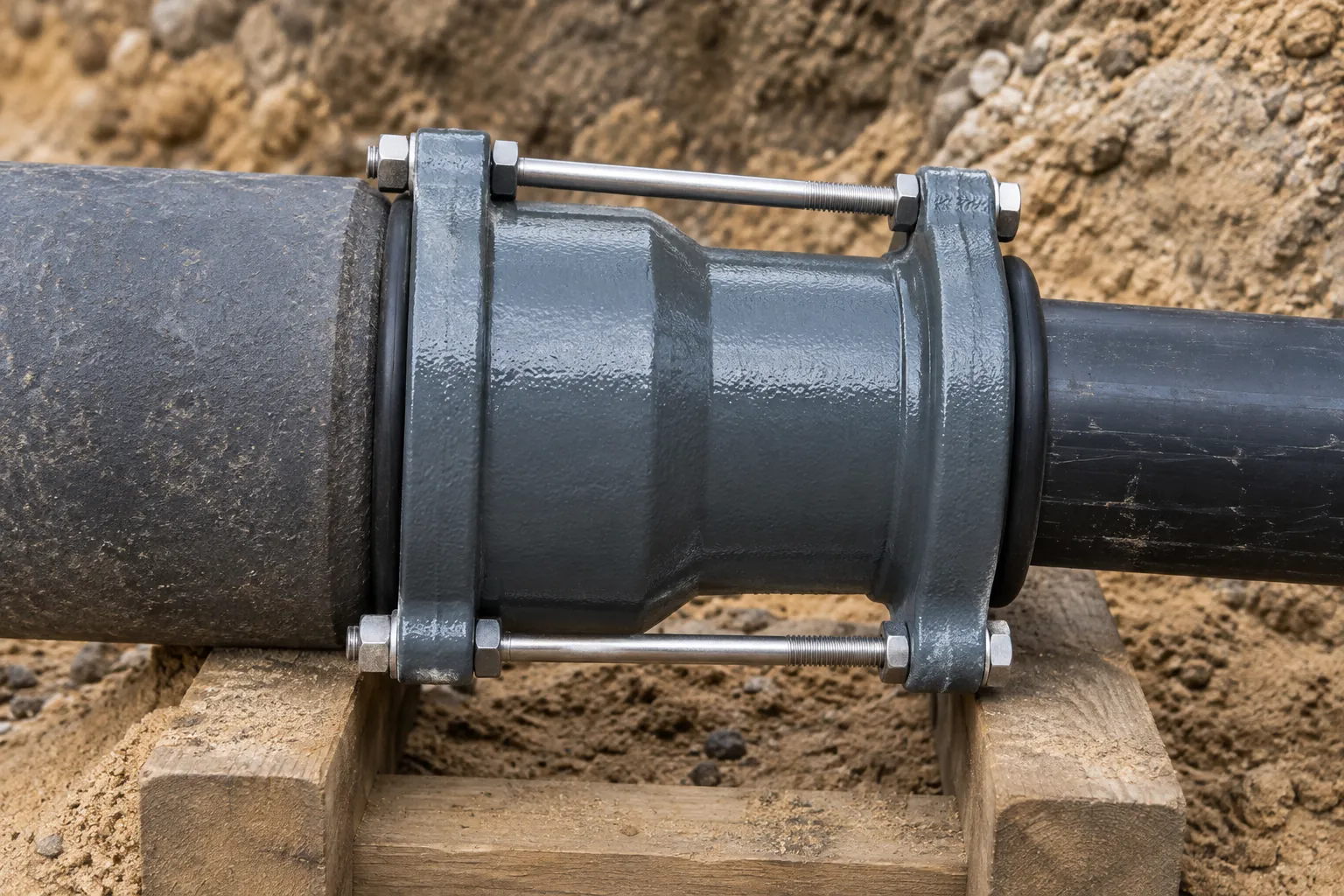
Scenario 2: 90 mm PVC-U onto a DN 80 flanged tee. Use the flange. A DN 80 PN 10 iron flange to EN 1092-2:2023 carries 8 M16 bolts on a 160 mm bolt circle; at DN 100 it is 8 M16 bolts on a 180 mm circle. The plastic-side flange must match that drilling.
Scenario 3: a US 4 in DI main. CIOD C900-22 PVC shares the 4.80 in OD, and HDPE comes in DIPS sizes for AWWA C111/A21.11-23 mechanical-joint fittings. PPI TN-36 lists MJ adapters in IPS and DIPS sizes that seal against leakage and restrain against pullout. One iron maker notes that IPS PVC needs special transition gaskets.
| Tie-in route | Covers | Check before ordering | Best for |
|---|---|---|---|
| Wide-tolerance coupling, straight or stepped (EN 14525:2022) | Plain iron end to plain plastic end | Grip range per side; restrained or not; stiffener for PE | Cut-in on a buried metric main |
| Flange adaptor or stub flange (EN 1092-2:2023 drilling) | Iron flanged tee, valve or spigot | Same DN and PN drilling; flange gasket | Chambers, valves, joints you will open again |
| Iron-OD plastic pipe (CIOD PVC, DIPS PE) | AWWA C151/A21.51-23 bells and MJ fittings | Bevel removed; MJ adapter kit | US projects to AWWA |
| Metric plastic pushed into iron socket | Nothing | DN 80 to 150: 4.5 mm or more under the iron band | Never |
Source: EN 14525:2022 scope; EN 1092-2:2023 drilling from McWane’s PN 10 table (2023 text not read); AWWA C151/A21.51-23, C900-22, C111/A21.11-23; PPI TN-36-2006; PVC Pipe Association briefs. Compiled 30 September 2026.
Gasket class. EN 681-1:1996+A3:2005 sets separate requirements for seals in cold potable water supply (up to 50 °C), hot water (up to 110 °C) and drainage. A potable main takes the cold potable water grade, and ISO 2531:2009 clause 4.1.4 adds the national drinking-water rules of the country of use. PPI TN-36 says gaskets must be used for connections between polyethylene and non-polyethylene flanges.
Stiffener. One ductile-iron maker says an MJ adapter or an internal stiffener will be required in the HDPE pipe, sized to its ID, wall or DR. PPI TN-36 recommends one at any DI or PVC bell end, and in a one-bolt sleeve especially if the DR is more than 11.
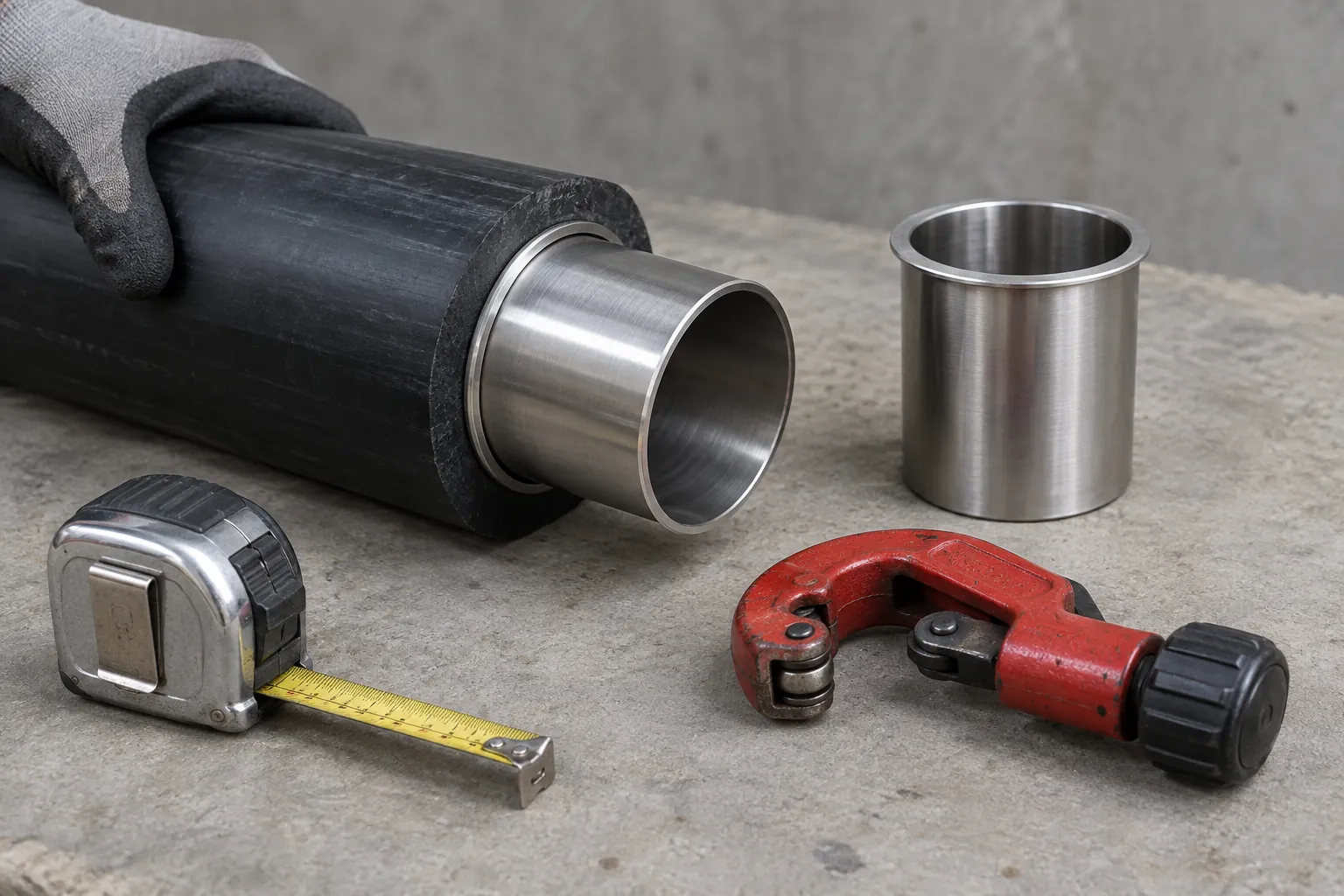
Restraint. PE expansion and contraction can pull an iron bell-and-spigot joint apart, so PPI TN-36 calls for restraint where PE meets an existing DI or PVC system. Do not swap restrainers: the same iron maker warns a DI restrainer may damage PVC pipe.
Pressure. ISO 2531:2009 classes flexible-joint pipe by PFA, so C40 means 40 bar. The allowable pressures within a pipeline system shall be limited to the lowest pressure classification of all components within the system. On a C40 main with a 16 bar coupling and PN 16 plastic, the tie-in is a 16 bar joint.
IFANNova is a French-designed, European-standard piping brand. Our pressure pipe stops at 110 mm OD and we do not make DN 150 to DN 400 mains, so our pipe meets iron at a DN 80 to DN 100 tee or main.
HDPE, 90 and 110 mm. Walls are 8.2 mm and 10.0 mm (HDPE pipe diameter chart), so 110 mm is DR 11 with a bore of about 90 mm; size the stiffener to that bore. No pressure class is stated here for our HDPE; get it in writing.
UPVC 806, 90 and 110 mm. Catalogue PN 16, walls 6.7 mm and 7.2 mm (UPVC pipe size table). The 110 mm wall is our 806 catalogue figure, not an ISO 1452-2:2009 class, so confirm its rating in writing. Pair it with a stepped coupling or with a flange from our UPVC/CPVC 806 fittings. Grooved steel instead? See grooved couplings on plastic pipe.
Lead time. We hold no lead-time figure for adapters, which we do not make. Ask the adapter supplier whether that DN and gripping range is stocked, and ask us for the pipe’s plant-departure date on the same size list.
A wide-tolerance coupling is the quickest cut-in on a buried metric main, but at DN 100 its two gripping ranges must cover 110.0 to 110.7 mm and 115.2 to 119 mm, with a stiffener and restraint. A flange costs more parts but reopens. Either route is rated at its weakest part.
118 mm to ISO 2531:2009 and EN 545:2010, whatever the pressure class. In the field the spigot can measure 115.2 to 119 mm. A 4 in pipe to AWWA C151/A21.51-23 is 4.80 in (121.9 mm).
Yes, when it is made to the cast-iron OD regime (CIOD), which is compatible with both cast-iron and ductile-iron pipe. AWWA C900-22 also includes IPS sizes; at 4 in these are 114.3 mm and need a transition gasket or coupling.
With an MJ adapter or PE flange adapter butt-fused to the pipe, or a wide-tolerance coupling with a stiffener in the PE bore. Restrain the joint, because PE movement can pull an iron bell-and-spigot joint apart.
No. The positive tolerance is + 1 mm and applies to all pressure classes of pipes; a higher class gets a thicker wall inside the same OD. At DN 100, C40 has a 4.4 mm wall and K9 has 6.0 mm.