
Buying Solvent Cement: Does the Remaining Shelf Life Cover the Job?
A sealed can can still be too old for the order you are placing. Before accepting a solvent-cement lot, establish its manufacturer-confirmed validity date, expected receipt date and last planned use. If the project extends beyond that validity, arrange a fresher lot or staged supply; do not restart the shelf-life clock on delivery. A date that fits the programme still leaves storage history, condition and product compatibility to be checked.
Key takeaways
- Manufacture date, purchase date and expiry date answer different questions.
- Decode the exact manufacturer’s marking; similar five-digit codes can mean different things.
- Compare the actual lot’s validity with the project’s final consumption, not merely its arrival.
- A closed container does not prove that its storage conditions were suitable.
- Keep date acceptance, product suitability and installation release as separate decisions.
- Do not add thinner or change a label to rescue unsuitable stock.
Why the delivery date is the wrong starting point
“New delivery” describes a movement of stock. It does not describe when that stock was manufactured. A supplier may dispatch an unopened batch promptly while much of its rated life has already elapsed in storage. The distinction matters when a maintenance department buys for several shutdowns, or when a contractor wants all consumables available before a project begins.
The purchasing question is therefore more precise than whether the cement is expired today. Will the identified material remain within its applicable validity through the work for which it is being bought? An order can meet the first condition and fail the second. Closing that gap before acceptance gives the parties time to agree a different lot, a smaller first release or a later delivery.
This is a real procurement-document issue. In an Eskom Hendrina plant-consumables procurement document, item 160280 requests PVC solvent cement with shelf-life, manufacture and expiry information. The document is a historical purchasing example, not a current tender invitation or a rule for your order. Its useful lesson is that these dates belong in the delivery evidence, alongside the product identity.
Do not convert that lesson into a universal requirement such as “every cement must have twelve months remaining.” The appropriate purchasing condition depends on the actual product, the project programme and the parties’ agreement. A short job and a phased maintenance programme need different stock plans, even if both use the same cement.
Identify the product before decoding the stamp
Start with the full product name, manufacturer, regional formulation and container marking. Preserve a legible photograph of the whole label and its date or batch code. The code is useful only when the interpretation belongs to that product. A familiar pattern is not enough to establish a manufacture date.
Oatey’s shelf-life explanation uses the example 19095 for April 5, 2019: the first two digits identify the year and the remaining three identify the day of that year. Its explanation starts the rated life at manufacture, rather than purchase. That is a named manufacturer’s example, not an instruction for every five-digit stamp.
The distinction becomes visible in E-Z Weld’s own date-code example. It interprets 00422 as the fourth day of 2002, batch 2. Applying the Oatey pattern to that code would misread its structure. Obtain the applicable maker’s interpretation when the brand, code format or century is uncertain; retain the response with the batch record.
Keep manufacture and batch references separate if the label does. A batch identifier supports traceability but is not automatically a date. Likewise, the presence of a calendar-like number does not establish whether it is a packing date, manufacture date or expiry date. Recording what the supplier actually confirms prevents an assumption from becoming the next buyer’s “verified” record.
Product-specific shelf life also matters. Manufacturer-hosted sheets for Weld-On 795, dated April 2009, and 905ECO, dated March 2018, state three and four years respectively in tightly sealed containers. These historical named-product sheets demonstrate why a single generic PVC-cement life is unsuitable. They do not establish the current label, formulation or supply condition of your proposed lot.
Turn a lot date into a project decision
Use the manufacturer’s confirmed expiry or validity endpoint for the actual product, rather than calculating from a generic internet chart. Then add the expected receiving date and the last planned consumption date. Keep the basis visible: an estimated arrival is a planning input, while a manufacturer’s date statement is product evidence.
For the schedule comparison, ask whether the last planned use occurs within the confirmed validity. A simple ordering of dates answers that narrow question. It does not establish acceptable storage or approve an assembled joint. If the programme changes, repeat the comparison using the revised date rather than preserving a green status from the original order.
| Record | What it establishes | What it does not establish |
|---|---|---|
| Manufacture date and maker’s validity | The applicable product time boundary | That storage was suitable |
| Expected receipt | When the buyer expects custody | A new shelf-life starting date |
| Last planned consumption | The latest intended use in this programme | Permission to use material outside its validity |
A safety allowance for delays can be agreed commercially, but it should be identified as that agreement. Do not present an invented buffer as a manufacturer requirement. If the programme has no credible end date, buying one large lot for all future work leaves a planning gap. Smaller releases may be worth discussing before the order is placed.
The IFANNova pipe and fitting range provides the component context for a matched piping enquiry. Confirm the required pipe/socket system and the chosen cement independently. The category page does not verify a cement SKU, its current batch, or a guaranteed remaining-life allowance.
Three completed receiving decisions
The following dates are invented teaching inputs, not a customer project, quotation or actual stock record. Assume that the selected cement’s manufacturer has explicitly confirmed March 31, 2027 as the validity endpoint for the identified sealed lot. No claim about its other properties follows from that assumption.
In the first case, receipt is planned for December 1, 2026 and the last use for February 1, 2027. The planned consumption precedes the stated endpoint. The schedule comparison passes. Record that precise result, then continue the separate checks for the product specification, closure, storage history and condition. “Date schedule fits” is a useful conclusion; “approved for every joint” would exceed the evidence.
Now keep the same lot but move the last use to May 1, 2027. The schedule no longer fits the confirmed validity. An unopened can and a good delivery photograph cannot reverse the date order. Discuss a fresher lot or divide the supply so later work receives suitable material. If the supplier proposes a different expiry, obtain the manufacturer’s documented basis for the actual product rather than accepting a replacement sticker as technical evidence.
The third case keeps the February use date but changes the storage evidence: the lot’s previous temperature exposure is unknown. The calendar comparison still fits, but the material review remains open. This is not proof of damage, and it is not proof of fitness. Refer the gap to the responsible supplier or manufacturer and record the disposition. Do not make a pressure joint merely to find out whether suspect stock appears to work.
| Case | Schedule result | Purchasing action |
|---|---|---|
| Last use February 1; validity March 31 | Within the confirmed date boundary | Continue product, storage and condition checks |
| Last use May 1; validity March 31 | Outside the confirmed date boundary | Seek a suitable lot or revise release quantities |
| February use; storage history unknown | Dates fit; storage unresolved | Hold the material disposition for documented review |

A date check cannot repair a storage gap
Shelf-life statements have conditions. The distinction between an unopened, appropriately stored container and an opened can matters because loss of volatile components can alter the material. A readable date is one piece of evidence, not a substitute for the rest of the handling history.
A supplier’s assurance should identify the actual lot and the applicable storage requirement. A statement about its warehouse in general may not cover previous transport or a returned container. Keep the question proportionate: ask which conditions are documented and what remains unverified. Do not invent a temperature history from the weather at the receiving address.
Follow the actual label and safety data sheet for handling. The Oatey guidance warns against restoring thickened cement by adding solvent or primer. A purchasing hold should therefore lead to an agreed disposition, not an attempt to change the formulation. Avoid treating an informal scrap-joint demonstration as proof of the remaining life or suitability of an entire lot.
Opening a can for inspection also changes its status. Do not use an opened sample’s condition as evidence that every closed can was stored identically, or count on the unopened rating continuing unchanged after repeated use. Decide with the responsible supplier what evidence is required, then preserve the lot identity through any sampling and review.
Write a lot-specific order and release record
A useful enquiry links the material to its intended consumption. State the exact cement proposed, the pipe and fitting system, quantities by release, destination, required receipt and final planned use. Ask for the lot’s marking interpretation, current applicable product documentation and confirmed validity. Keep any requested delay allowance separate from the manufacturer’s stated life.
At receipt, compare the delivered references with the agreed ones. A substitute product requires its own review even if the label says PVC cement and the container size is unchanged. If several batches arrive, record each separately; accepting the first batch does not automatically close the dates for the rest.
Use four possible status entries rather than one unexplained tick: identity confirmed, date schedule fits, storage evidence resolved, and material disposition authorised by the responsible party. Each entry answers a different question. Record the reviewer and supporting reference so a later project change can reopen the correct decision.
Once material is accepted, keep the agreed lot and programme connected. If the job slips, recalculate the date comparison before issuing the remaining stock. If only the early phase fits, identify what quantity belongs to that phase and which future requirement is still open. This turns a calendar concern into an actionable release plan without pretending that a purchasing worksheet replaces installation instructions.
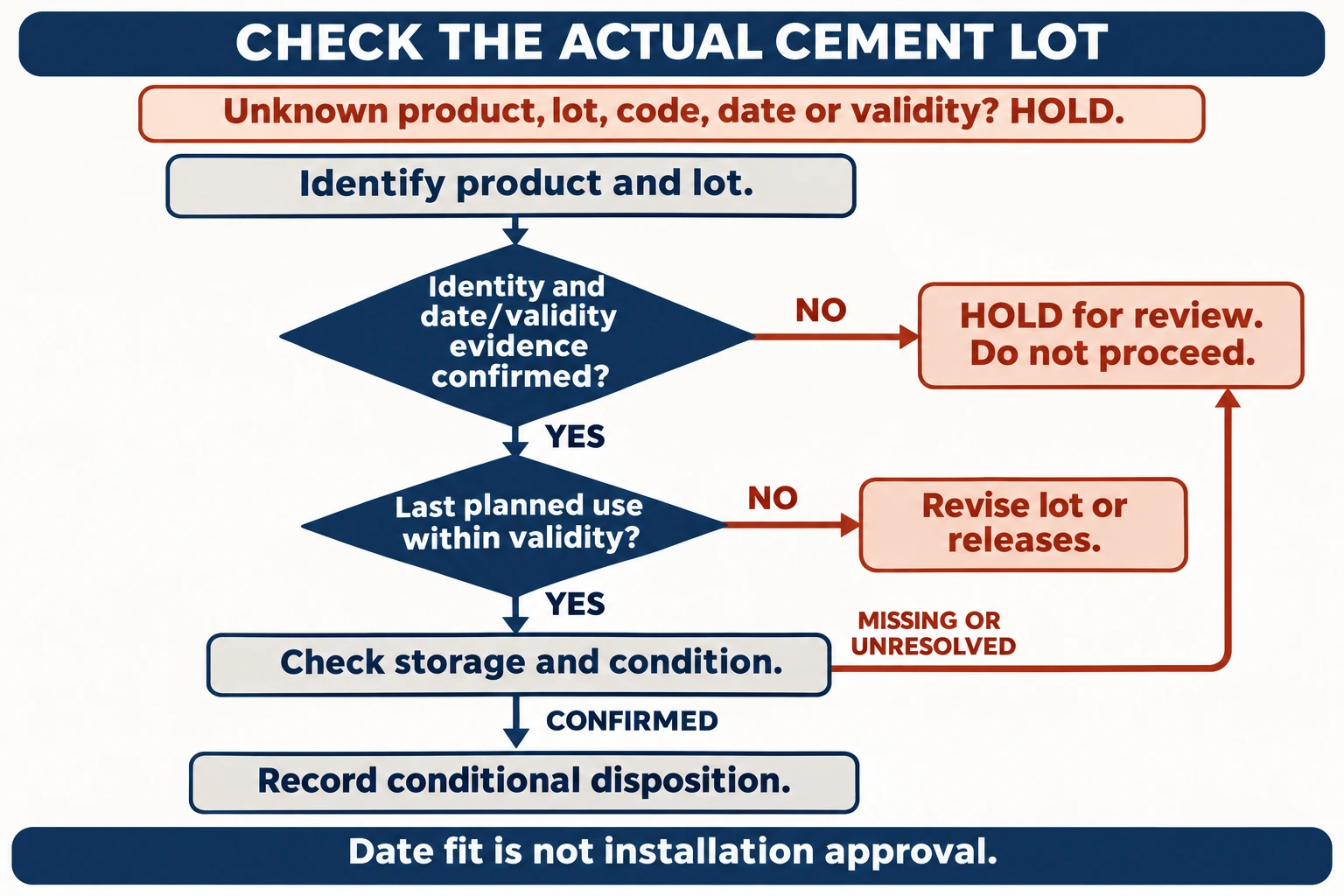
- Identify the exact product and lot before decoding its marking.
- If identity, manufacture date or validity evidence is unconfirmed, hold the lot review and obtain manufacturer confirmation.
- Compare confirmed validity with the last planned use; if use falls beyond validity, request a fresher lot or staged supply.
- Hold the disposition while storage history or condition remains unresolved.
- Record the supported conditional disposition; this record does not approve installation.
Conclusion
Buy the usable time the project needs, rather than assuming a sealed delivery is newly manufactured. Identify and decode the actual lot, compare its confirmed validity with the final planned consumption, and keep storage and suitability checks visible. Send the resulting record with the pipe-system enquiry; ask the supplier to resolve the specific gap before accepting a substitute or committing the whole programme to one batch.
Frequently asked questions
Does shelf life restart when the supplier delivers the can?
No. Use the actual manufacturer’s date basis and product validity; the receipt date is a separate purchasing record.
Can I decode every five-digit stamp like Oatey’s example?
No. Code structures differ. Confirm the interpretation for the named manufacturer and product before assigning a manufacture date.
Does a passing date comparison mean the cement is ready to use?
No. Product compatibility, container condition, storage history and applicable installation requirements remain separate checks.
Should every order require the same remaining months?
No universal minimum is established here. Agree a requirement for the actual product and programme without extending the manufacturer’s validity.