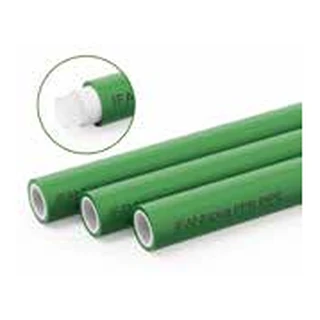
The question arrives in almost the same words every time. “Is your PPR green or white?” — followed, once the answer is given, by “and is white the better one?” The first question is legitimate and easy: our PPR is green — and since this page is going to be strict about sourcing, we will be strict about that too: green is what our line produces, confirmed from our own product photography and product pages. It is not a colour specification published in our catalogue, because our catalogue does not carry a colour field for PP-R at all. The second question rests on a premise that we do not think survives contact with the documents.
Here is our position, stated before the reasoning rather than after it, so you can stop reading if you only came for the answer: we read the governing product standard, ISO 15874-2:2013, and it contains no clause assigning any meaning to PP-R pipe colour. Colour on PP-R appears to us to be a market convention — regionally variable, brand-variable, and not a grade. If a supplier tells you their white PPR is a higher class than their green PPR, the correct response is not to believe or disbelieve them on the colour; it is to ask them for the wall thickness, the class designation and the test evidence, at which point the colour stops being part of the conversation. Our published sizing charts are where that second conversation starts.
This page is about that specific confusion. It is not a PPR sizing page — the exact dimensions, the wall thicknesses and the inch-name problem live on our PPR sizes page, and we will not restate them here beyond what the argument requires.
We want to be precise about the limits of what follows, because this is a topic where confident-sounding claims circulate freely and almost none of them carry a citation.
What we checked: ISO 15874-2:2013, the product standard for PP-R pipes, in full text rather than in a preview. Its clause structure is short enough to list: scope, normative references, terms, material, general characteristics, geometrical characteristics, mechanical characteristics, physical and chemical characteristics, performance requirements, marking. There is no colour clause among them. The word “colour” appears exactly twice in the document, and neither instance assigns colour a meaning:
The marking clause is the one that settles the argument commercially. Clause 10.2 sets out the minimum information a compliant PP-R pipe must carry — the standard number, the manufacturer, the dimensions, the pipe dimension class, the material designation, the application class with its pressure, the opacity, and traceability information. Eight required marks, and colour is not one of them. A standard that intended colour to communicate grade would have required it to be marked.
What we could not verify: we are not asserting that no such clause exists anywhere in any national annex or local regulation. That is not a claim anyone can honestly make, and as the next section shows, the CEN system does sometimes push colour preferences down to the national level. What we can say is that the main standard is open in front of us and there is nothing in it.
What that means for you: any claim you receive that a colour means something for PP-R should be treated as a supplier statement requiring evidence, not as a standards fact. That includes claims made by us. Our pipe is green because that is what the line produces and what our markets expect — not because green certifies anything.
| Claim you will hear | Our assessment | What to ask for instead |
|---|---|---|
| “White PPR is the premium/European grade” | No clause in ISO 15874-2 supports it. Our view: a market-preference statement dressed as a technical one. | Class designation and wall thickness for the exact diameter, in writing |
| “Green PPR is only for cold water” | We could not substantiate this. Our own green PPR is the PN20 line; PN20 is a catalogue figure, the green is an observation about what we produce | The pressure class and the intended application class |
| “The colour tells you the pressure rating” | Contradicted by the standard’s own marking clause, which requires the application class and pressure to be marked and does not require colour at all | Outside diameter × wall, plus the class marking |
| “Colour indicates whether it is potable-safe” | ISO 15874-2 clause 4.3 routes drinking-water suitability to the material, not to appearance. It is a certification and material question | The certification scope, and which body issued it |
| “Grey/black PPR is a different polymer” | Outside our range; we make no claim either way. Coming soon if we ever produce it | The material designation from that supplier |
The obvious objection, answered: a British reader is now thinking “but green is the water colour — BS 1710 says so.” It does, and that is worth being precise about rather than brushing aside. BS 1710 sets green as the basic identification colour for water services, with public supply carrying green plus an auxiliary blue. But BS 1710 governs pipe identification after installation — the bands, rings and wrapped tape applied so that someone opening a ceiling void in ten years knows what they have found. It can be applied over the whole length of a service or as bands, and it applies to metal and plastic alike. It is not a specification for the pigment a pipe extruder puts in the raw material. A green PP-R pipe is not BS 1710 compliant by virtue of being green, and a white one does not become non-compliant — the identification requirement is met by what you apply on site, not by what colour the pipe arrived in.
Colour feels like it should be regulated because in adjacent product families it genuinely is. The cleanest comparison is EN 1555-2, the standard for polyethylene gas pipes, which devotes a numbered clause to the subject and writes it in mandatory language: “Pipes shall be black (PE 80, PE 100 and PE 100-RC), yellow (PE 80) or orange (PE 100 and PE 100-RC).” It even anticipates regional variation, noting that national preference for colour can be stated in the national foreword. So a buyer who believes pipe colour is a regulated property is not being foolish — in the gas world they are simply right.
That contrast is the whole argument in one line. Two plastic pipe standards, written by the same standards culture, for products that look similar on a pallet: one has a mandatory colour clause, the other has no colour clause at all. The absence in ISO 15874-2 is not an oversight we are exploiting. It is a deliberate difference, and it means colour on PP-R was left to the market on purpose.
Buyers move the gas-pipe intuition across to PP-R, and suppliers have little incentive to correct it — a colour preference is much easier to sell against than a wall thickness.
In our experience, and we are labelling this as experience rather than as a fact, the colour a market expects is largely a matter of what the dominant supplier into that market has historically shipped. Where a green-supplying manufacturer established the category, installers came to read green as “the normal one” and white as unfamiliar. Where the reverse happened, the reverse intuition formed. Neither intuition is evidence about the pipe.
The commercial consequence is real even though the technical basis is not. A contractor whose crews have installed green for a decade may genuinely reject white on sight, and a distributor whose shelf is green may find white slow-moving regardless of specification. That is a legitimate reason to care about colour. It is not a reason to describe colour as a grade.
If colour is not the differentiator, something has to be. On our PPR line, these are the things that are documented and that we will put in writing.
| Attribute | Our PPR 1103 | Source | Is this what colour is standing in for? |
|---|---|---|---|
| Colour | Green | Our product photography and product pages — not a catalogue field | — |
| Pressure class | PN20 | Catalogue | Yes — this is the real answer when someone asks “which is the better colour” |
| Sizes available | 20 × 2.8, 25 × 3.5, 32 × 4.4 mm, 4 m lengths | Catalogue | Yes — range limits matter far more than pigment |
| Above 32 mm | Coming soon — not produced on this line | Catalogue (range ceiling) | Yes, and this is the constraint most buyers should check first |
| Fittings | Series 1138, 75 items in the series | Catalogue | Yes — system match matters; colour match is cosmetic by comparison |
| Jointing | Heat fusion and electrofusion | Catalogue | No |
| Potable water | Non-toxic, suitable for drinking water | Catalogue | Partly — but the evidence is certification, not colour |
| Recycled content | Not more than 10%, with quality unaffected | Catalogue | Sometimes — colour is occasionally used to imply this. Ask for the figure instead |
| Certificate numbers | Coming soon | — | — |
The source column above is not decoration. Every figure in it comes from our catalogue except the colour, which our catalogue does not specify — we are telling you green because that is what we make and photograph, and we would rather flag that distinction than let a page about evidence quietly borrow authority it has not earned. The certification bodies in scope for our operation are SKZ, CE, WRAS, DVGW, SGS, ISO 9001 and ISO 14001; the individual certificate numbers are Coming soon and we would rather publish that than a number we cannot yet stand behind.
One thing worth knowing when you do receive certificate numbers from anyone, us included: approvals of this kind are granted per material and per product, not to a manufacturer’s entire range, and they expire — a WRAS approval, for example, runs for five years. “We are WRAS approved” is therefore not an answer. “This product, under this certificate number, valid until this date” is. That is a far more useful thing to interrogate than a pigment.
One reason colour arguments persist is that a darker or more saturated pigment is sometimes said to hide regrind. We are not going to endorse or attack that reasoning, because we could not find evidence for it either way and we would be inventing a mechanism.
What we can do is answer the underlying question directly rather than through the colour proxy. Our PPR carries not more than 10% recycled material, with the quality not affected (per our catalogue). That is the figure. If a buyer’s real concern is regrind, the productive move is to put that number in the specification and require it of every bidder — a demand that works identically on green pipe and white pipe, which is rather the point.
Being honest about colour cuts both ways. Green is what we produce, so a buyer who needs white for market-acceptance reasons faces a genuine problem with us, and we would rather say so on this page than in week three of a negotiation.
That last question is the useful one. A supplier who can explain, with a citation, why colour changes a technical answer has told you something worth knowing. A supplier who cannot has confirmed that colour was never the variable. You are welcome to put all six to us in writing and hold the answers against whatever else is on your desk.
Our stance, plainly. Choose on class, size range, fittings match and certification. Choose colour on what your market will accept. Do not let the second choice be presented to you as the first.
Our PPR is PN20, in 20, 25 and 32 mm, with a 75-item fitting series behind it — all four of those figures are catalogue figures. It is also green, which is not a catalogue figure but a description of what comes off the line. If that range and that class fit your project, the colour is a fact about our line rather than a claim about its quality — and if the range does not fit, no colour we could offer would fix that. IFANNova is a French brand; the pipe is manufactured by Zhuji Fengfan Piping Co., Ltd in Zhejiang, China. Nothing in our range is made in France.
Brass or plastic fittings?
At 45 °C a pipe loses pressure capacity, stiffness and surface integrity — three separate deratings governed by three different documents.
The pressure side of SDR is well covered elsewhere.