Importing & Compliance · explainer
What TMV2 and TMV3 each prove, which EN 1111 and EN 1287 edition to cite, the 2021 audit failure at low flow, and the blended pipe run no valve approval covers.
Two numbers decide most thermostatic mixing valve tenders: 48 °C and 41 °C. A thermostatic mixing valve (TMV) blends hot and cold water to a set temperature and shuts the flow down if one supply fails. In England, requirement G3(4) caps the water delivered to a bath in a new dwelling at 48 °C, and TMV2 is the UK approval scheme for domestic valves that meet BS EN 1111 and/or BS EN 1287. TMV3 is the healthcare scheme: valves that meet NHS specification D 08, with 41 °C at showers and washbasins and 44 °C at baths. On a hospital job the two are not interchangeable.
Both approvals describe a valve on a test rig, not the valve after months in your building or the blended pipe run after it. Below: the two schemes, the standard editions to cite, a 2021 audit failure, and the tender checks.
Key takeaways
TMV2 and TMV3 are UK third-party approval schemes, not standards. Both began under BuildCert; the TMV2 Scheme and TMV3 Scheme logos are now registered marks of NSF Wales Limited. According to BEAMA, TMV2 confirms that a domestic valve meets either or both BS EN 1111 and BS EN 1287. TMV3 confirms compliance with D 08, the NHS performance specification published as a supplement to Health Technical Memorandum 04-01.
The domestic legal hook is narrow. Requirement G3(4) applies when a dwelling is erected or formed by a material change of use, and limits water delivered to a fixed bath to 48 °C. Approved Document G (2015 edition with 2024 amendments), paragraph 3.66, still names BS EN 1111:1999 and BS EN 1287:1999 as ways to show the valve will fail safe. It does not name TMV2. For care settings, HSE guidance points to a TMV Type 3 so that water discharged to vulnerable users does not exceed 44 °C.
| Scheme | Tested to | Best for | Max outlet temperature (°C) | In-service check |
|---|---|---|---|---|
| TMV2 | BS EN 1111:2017 and/or BS EN 1287:2017 | Dwellings; baths under requirement G3(4) | 48 at a bath (G3(4), England) | Once a year |
| TMV3 | NHS D 08, 2017 edition | High-risk areas of healthcare premises | 41 shower and basin; 44 bath; 46 assisted bath; 38 bidet | At 6 to 8 weeks, then 12 to 15 weeks |
Source: NSF, TMV2 and TMV3 certification; HTM 04-01 Supplement, D 08 (2017), Table 2; Approved Document G, requirement G3(4); BEAMA TMV FAQ for in-service intervals. Compiled 25 September 2026.
D 08 expects isolating valves on each TMV so it can be tested in place, and the check valves its maker specifies. For contractors building that package around TMV2 or TMV3 valves, our brass ball, gate and check valves run from 1/2″ to 4″. They are isolation and non-return parts, not TMVs, and carry no TMV2 or TMV3 approval.
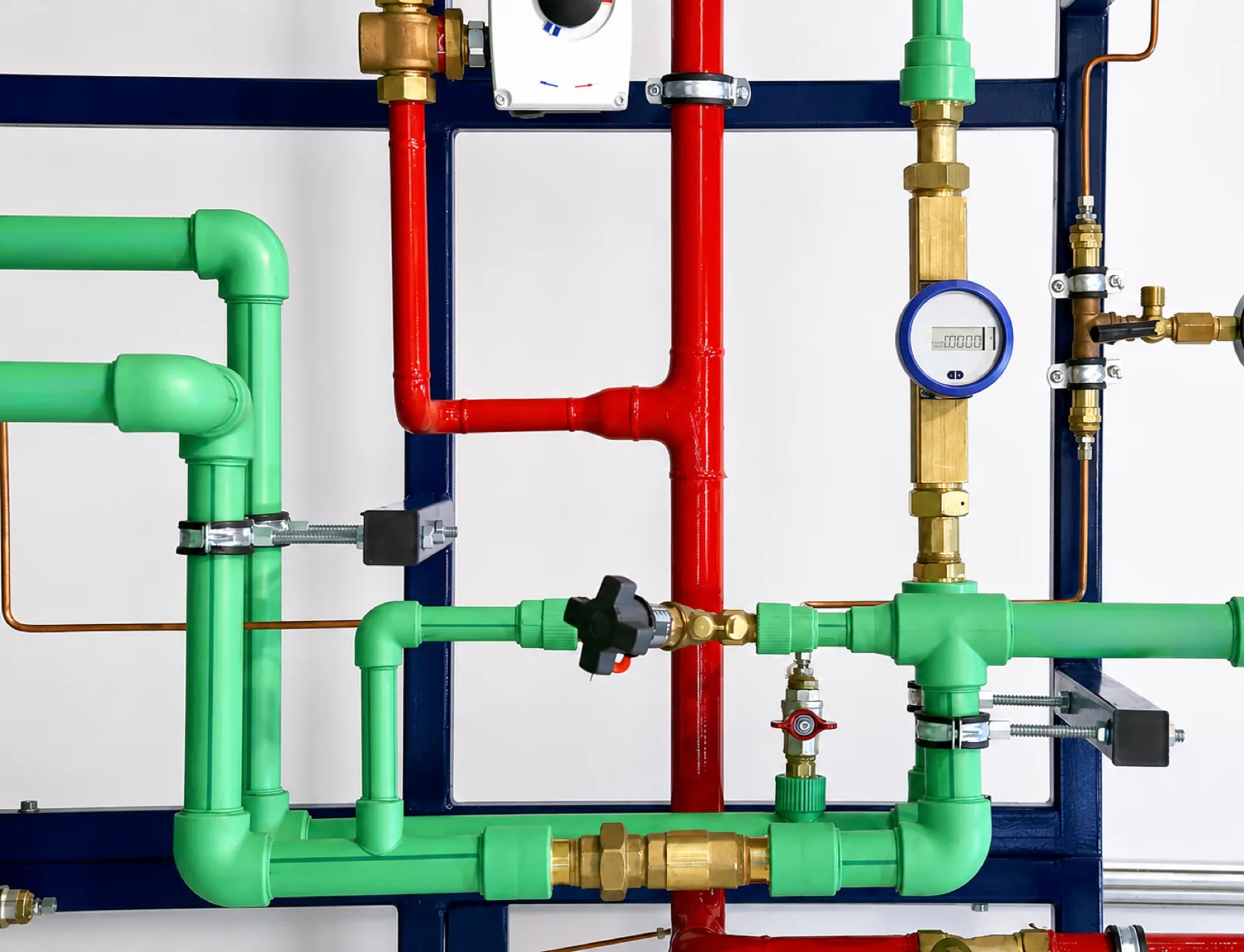
EN 1111 covers PN 10 thermostatic mixing valves for high-pressure supplies; EN 1287 covers low-pressure valves. Both are domestic standards: their 2026 scope covers valves serving one or a few outlets in kitchens, washrooms and bathrooms, and excludes institutional systems with large numbers of outlets. They test mixed water below 45 °C and recommend about 38 °C where the valve gives anti-scald protection.
Both were revised this year. Estonia’s national standards body lists EVS-EN 1111:2026 as current from 1 April 2026 and EVS-EN 1287:2026 from 15 April 2026, each replacing the 2017 edition, and BS EN 1111:2026 appears on BSI’s development list. NSF’s TMV2 page still names BS EN 1111:2017 and BS EN 1287:2017. A 2017-edition TMV2 certificate is therefore normal today, not lapsed. A tender that says only “to EN 1111” leaves the edition open: state the edition you accept, or accept either and record which arrived.
D 08 builds on EN 1111 and EN 1287. Its clauses 5.1 and 6.1.1 accept their certification as proof of leaktightness and on/off durability; the thermal tests are D 08’s own, run inside the envelope below.
| Parameter | High pressure (HP) | Low pressure (LP) |
|---|---|---|
| Maximum static pressure (bar) | 10 | 10 |
| Flow pressure, hot and cold (bar) | 1 to 5 | 0.2 to 1 |
| Hot supply temperature (°C) | 55 to 65 | 55 to 65 |
| Cold supply temperature (°C) | 5 to 20 | 5 to 20 |
Source: HTM 04-01 Supplement, performance specification D 08 (2017 edition), Table 1. Compiled 25 September 2026.
Measure hot and cold flow pressures at the outlet before choosing an HP or LP designation.
The case that shows the gap is on record. On 4 February 2021 NHS Scotland issued Safety Action Notice SAN(SC)21/04 on RWC TMV3 Easifit 15 mm T-type valves. In audits to HTM 04-01, the valve failed two D 08 tests: 7.10, temperature stability with changing supply pressure, and 7.12, temperature stability at reduced flow rate. Retested after a 48-hour thermal-endurance conditioning run, it failed the same two tests again in the same way. With hot pressure above cold, mixed water reached 45.4 °C, 3.4 °C over the shower limit.
| Reading | D 08 shower maximum (°C) | SAN(SC)21/04 audit (°C) |
|---|---|---|
| D 08 shower limit | 41 | — |
| Audited valve, hot above cold | — | 45.4 |
The same notice records that the valve satisfied BS EN 1111 and BS EN 1287, the domestic standards. Health boards had until 12 April 2021 to find the valves and risk-assess them through their Water Safety Group.
Cold pressure drops to 80 to 85% of its set value, then flow drops to 4 L/min for a shower, basin or bidet, or 10 L/min for a bath fill. The average mixed temperature may move by no more than 2 K. A basin run gently on an unbalanced supply meets that condition in normal use, and domestic approval alone did not answer it.
For healthcare, ask for the D 08 designation that matches each outlet, such as HP-W for a basin or HP-T44 for a bath. A TMV3 mark belongs to one valve reference: NSF’s rules require the valve’s unique reference number and the licence holder’s name beside the logo, next to the exact approved valve. A substitute needs its own certificate.
Every test above measures the valve; none measures the pipe between valve and tap. Under D 08 the water in that run is set between 38 and 46 °C. HSE gives 20 to 45 °C as the range suitable for Legionella growth, and asks for hot water stored at 60 °C or above and distributed so that it reaches 50 °C (55 °C in healthcare premises) within one minute at outlets.
| Outlet | D 08 maximum (°C) | G3(4) bath cap (°C) | HSE growth range (°C) |
|---|---|---|---|
| Bidet | 38 | — | — |
| Shower | 41 | — | — |
| Washbasin | 41 | — | — |
| Bath (T44) | 44 | — | — |
| Assisted bath (T46) | 46 | — | — |
| New-dwelling bath | — | 48 | — |
| Growth range, lower edge | — | — | 20 |
| Growth range, upper edge | — | — | 45 |
The guidance answers with length, not with a test. Approved Document G paragraph 3.68 asks for supply pipes between in-line blending valves and outlets to be kept to a minimum “in order to prevent the colonisation of waterborne pathogens”. HSE asks for TMVs to be fitted as close as possible to outlets where a scald risk is identified, and for infrequently used outlets to be flushed at least weekly. Neither sets a length in metres, and we found no authority that does.
That makes the blended run a drawing decision: put the valve at the outlet rather than in a cupboard feeding several rooms, and list blended pipe length per outlet on the schedule. The hot and cold feeds are a separate choice, covered in our note on CPVC vs PP-R for hot water. IFANNova’s PP-R pipe and fittings are PN20 in 20, 25 and 32 mm.
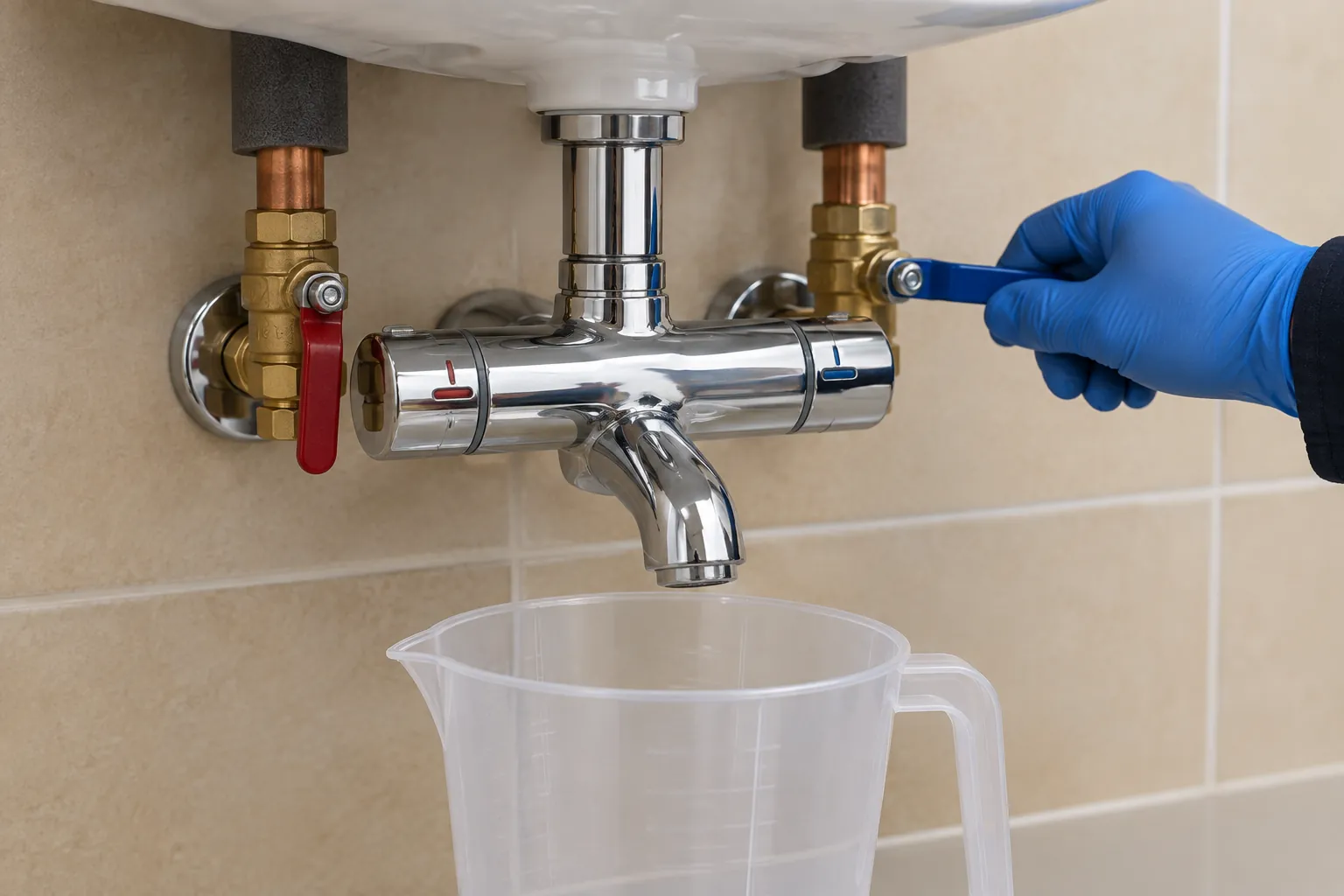
Then the proof. D 08 clause 11.2 sets the in-service test: record the mixed temperature at full flow, isolate the cold supply, and after 5 seconds collect what runs for 60 seconds. More than 120 mL means the valve needs recommissioning. Restore the cold supply, and the temperature should come back within 2 °C of the first reading. BEAMA gives the intervals: once a year for TMV2 valves, and for TMV3 a first test 6 to 8 weeks after commissioning and a second at 12 to 15 weeks.
We publish no TMV lead time because we do not make TMVs. The first date that matters is when the exact certified valve reference is confirmed, since a substitute needs its own certificate and restarts the submittal. For the pipe and brass parts around the valves, ask us for the plant-departure date against that confirmed schedule; we hold no standing figure to print.
IFANNova is a French-designed, European-standard piping brand supplying PP-R, PEX, HDPE and UPVC/CPVC systems, 2405 brass fittings from 1/4″ to 1″, and brass valves from 1/2″ to 4″. We make no thermostatic mixing valves and hold no TMV2 or TMV3 approval.
The choice trades cost and paperwork against margin. TMV2 gives a valve proven to EN 1111 or EN 1287 at domestic conditions and a 48 °C bath limit. TMV3 adds D 08’s thermal tests, the 41 °C and 44 °C limits and a tighter in-service regime, which a ward needs and a flat usually does not. The 2021 Scottish notice shows a domestic pass does not predict healthcare behaviour at low flow, and neither scheme covers the blended run.
TMV2 approves domestic valves that meet BS EN 1111 and/or BS EN 1287. TMV3 approves valves for healthcare premises that meet NHS specification D 08, with maximum mixed water temperatures of 41 °C at showers and washbasins and 44 °C at baths.
No. EN 1111 is the European standard for PN 10 thermostatic mixing valves; TMV2 is a UK approval scheme that confirms a valve meets BS EN 1111 and/or BS EN 1287. EN 1111 was revised in 2026, and NSF’s TMV2 page still names the 2017 editions.
BEAMA gives once a year for TMV2 valves. For TMV3, the first in-service test comes 6 to 8 weeks after commissioning and the second at 12 to 15 weeks. D 08 clause 11.2 sets the method, with a 120 mL limit on water collected after the cold supply is isolated.
For a bath in a new dwelling in England, no more than 48 °C under requirement G3(4). Under D 08: 41 °C at showers and washbasins, 44 °C at baths (46 °C for assisted baths) and 38 °C at bidets.