Importing & Compliance · explainer
A backflow preventer follows fluid category: the UK rates an RPZ to 4 and a double check to 3; category 5 needs an air gap. Cites EN 1717:2025+A1:2026.
The backflow preventer on a building’s incoming main is chosen by the fluid category downstream of it, and the pipe size has no say. Under the UK Regulators’ Specification, an RPZ (type BA, product standard EN 12729) is rated to fluid category 4 for both back pressure and back siphonage. A double check valve (DC, type EC or ED to EN 13959) is rated to category 3, a single check to category 2, and category 5 needs a type AA or AB air gap. A DC is enough when nothing past it exceeds category 3; category 4 takes an RPZ, and no RPZ covers category 5.
Many tender sheets still write “backflow protection to EN 1717:2000”. That edition is withdrawn, and the RPZ product standard was reissued in 2023. Below: the five categories, a four-question decision tree, the editions a certificate should cite, and what an RPZ commits the owner to after handover.
Key Takeaways
Schedule 1 of the Water Supply (Water Fittings) Regulations 1999 (England & Wales) sets out five categories. Scotland (Water Supply (Water Fittings) (Scotland) Byelaws 2014) and Northern Ireland (Water Supply (Water Fittings) Regulations (Northern Ireland) 2009) have their own instruments that use the same five-category scale. Category 1 is wholesome water from the undertaker’s main. The same water changed only in temperature, taste, odour or appearance is category 2, which is why hot water sits there.
Category 3 is a slight hazard from low-toxicity substances, and the law names ethylene glycol, copper sulphate and sodium hypochlorite. A significant hazard, such as pesticides or carcinogenic substances, is category 4. The top of the scale, category 5, is a serious hazard: pathogens, faecal material, radioactive or very toxic substances. Only an air gap answers it, and a type AA gap is no less than 20 mm or twice the supply’s internal diameter, whichever is greater.
The rule that turns this into a purchase sits in Schedule 2, paragraph 15(3): the device must suit the highest category downstream of it before the next device. One dosing pot behind the main is enough to move the whole supply up a category unless that pot has its own protection at the point of use.
| Fluid category | Typical source | UK minimum device | DIN EN 1717 practice | Verdict for the main |
|---|---|---|---|---|
| Category 2 | Hot water, plain sprinkler branch | Single check, EA or EB | Verifiable single check, EA | Single check; no RPZ needed |
| Category 3 | Glycol heating, hypochlorite dosing | Double check EC or ED, or CA | Backflow preventer, CA | DC is the UK default; CA equally rated, Germany’s default |
| Category 4 | Pesticides, inhibitor-dosed sprinklers | RPZ, BA | RPZ, BA | RPZ, with consent and annual tests |
| Category 5 | Pathogens, faecal or animal waste | Air gap AA or AB | Air gap AA or AB | Break tank; no valve qualifies |
Source: UK column, Regulators’ Specification as published by Water Regs UK; German column, the SYR drinking-water protection brochure (DIN EN 1717 with DIN 1988-100). Category 1 needs no device.
Whichever device the category calls for, it needs isolating valves directly upstream and downstream so the tester can shut it in. For contractors assembling that valve set on the incoming main, our brass ball and gate valves run from 1/2″ to 4″. They isolate; they are not backflow devices.
| Device type | Air gaps (fluid category) | Mechanical devices (fluid category) |
|---|---|---|
| AA air gap | 5 | — |
| AB air gap | 5 | — |
| BA (RPZ) | — | 4 |
| CA disconnector | — | 3 |
| EC double check | — | 3 |
| ED double check | — | 3 |
| EA single check | — | 2 |
| EB single check | — | 2 |
Walk the questions from the top, because the most severe category downstream settles the answer and the lower ones stop mattering.
The boiler room is where this goes wrong. The England & Wales regulations name ethylene glycol as a category 3 substance, so a glycol-filled heating fill point can sit behind a double check. Kemper lists a heating fill point with inhibitors as a category 4 example under DIN EN 1717. The same plant room can land one category apart on either side of the Channel, so read the dosing chemical’s data sheet and compare its oral LD50 with the 200 mg/kg line before you size anything. Sprinklers follow the same logic: Water Regs UK treats a plain-water sprinkler branch as typically category 2, and one dosed with a rust inhibitor as typically category 4.
EN 1717 sets the method: classify the fluid, then pick a device family. Its current text is EN 1717:2025+A1:2026, adopted in Germany as DIN EN 1717:2026-08; the 2000 edition is withdrawn. The device standards sit underneath it. EN 12729:2023 replaced the 2002 edition for the BA. EN 13959:2004 is still current for check valves.
| Standard (current edition) | Covers | Size range (DN) | Pressure class (PN) | Replaces |
|---|---|---|---|---|
| EN 1717:2025+A1:2026 | Fluid categories, device selection | Not a product standard | Not applicable | EN 1717:2000 (withdrawn) |
| EN 12729:2023 | RPZ, family B type A (BA) | 6 to 250 | 10 | EN 12729:2002 |
| EN 13959:2004 | Check valves EA, EB, EC, ED | 6 to 250 | 10 | Still current |
Source: BSI Knowledge and SIS status records, DIN Media, read 27 September 2026.
Two scope limits matter on a schedule. EN 12729:2023 covers PN 10 devices rated for 65 °C permanent duty and 90 °C for up to one hour. A BA on a hot supply needs its maker’s rating checked against the flow temperature. EN 13959 check valves above DN 50 are for horizontal installation only, which rules out a vertical riser position on larger mains. A certificate dated before 2023 for an RPZ is not wrong by itself, but ask whether the device has been assessed to the current edition.
A schedule line that survives review names all three layers: the category, the device type and the product standard with its year. Here is a worked example:
Incoming main, fluid category 4 downstream. Type BA to EN 12729:2023, DN 50, isolating valves either side, relief discharge to a type AA air gap. Selection per EN 1717:2025+A1:2026.
A line that says only “backflow preventer” leaves the category decision to whoever buys the valve.
An RPZ is a maintenance contract as much as a valve. Under paragraph 15(4) the England & Wales regulations already require protection on the supply pipe where premises are separately occupied or where the undertaker serves notice. Water Regs UK adds that where high-risk contaminants are likely, the undertaker can ask for zone or whole-site protection on top of point-of-use devices. An RPZ may be accepted for that whole-site role up to category 4.
Before an RPZ goes on the main, check whether the one category 4 source can be protected where it is used. An RPZ on the chemical line alone can leave the main at a double check, and the annual test then covers one small device rather than the whole supply. The undertaker still decides whether whole-site protection is required, so put that question to it in the same notification.
From the RPZ guidance, five obligations follow in the UK:
The plant room has to accept the device too. The relief outlet of a BA or CA must discharge through an air gap that satisfies type AA, so a floor drain sized for the discharge belongs on the drawing. One manufacturer’s BA opens its relief valve at a 140 hPa (0.14 bar) difference between inlet and middle zones, and the test ports need shut-off valves directly upstream and downstream.
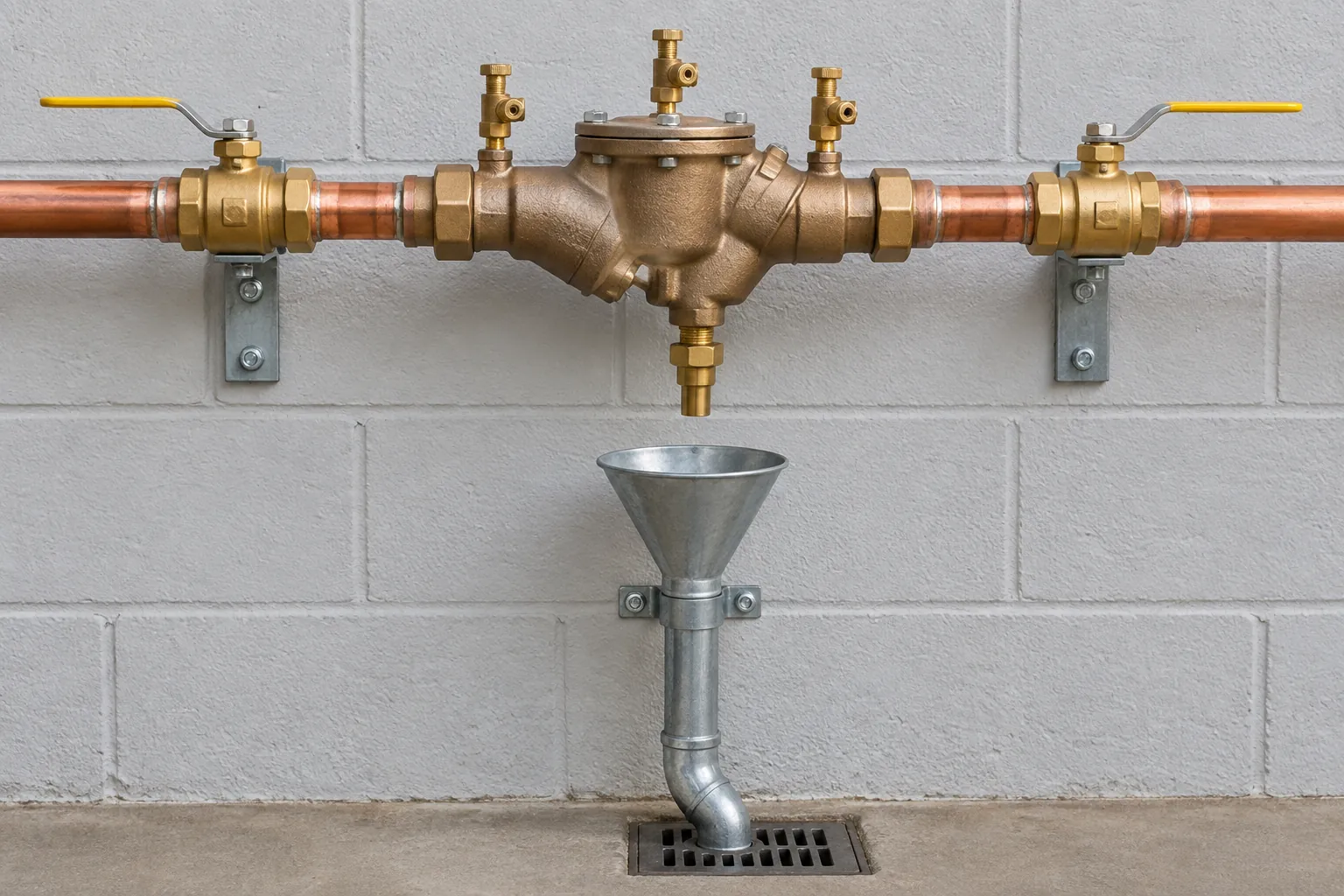
The name on the valve does not settle it. Water Regs UK is explicit. A check valve or non-return valve provides backflow protection only if it conforms to BS EN 13959, or passes all of the Regulators’ Specification tests for a single or double check, endurance tests included. A generic swing check on the drawing is not your category 2 device.
That applies to our own range. Our brass check valves, 1/2″ to 4″, are non-return valves. They carry no EN 13959 or EN 12729 certification, so they are not a rated backflow device, and we make no RPZ or double check devices. Where we fit is the rest of the incoming service. That means the isolating valves either side of the certified device and the pipe after it, such as PP-R pipe and fittings in PN20, 20, 25 and 32 mm.
For the certified device, ask the supplier for three things: the EN 12729:2023 or EN 13959 certificate for that exact reference and DN, the maker’s temperature rating, and the plant-departure date. Set that date against your notification date, because the RPZ cannot go in before the undertaker has had its 10 working days. We publish no standing lead time; ask us for the plant-departure date on the valves and pipe against the same programme. For how these lines sit in a tender, see our guide to tender documents for pipe supply; hot-water outlets further down the same system are covered in our TMV specification guide.
The risk sits in the category you did not look for. A double check on the main is compliant in the UK only while everything past it stays at category 3 or better, and one inhibitor dose or chemical line added later can void it. Classify every downstream source before choosing the device, cite EN 1717:2025+A1:2026, EN 12729:2023 and EN 13959:2004, and budget an RPZ’s annual test with the valve.
An RPZ (type BA) has a relief valve that vents its middle zone to atmosphere, and the UK rates it to fluid category 4. A double check (type EC or ED) has two check valves and no relief, and the UK rates it to category 3.
Fluid representing a serious health hazard from pathogens, radioactive or very toxic substances, such as faecal material or animal waste. No valve is accepted for it; it needs a type AA or AB air gap.
In the UK, at intervals set by the water undertaker and at least once a year, by a competent tester working to the RPZ AIM. Before the end of 2026 testers must renew their qualification for certificates to be accepted.
No. It has been withdrawn; the current text is EN 1717:2025+A1:2026, adopted in Germany as DIN EN 1717:2026-08. The RPZ product standard is EN 12729:2023.