Material Selection · guide
A pump turns a sewer into a pressure pipe, and the gravity specification already in your hand assigns no pressure class at all. This page reads the two standards against each other, and says plainly where our own range stops.
A pump station goes in at the low end of a subdivision, and the sewer leaving it is drawn on the same sheet as the sewer arriving. The arriving line is ASTM D3034 SDR 35. So, the drawing says, is the one leaving.
That single carry-over is what this page exists to catch. A force main is a sewer that a pump has turned into a pressure pipe, so it is bought against a pressure standard: ANSI/AWWA C900-22 for PVC, AWWA C906-21 for HDPE. It needs a pressure class, a separate surge check, restrained joints and a minimum flow velocity. The gravity specification already in your hands assigns no pressure class at all. That number was never in the standard.
Key takeaways
A fused joint restrains itself; a gasketed one does not. This 0:30 clip shows the fusion.
The sewage is identical on both sides of the pump. The loading is not. A gravity sewer flows partly full at atmospheric pressure, so the governing load comes from outside: earth cover, traffic, and the ring deflection those produce. Downstream of a pump the same fluid sits under continuous internal pressure, and the governing stress moves into the pipe wall.
Two design problems, two families of standards. Get the separation right and the specification follows. Miss it and every number downstream, from the 4 in minimum diameter to the restraint detail, is read off the wrong document.
Read the scope of ASTM D3034-24E01 and the absence is plain. It covers flattening resistance, impact resistance, pipe stiffness, extrusion quality, joining systems and marking. No pressure class appears in it. The installation practice it points to settles the question: ASTM D2321-26 is titled Underground Installation of Thermoplastic Pipe for Sewers and Other Gravity-Flow Applications.
So what does SDR 35 actually buy? A minimum pipe stiffness of 46 psi tested to ASTM D2412, with SDR 26 at 115 psi. Both are ring values: resistance to squashing under earth load. Neither describes holding pressure from the inside, which is why no supplier can hand you a psi rating for SDR 35 sewer pipe. For the gravity system feeding the wet well, a PVC drainage pipe and fittings specification is the right document, and our uPVC drainage guide covers how those sizes are called out.
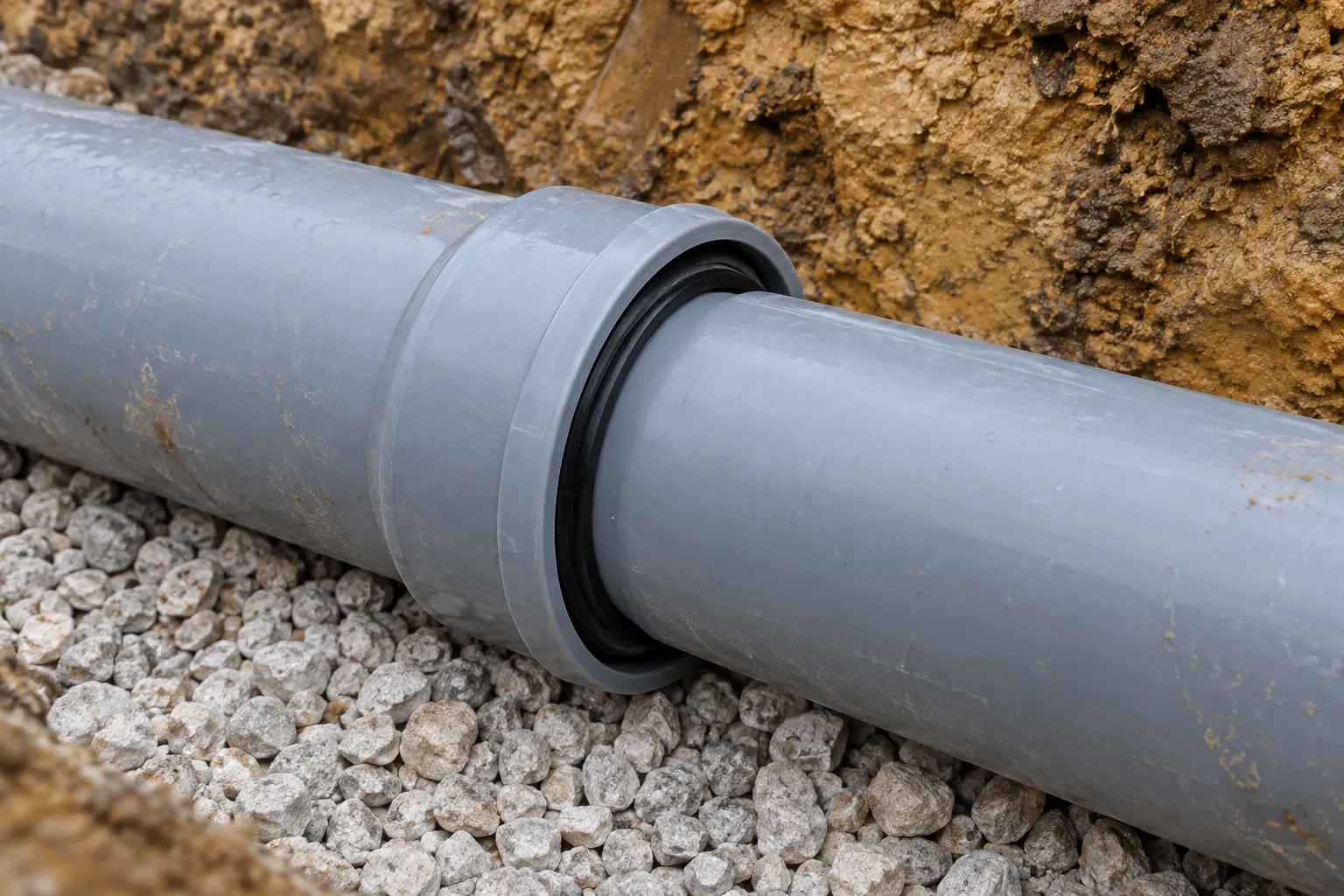
Working municipal specifications already keep the two apart, buying D3034 SDR 35 gravity pipe in one section and AWWA C900 force main pipe in another.
| Criterion | Gravity sewer (ASTM D3034) | Force main (AWWA C900) | Verdict |
|---|---|---|---|
| Governing number | Pipe stiffness, 46 psi at SDR 35 | Pressure class, 165 to 305 psi by DR | Not interchangeable |
| What it resists | Earth load and ring deflection | Internal hoop stress plus surge | Different failure mode |
| Pressure rating | None assigned by the standard | DR 18 = 235 psi; DR 25 = 165 psi | The absence is the finding |
| Installation practice | ASTM D2321, gravity-flow applications | Pressure bedding plus joint restraint | Restraint is additional |
| Joint duty | Gasketed, unrestrained, no thrust | Restrained, fused or thrust blocked | Check every bend |
Source: ASTM D3034-24E01 and ASTM D2321-26 scope statements; Uni-Bell PVC pressure pipe standards for sewer force mains; municipal sewer specification Section 1016, Rev. 11/2020. Compiled 22 September 2026.
For the small-diameter pressure lines around a pumped system, distributors and procurement teams can work from our HDPE pipe and fittings catalogue.
PVC pressure pipe to ANSI/AWWA C900 runs 4 to 60 in across a ladder of dimension ratios: PC 165 psi at DR 25, PC 235 psi at DR 18, PC 305 psi at DR 14, all at a design safety factor of 2.0. The current edition is C900-22. Picking a DR off that ladder is the first decision, and on its own incomplete.
| Dimension ratio | Pressure class (psi) |
|---|---|
| DR 51 | 80 |
| DR 41 | 100 |
| DR 32.5 | 125 |
| DR 27.5 | 150 |
| DR 26 | 160 |
| DR 25 | 165 |
| DR 21 | 200 |
| DR 18 | 235 |
| DR 17 | 250 |
| DR 14 | 305 |
Here is the trap for anyone working from older habits. Before 2007, C900 used a 2.5 safety factor with surge overhead built into the class, so “the class covers water hammer” was roughly true. The 2007 revision moved to a 2.0 factor and pulled surge into its own calculation. Quoting a class and stopping there leaves the surge check undone.
The Uni-Bell force main design guide sets three checks: working pressure against the class, recurring surge against the class, and occasional surge against 1.6 times the class. Those multipliers belong to PVC. HDPE to AWWA C906-21 is rated on a different ladder, which is where a number copied from the wrong document does real damage.
| Material and standard | Pressure class (psi) | Recurring surge limit | Occasional surge limit | Published as |
|---|---|---|---|---|
| PVC, AWWA C900, DR 18 | 235 | Working plus surge within class | Within 1.6 times the class | Formula, Uni-Bell guide |
| PVC, AWWA C900, DR 14 | 305 | Working plus surge within class | Within 1.6 times the class | Formula, Uni-Bell guide |
| HDPE PE4710, AWWA C906-21, DR 11 | 200 | 300 psi, 1.5 times the class | 400 psi, 2.0 times the class | Stated values, Charlotte Water |
Source: Uni-Bell Force Main Design Guide for PVC Pipe; Charlotte Water Design Manual Section 33 31 20. PVC rows state the published formula rather than a derived figure. Compiled 22 September 2026.
Velocity runs opposite to the usual instinct: oversizing a gravity sewer costs money, while oversizing a force main costs maintenance. Two independent jurisdictions, WSSC and Iowa DNR, land on the same floor of 2 ft/s, about 0.61 m/s, to hold solids in suspension. Fall below it and solids drop out; re-suspending them takes 3 to 3.5 ft/s, which the station may not produce. The practical ceiling is near 6 ft/s and the minimum diameter is 4 in.
Air is second. Every high point on a pressurised line collects it, and trapped air throttles flow while sharpening surge. The strongest guidance is geometric: profile the line so intermediate high points do not exist. Where terrain refuses, valve selection goes to AWWA M51 rather than a rule of thumb.
Thrust is third, created by the pressure itself at changes in direction, at reducers and at dead ends. A gravity line never sees it, so gravity fittings carry no restraint. On a force main every bend, tee and closed valve needs a restrained joint, an external restraint device or a thrust block, because an unrestrained gasketed joint can pull apart under pressure. Fused HDPE handles it inherently; our note on HDPE pipe joint types shows how that differs from a gasketed joint.
Hydrogen sulfide is fourth, and the budget for it usually lands on the wrong target. It attacks cast iron, ductile iron, steel, copper, asbestos cement and concrete, and is not a concern for PVC pipe. Damage concentrates at the discharge structure.
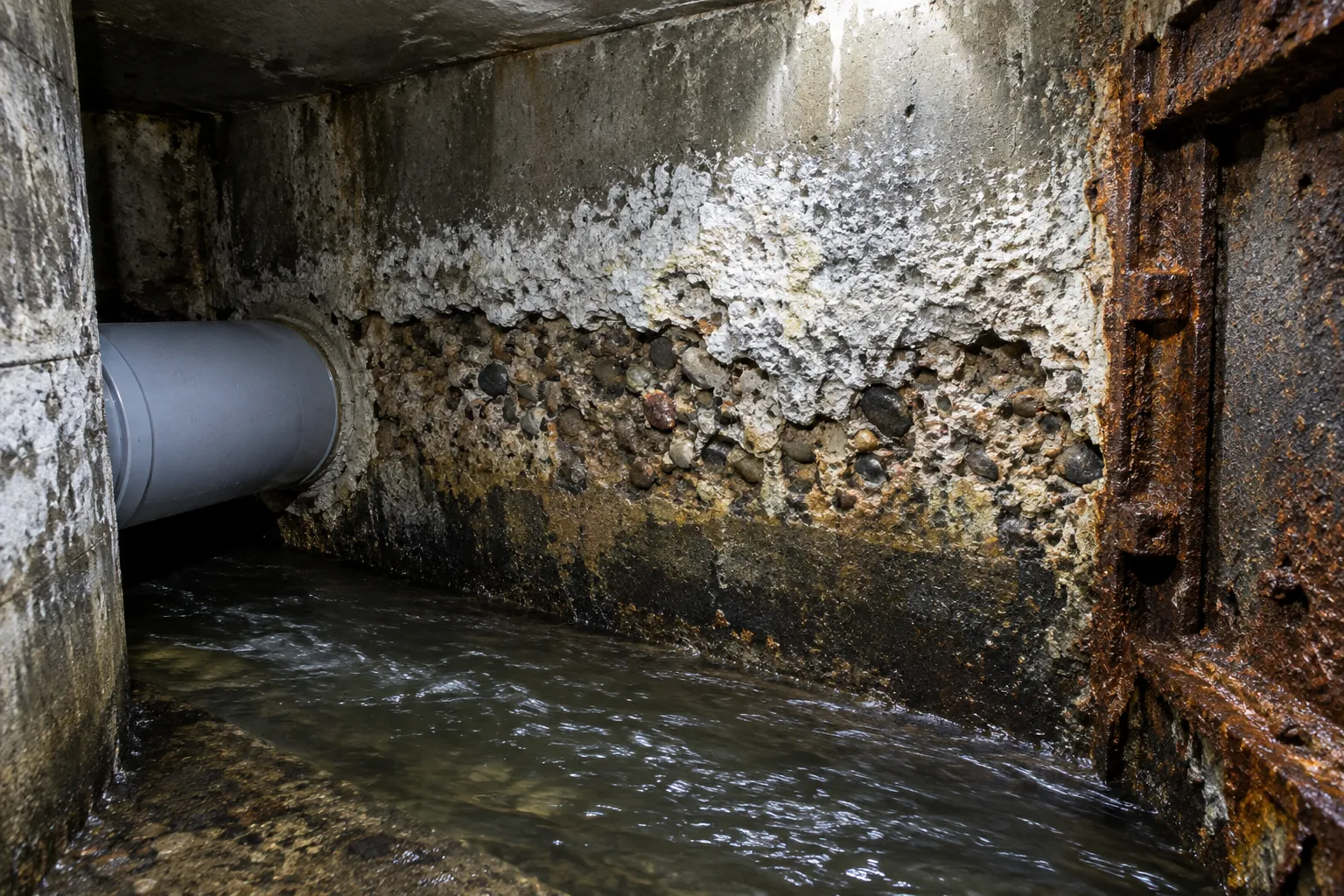
A force main line item a reviewer will accept carries five things. Leave one out and the bid returns the cheapest reading.
Testing is material-specific too. Fused HDPE is proved hydrostatically, commonly at 150 psi held four hours and steady within 5 percent over the final hour; compressed-air leakage testing of HDPE pressure piping is prohibited on safety grounds. Fusion is a procedure specification, ASTM F2620 or PPI TR-33.
On lead time we publish no figure, because we hold no verified one for force-main pipe and a plausible-looking number is worse than silence. What drives it is knowable, so ask directly. Is this DR and diameter stock or a production run? What is the extrusion slot, in weeks? Is the resin grade held or bought against the order? What is the lead time on fusion and restraint hardware, which often runs longer than the pipe itself? Ask for the date the pipe leaves the plant, not a duration.
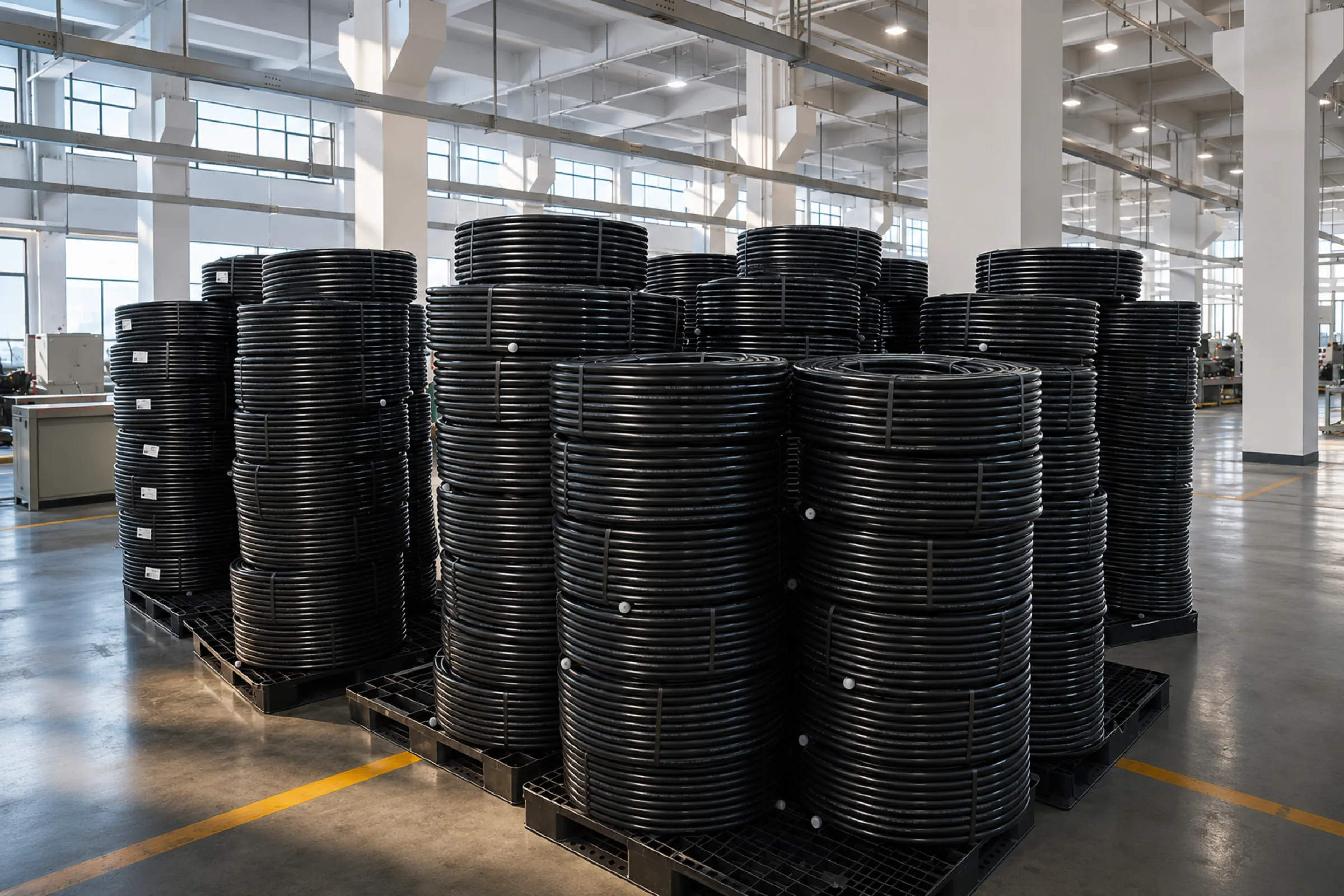
One boundary, stated plainly. IFANNova’s pressure systems stop at OD 110 mm, while force main diameters begin at 4 in. This is not pipe we supply, and we would rather say so than route the enquiry onward. Our range serves the small-diameter pressure and drainage work around a pumped system: the pipe material selection matrix shows where each system sits, and pressure testing and creep in plastic pipe covers how sustained pressure is verified.
Before the force main line item leaves your desk:
What pipe is used for a sewage force main?
Pressure-rated pipe. For plastics that means PVC to ANSI/AWWA C900, sized by dimension ratio from PC 165 psi at DR 25 up to PC 305 psi at DR 14, or HDPE to AWWA C906-21 in PE4710, typically DR 11 at 200 psi for 4 to 12 in lines. Ductile iron is the common metallic alternative.
Can SDR 35 sewer pipe be used for a force main?
No. ASTM D3034 assigns no pressure rating, so there is no rated basis on which to use it under pump pressure. Its 46 psi figure is a pipe stiffness measured to ASTM D2412, describing resistance to deflection under earth load, and it cannot be read as a pressure capability.
What is the minimum velocity in a force main?
2 ft/s, about 0.61 m/s, is the widely specified floor for keeping solids in suspension, corroborated across independent jurisdictions. Once solids have settled, 3 to 3.5 ft/s is needed to re-suspend them, and the usual working ceiling is around 6 ft/s.
What is the difference between a force main and a gravity sewer?
A gravity sewer flows partly full under atmospheric pressure and is designed against earth load and ring deflection. A force main is pumped, sits under continuous internal pressure, and is designed against hoop stress with a surge allowance, restrained joints and a minimum scouring velocity.