Chemigation Shutdown: Check Valve or Interlock?
A check valve cannot, by itself, stop an electrically driven chemical injection pump when irrigation water stops flowing. A chemigation shutdown review must distinguish reverse flow in the irrigation main, water entering the chemical line, gravity feed from the chemical tank and continued powered injection. Each needs an identified control; one item labelled “backflow prevention” does not establish that all four are covered.
This is a selection and coordination guide for irrigation buyers and project designers. The university guidance cited below describes US chemigation safeguards. Its regional requirements are examples, not worldwide rules or approval of an IFANnova assembly. Have a qualified local designer establish the applicable chemical label, water-supply requirements and accepted installation before equipment is ordered or operated.
- A non-return function and a shutdown command solve different problems.
- An injection pump that stops may still leave a path for gravity-driven chemical flow.
- Separate main-line and injection-line protection on the review drawing.
- Document what happens when water flow fails, not only when normal power is switched off.
- Keep design acceptance and component availability as separate decisions.
Related ITRC educational video: Fertilizer and Chemical Injection Devices. Category context; not IFANnova equipment approval. Playback has not been manually verified.
Trace the liquid paths before naming the valve
Start with the water source, the irrigation pump, the chemical tank, the injector and the injection point. Mark the normal direction of flow in both the irrigation main and the chemical line. Then consider where liquid could move when irrigation pressure falls or a pump stops. The purpose is to identify the driving force and destination, rather than assume every unwanted movement is the same kind of backflow.
One path leads from the irrigation main towards the water source. Another leads from the pressurized main back through the injector line towards the chemical tank. A third begins at the chemical tank: its elevation and the connected piping can allow chemical to continue moving after the intended injection stops. Finally, a powered injector can keep delivering chemical if its controls do not respond to loss of irrigation water. A drawing that shows only the first path leaves the other questions unanswered.
The University of Hawaiʻi chemigation guide distinguishes irrigation-line safeguards, injection-line protection and interlocking controls. Those distinctions explain why a single check-valve symbol is insufficient for a complete shutdown review. Its public-water-supply discussion also makes the source type consequential; a private irrigation source and a municipal connection must not be treated as interchangeable approval situations.
For a general incoming-building service, see water-service backflow protection. That is a different selection task from coordinating a chemical injector. Likewise, a Venturi that will not draw under operating conditions needs a hydraulic-duty check; restoring suction does not establish safe shutdown behaviour.
Match each failure path to its protection
The following matrix separates functions. It is not a bill of materials or a substitute for the accepted assembly detail. A particular approved arrangement may combine functions, but the review still needs to show how each one is achieved.
| Failure path | Function to establish | What a generic check-valve claim leaves unresolved |
|---|---|---|
| Liquid returns towards the water source | Accepted irrigation-main source protection, with the required associated safeguards | Whether the source type, local rules and complete arrangement permit that device |
| Irrigation water enters the chemical line | Injection-line reverse-flow protection | Whether a valve elsewhere in the main protects the chemical tank |
| Chemical feeds by gravity after shutdown | Positive closure or another accepted means of preventing unintended tank discharge | Whether forward-direction gravity flow can open or bypass the proposed arrangement |
| The injection pump runs after irrigation flow is lost | A functional interlock responding to the applicable irrigation shutdown or flow-loss condition | How a passive valve would stop an energized injection pump |
Minnesota Extension’s safety guidance addresses the interlock separately from the chemical injection-line check valve. It also describes a normally closed solenoid valve where chemical could continue leaving the tank after shutdown. Its location and control arrangement belong to that guidance and the actual accepted design; they should not be improvised from a simplified article diagram.
Both Minnesota and Hawaiʻi guidance say that a properly specified injection-line check valve can prevent gravity flow from the chemical tank after shutdown. That capability must be established for the actual valve and tank head; it does not follow from the generic label “check valve.” A separate normally closed solenoid is configuration- and guidance-dependent, rather than universally required by this article.
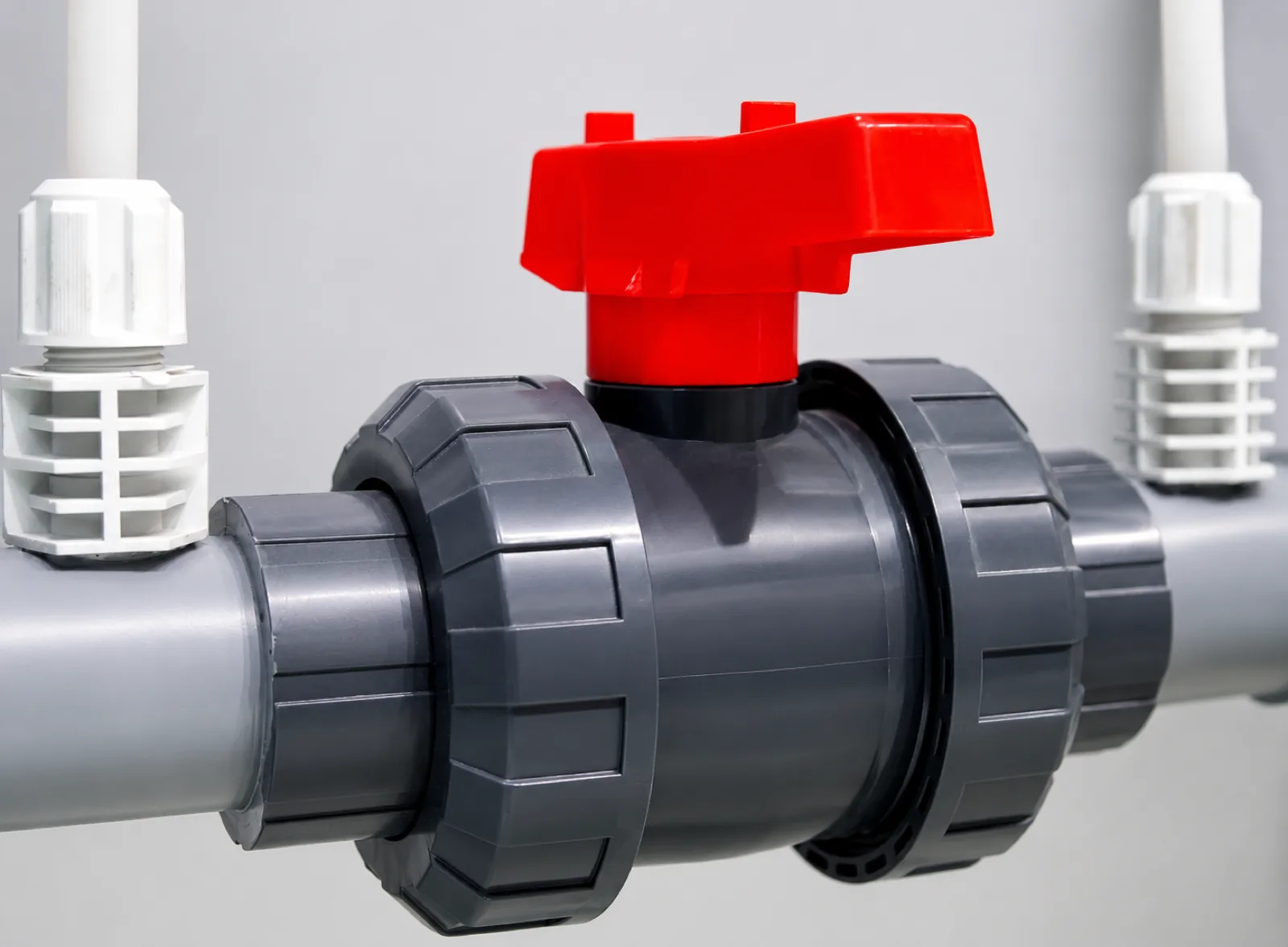
A normally closed valve is useful only within an arrangement that produces the required closed condition. The review therefore asks what supplies its opening command, what happens when that supply disappears and whether the physical flow path is the one being controlled. A valve name on a quotation cannot answer those questions. Conversely, an interlock that stops a motor does not automatically close every open liquid path connected to the tank.
Read three shutdown scenarios
Scenario A: the irrigation pump stops, but the injection pump remains powered. The missing demonstrated function is coordinated injection shutdown. A check valve intended to allow normal injection cannot be assumed to stop that same forward flow merely because irrigation delivery has ceased. Keep the system on hold until the designer identifies the effective interlock and its accepted verification. Adding another unspecified check valve does not resolve the control question.
Scenario B: both motors stop, but the chemical tank can still feed the line. Successful electrical shutdown has addressed the powered-injection path. It has not proved that elevation-driven discharge is prevented. First establish whether the specified injection-line check valve already prevents that gravity flow. Minnesota guidance separately calls for a suitable interlocked, normally closed solenoid where chemical could still leave the tank after shutdown. The actual review must establish the relevant tank level, piping route and accepted closure, without transferring a generic valve’s cracking-pressure figure into this design.
Scenario C: the injector stops while the irrigation main remains pressurized. The concern now includes water moving towards the chemical tank. Injection-line protection is relevant even though the irrigation main may have its own upstream source-protection assembly. These devices occupy different paths. Identifying the main-line valve therefore does not close the injection-line item in the record.
The countercheck is useful: change only the status of the injection pump from running to stopped. In Scenario A, preventing powered injection is central. In Scenario B, stopping the pump is already true, yet unintended chemical movement remains possible. If a proposed explanation gives the same “pump stopped, safe” result in both situations, it has omitted the gravity-feed question.
Build a usable review record
Use a review sequence that a buyer can hand to the responsible designer. It is a document review, not a procedure for testing chemical equipment or bypassing a control.
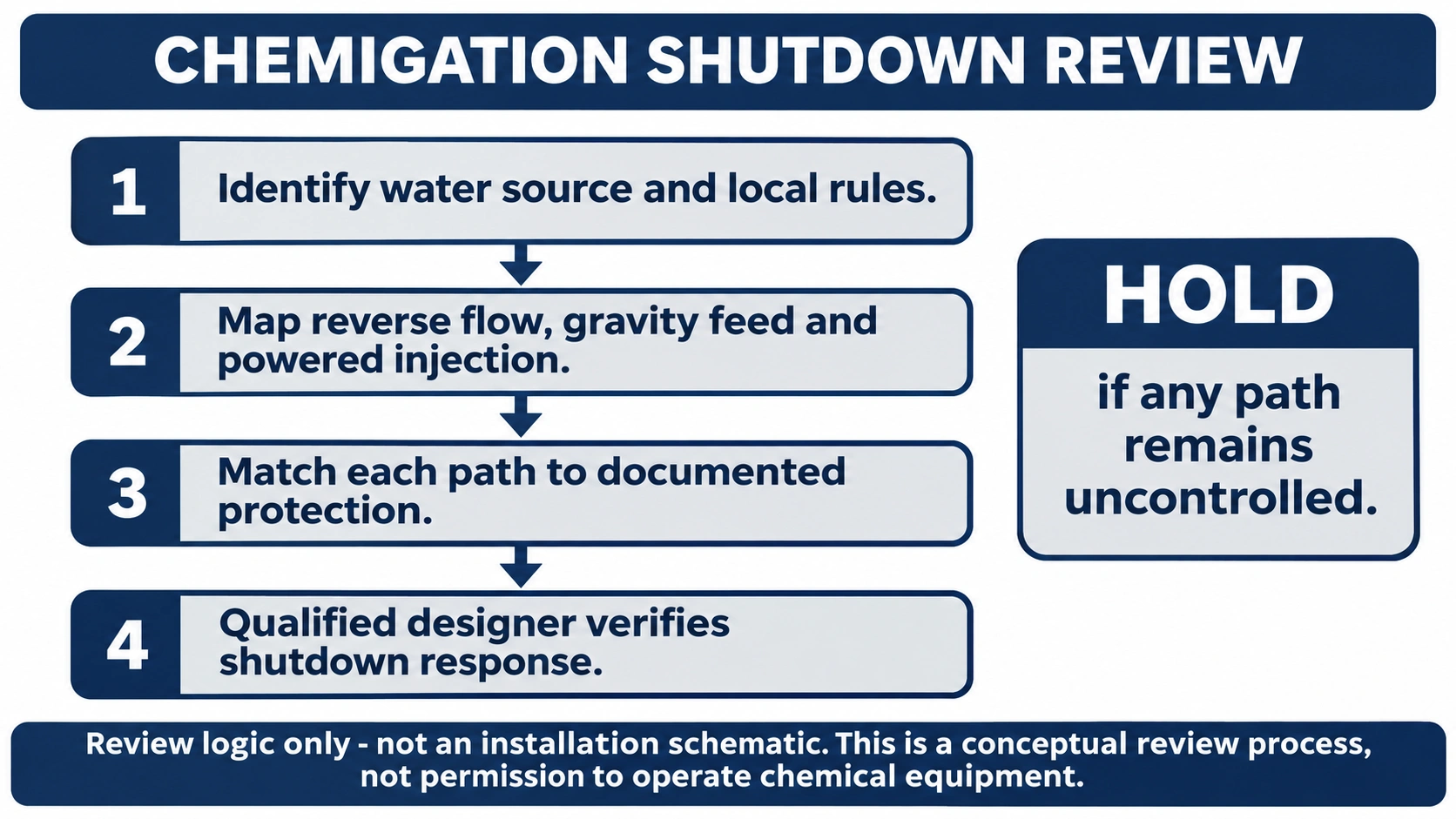
- Identify the source and applicable instructions. Record source-water type, chemical product and label, jurisdiction and the designer responsible for acceptance. Unresolved applicability stays open.
- Mark each liquid and control path. Include tank elevation, the main and injection-line routes, pump drives and the condition that indicates irrigation water has stopped or failed.
- Assign documented protection to each failure path. Record the exact device or control, the instruction that supports its function and the remaining conditions. A blank function is a hold, even if another row has two valves.
- Obtain qualified verification of shutdown response. Record the approved inspection or test method, responsible person and result. Keep unverified functions open; do not operate on the strength of a completed purchasing checklist.
For example, a supplier submission may identify an injection-line check valve and confirm that the injection motor shares an interlock with the irrigation pump. That supports two parts of the review, but it does not by itself resolve gravity feed or suitability of the water-source protection. The useful purchasing response is a specific request for the missing functions and evidence. It is not a declaration that the entire proposal is compliant.
When selecting irrigation piping and fittings, keep chemical compatibility, operating conditions and connection details tied to the actual equipment schedule. The university material explains safety functions; it does not prove a particular IFANnova component is available, chemically suitable or approved for a chemigation assembly.
Submit the pipe material, sizes, connection details, chemical and operating conditions for an availability check. Identify the designer-approved function required of each component.
| Submission | Disposition |
|---|---|
| Only an injection check valve and motor interlock are identified | Keep gravity-feed capability and source protection open pending specific evidence. |
| A specified check valve already prevents gravity discharge | Record that documented function; establish any separate solenoid requirement from the applicable design and guidance. |
| The pump stops, but the chemical tank may still discharge | Hold the gravity-feed function; motor shutdown alone is insufficient. |
Conclusion
Review chemigation shutdown by failure path. Main-line source protection, injection-line reverse-flow control, prevention of unintended tank discharge and stopping powered injection have different jobs. Match each to documented equipment and controls, then leave installation acceptance and verification with the qualified local designer. That produces a useful purchasing record without mistaking one valve for a complete safety system.
Frequently asked questions
Does a check valve replace the injection-pump interlock?
No. A passive non-return function does not establish that powered injection stops when irrigation water fails.
Is stopping both pumps enough?
Not necessarily. The review must also address unintended tank discharge and the other liquid paths after shutdown.
Can these US examples approve an overseas installation?
No. The actual chemical label, water-source conditions, local requirements and qualified design acceptance control the installation.