Installation & Jointing · Irrigation maintenance
Is Your Dripline Flush Fast Enough? Measure the Outlet
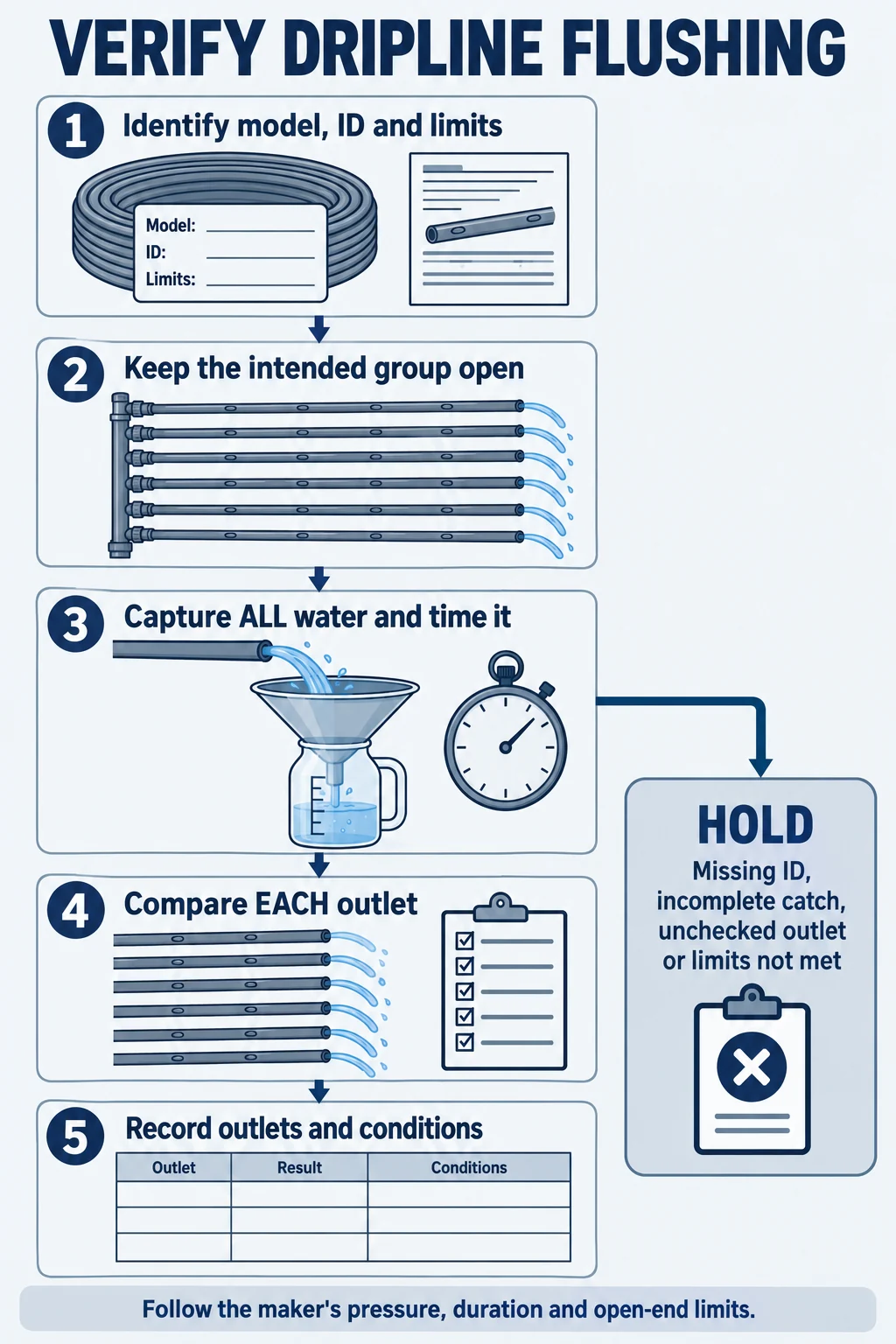
Clear water and a pressure reading do not measure dripline flushing velocity. Capture the complete discharge from each accessible lateral end with the intended group open, then compare its flow with the applicable product criterion using the actual inside diameter. Keep the maker’s pressure, duration and open-end limits. An unchecked outlet remains unverified.
This check establishes a hydraulic flushing condition. It does not prove that every emitter is clear, diagnose a blocked emitter or set a universal flushing interval.
Key Takeaways
- Record pressure, water appearance and outlet flow separately.
- Use the exact dripline model and inside diameter, rather than a nominal size or a distribution-pipe label.
- Keep the intended group open while timing each complete outlet catch.
- Accept a whole group only when every outlet being accepted has been checked under the same permitted condition.
- A failed outlet rejects that tested group; an unchecked outlet leaves acceptance unknown.
- Change the group only within the installed maker’s instructions. If required flow and permitted limits cannot coexist, stop.
 Play: Drip Irrigation Maintenance
Pressure, clarity and outlet flow answer different questions
A public irrigation-maintenance question describes flushing several end runs, seeing almost no dirt and reading 25 PSI at the ends. The operator concludes that pressure should be enough to scour. That is a useful question about evidence: the report supplies neither the actual inside diameter nor a timed outlet discharge.
It would be equally unjustified to declare that installation’s flushing successful or unsuccessful from those details. The pressure-measurement location and whether the end was open during the reading also matter. The missing flow measurement is the point to resolve.
| Observation | What it establishes | What it leaves open |
|---|---|---|
| A pressure reading | Pressure at that gauge, under the recorded condition | Actual lateral-end flow and velocity |
| Clear-looking flush water | Visible appearance of the discharge at that moment | Whether the applicable flushing velocity was reached |
| Complete outlet volume divided by time, with exact ID | An outlet flow/velocity comparison for the tested condition | Other unchecked outlets, emitter uniformity and the cause of a blockage |
Netafim’s 2022 maintenance handbook, printed pages 23–25, treats clear water and verification of flushing velocity as separate parts of its procedure. Keep both. A clear catch does not excuse a failed flow check; a fast catch does not excuse ignoring the maker’s cleaning endpoint.
The same distinction applies upstream. A distribution connection can feed several lateral lines, but seeing water move through that connection does not establish each line’s end flow. Map the ends you intend to verify before opening them.
For the wider pipe-and-fitting layout, see the irrigation network tier guide. The present check concerns the downstream dripline ends.
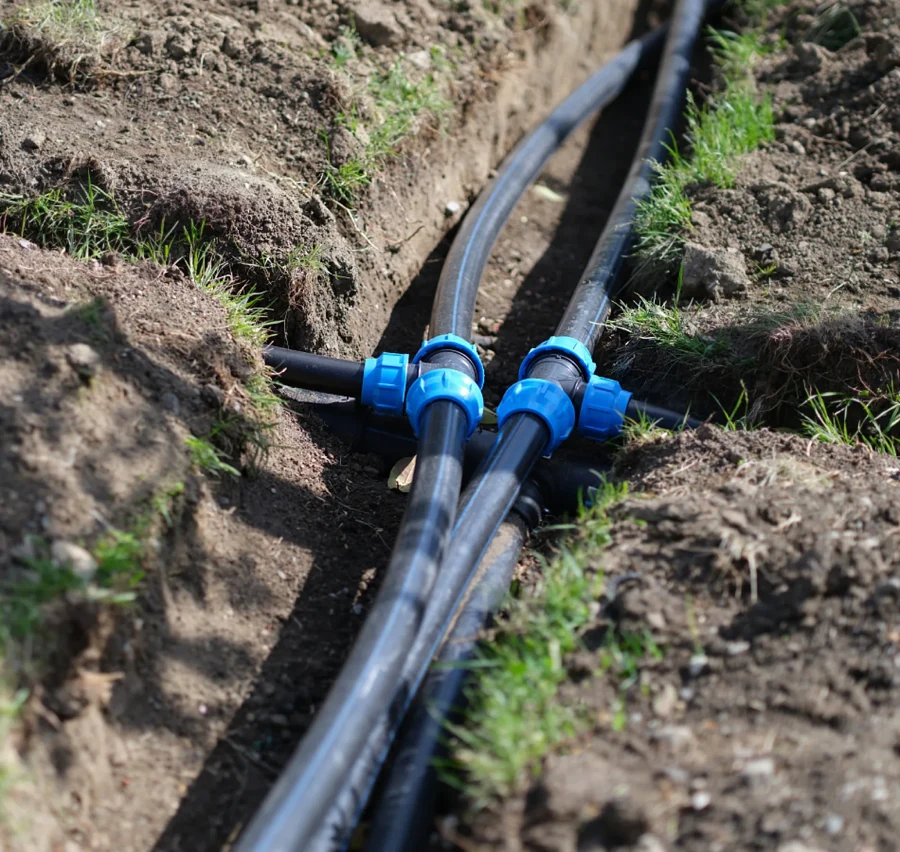
Time a complete outlet catch with the group open
UC ANR’s flushing guidance explains that the number of laterals that can be flushed together may need trial-and-error to maintain the desired flow. For the record used here, keep the selected group and operating condition unchanged while measuring each outlet. If they change between catches, the measurements no longer describe one group trial.
- Identify the exact product and its limits. Obtain the dripline model, actual inside diameter, applicable flushing criterion and the maker’s pressure, duration and minimum-open-end conditions. Include limits of the connected components. If one of these necessary inputs is missing, hold the acceptance check; do not use a nearby nominal-size row.
- Prepare the permitted flushing condition. Follow the installed system’s instructions. The cited maintenance guidance flushes upstream mains and submains before laterals. Identify which ends form the intended group and keep the relevant pump mode and valve positions unchanged during its measurements.
- Capture all the outlet water. At an identified accessible lateral end, time a known collected volume. Netafim’s printed-page-23 method uses a funnel and a 1.5-litre bottle, with all discharge entering it. If water spills or escapes the funnel, repeat the catch; that time does not measure the complete outlet flow.
- Compare each outlet. Use the applicable model procedure and exact ID. Keep the same selected ends open while moving between outlets. Record the gauge location and observed pressure during the catches. A total collected at a combined flushing manifold, divided by its number of laterals, does not prove each individual lateral meets its criterion.
- Record the checked configuration. Name the outlets, group, catches, pressure condition and result. If one end is inaccessible or unchecked, withhold whole-group acceptance until it can be verified by an appropriate approved method.
Inside diameter is a separate input
Netafim warns that the dimensions in its model-identification table are not exact product dimensions; the specific technical datasheet controls. A “16 mm” name is not permission to choose any 16 mm row or substitute the size of the supply pipe.
For a complete catch, flow (L/min) = 60 × collected litres ÷ seconds. Velocity then depends on the internal area: v = Q ÷ A, with compatible units and A = π × (ID ÷ 2)². Larger actual ID requires more flow for the same velocity.
Criteria have scope. Netafim’s cited bottle test checks at least 0.5 m/s. UC ANR’s guidance states at least 1 ft/s in its context. Do not turn these into a universal “acceptable versus optional optimal” hierarchy. Use the installed product’s applicable instructions.
Read the record: clear water can still fail the flow check
The table and chart below reproduce Netafim’s 2022 printed-page-23 bottle-time reference. They apply to a 1.5 L complete catch and at least 0.5 m/s at the stated exact IDs. They are neither a list of nominal pipe choices nor confirmation that this criterion applies to every installed dripline.
The reference chart scrolls horizontally. Focus the chart and use the left and right arrow keys, or swipe, to read every label; the complete values are also in the table below.
| Exact ID (mm) | Maximum fill time (s) |
|---|---|
| 11.8 | 27.4 |
| 14.2 | 18.9 |
| 16.2 | 14.6 |
| 17.5 | 12.5 |
| 20.8 | 8.8 |
| 22.2 | 7.8 |
| 25.0 | 6.1 |
| 35.0 | 3.1 |
An illustrative failure, then a fully checked group
All trial inputs below are hypothetical teaching assumptions. Assume “Model X” has an exact ID of 14.2 mm and an applicable procedure requiring at least 0.5 m/s. Its instructions permit the groups and operating conditions described. No actual product, field test or safe pressure setting is being reported.
Trial A: eight ends open. L8 takes 24 seconds to fill 1.5 L, even though its water looks clear. Its flow is 60 × 1.5 ÷ 24 = 3.75 L/min. It exceeds the applicable 18.9-second maximum, so reject this eight-end group as tested. L1–L7 were not checked in this trial; no passing claim is made for them. One failed end is already enough to reject the group.
Trial B keeps the same six ends open: L1–L6; L7 and L8 are closed. Every catch below is taken with all six selected ends still open, the same pump mode and the same other relevant valve positions.
Shared condition B-G6-PG: assume gauge P-G at the submain/lateral feed reads 1.00 bar before and after each catch and remains at that observed value during each catch. Assume the trial takes 12 minutes and every product/component pressure, temperature and duration limit is satisfied. These are illustrative record entries, not recommended settings. Without the actual maker’s permitted limits, the result would remain on hold.
| Outlet | Fill time (s) | Calculated flow (L/min) | Against 18.9 s |
|---|---|---|---|
| L1 | 15 | 6.00 | Pass |
| L2 | 16 | 5.63 | Pass |
| L3 | 16 | 5.63 | Pass |
| L4 | 17 | 5.29 | Pass |
| L5 | 17 | 5.29 | Pass |
| L6 | 18 | 5.00 | Pass |
All six individual catches meet the comparison under the assumed permitted condition. Six is therefore the largest tested passing count in these two trials. Seven was never tested. The record establishes neither a true maximum nor the performance of another six-line group.
Now remove L6’s catch from the record. Five passing catches do not prove the sixth. The result for the whole six-end group becomes unknown, rather than a representative pass. The same problem arises if the operator closes other ends between measurements: those catches no longer describe one common open-group condition.
Keep the result within its operating limits
Reducing an open group can improve the flow available to each lateral, but it is not an unrestricted instruction. The maker’s permitted pressure procedure may also depend on how many ends remain open.
Do not raise pressure blindly to rescue a failed catch. Confirm the installed maker’s method and every affected component limit. If the required outlet flow cannot be obtained within those conditions, the flushing arrangement needs review; another reassuring gauge reading does not resolve the incompatibility.
Retain a record with the block and outlet IDs, exact model and datasheet, ID, applicable criterion, open-group membership, pump/valve condition, gauge location and observations, each catch, duration and result. Keep water appearance in a separate observation field. Recheck when group membership, relevant valve positions, pump mode, layout or other conditions affecting flow change.
Keep the distribution connection separate. A dripline maker’s flushing instruction does not establish that an upstream pipe, fitting or valve is compatible. Record the actual material, dimensions, connection and service conditions alongside it. IFANNova’s compression-fitting category concerns this connection side; it does not establish a dripline, filter, flushing-valve or irrigation-design-service offer.
For a business pipe-and-fitting enquiry, Check pipe and fitting availability. Include the pipe dimensions and material, connection specification, service pressure and temperature, quantities and destination. Confirm availability and compatibility records for the actual request. IFANNova’s contact page directs individual homeowners to local distributors or retailers.
Conclusion
Start by identifying the line and its permitted procedure. Capture the full outlet discharge with the intended group open, compare every accepted end and retain the exact condition. Clear water remains a useful cleaning observation; it cannot replace the hydraulic check. Missing evidence stays unknown, and a failed test never overrides the operating limits.
Frequently Asked Questions
Does 25 PSI prove flushing is fast enough?
No. It is a pressure reading under a particular condition. Actual outlet discharge and inside diameter are needed to check velocity against the applicable product criterion.
Can I use the nearest diameter in the bottle-time table?
No. Use the actual inside diameter and the applicable maker’s data or calculation. A nominal size or outside diameter does not identify the correct internal flow area.
Can one combined manifold catch prove every lateral passes?
No. Total flow divided by the number of laterals is an average. It does not establish each individual outlet’s flow; use an appropriate approved verification method.
Does a passing outlet-flow check mean all emitters are unclogged?
No. It verifies the checked outlet’s hydraulic flushing condition. Emitter discharge, uniformity and any remaining blockage require their own assessment.