Pipe is a volumetric cargo. This page covers what fits in each container type, how mixing product lines changes the answer, and which decisions belong on the purchase order rather than at the loading bay.
Ask a forwarder to quote a 40 ft of steel pipe and the binding constraint is weight. Ask for a 40 ft of PPR, UPVC or HDPE and the binding constraint is almost always volume — the box is full, the payload gauge has barely moved, and you are paying ocean freight on enclosed air.
The numbers make this concrete. A 40 ft standard dry container in Maersk’s own fleet has an internal capacity of 67 m³ and a maximum payload of 28,800 kg (Maersk, “Our fleet — equipment specifications, DRY CONTAINERS”, official PDF). To reach that payload inside that volume, your cargo would have to average roughly 430 kg per cubic metre of container space — and that is space, not material. Bundled thin-wall plastic pipe does not come close, because most of what you are stowing is the bore.
This is the practical definition of a volumetric or “light” cargo: you run out of cubic metres first. Steel pipe, cement, tiles and valves are the opposite — they weight out. The entire discipline of loading a pipe container is deciding what to put in the remaining payload so the box leaves neither half-empty nor over its plate.
This page covers container selection and mixed loading. It does not repeat the length-and-packing question — whether your pipe should be 4 m or 6 m, and how socket depth affects your metre count, are handled in our companion page on PPR pipe length and packing. Read that one first if your length is still open; this one assumes it is fixed.
You will be told, confidently, that ocean freight bills on a “revenue ton” of 1 m³ or 1,000 kg, whichever is greater. We went looking for the authority behind that ratio and did not find one.
Specifically: we retrieved and parsed the full text of 46 CFR 520.2, the US Federal Maritime Commission’s definitions section for carrier automated tariffs. It defines “Rate”, “Publisher”, “Retrieval” and related terms. It contains no definition of W/M, “measurement ton”, “revenue ton”, or any 1 m³ = 1,000 kg equivalence. Searches against UNECE and WCO returned only forwarder glossary and marketing pages, which we do not treat as citable sources.
Our conclusion, stated plainly: the weight/measurement ratio is a commercial carrier tariff convention, not a regulated or standardised figure, and it demonstrably varies — 750 kg/m³ and 500 kg/m³ both circulate in quoted tariffs. We are therefore not going to give you a conversion rule. Read the rate basis on your own carrier’s or NVOCC’s quotation, in writing, for your specific trade lane, and plan against that. A supplier who hands you a universal ratio is handing you someone else’s tariff.
The same caution applies to the air-freight volumetric divisor of 6,000 that gets imported into sea-freight discussions by analogy. It is widely attributed to IATA, but we could not open any IATA-official page stating it, and several sources note carriers also use 5,000. It is outside the scope of a sea-freight page anyway, and we flag it here only so it does not get borrowed.
What is not in doubt is the physical fact underneath the commercial convention: pipe consumes volume disproportionately to its mass. That holds whatever your carrier’s tariff says, and it is what drives every decision below.
There are three different sets of numbers in circulation for the same box, and mixing them is how a stow plan goes wrong. In order of authority:
1. ISO 668 external dimensions. These are standardised and fixed. Series 1 general purpose containers are 6,058 mm long (20′), 12,192 mm (40′) and 13,716 mm (45′); 2,438 mm wide; 2,591 mm high in standard and 2,896 mm in high cube (Hapag-Lloyd Container Specification, official PDF, p.5, “External and minimum internal dimensions according to ISO 668”). You will never load against these — they are the outside of the steel.
2. ISO 668 minimum internal dimensions. These are guarantees of a floor, not descriptions of a typical unit: minimum internal length 5,867 mm (20′), 11,998 mm (40′), 13,542 mm (45′); minimum internal width 2,330 mm; minimum internal height 2,350 mm (8’6″) or 2,655 mm (9’6″). Minimum door opening 2,286 mm wide, and 2,261 mm high (8’6″) or 2,566 mm high (9’6″) (ISO 668:2020, Table 3). Note that Hapag-Lloyd’s booklet prints a slightly more generous set of minima on p.5 under an ISO 668 heading; those are that carrier’s own nominal figures, and the standard’s floor is the lower one. Plan tight-fitting cargo against these, because a conforming container is permitted to be exactly this size and no larger.
3. Actual fleet dimensions. Real equipment usually exceeds the ISO minimum, and carriers publish their own figures. These are the numbers to use for volume estimation once you know you physically fit.
| Container | Internal L × W × H (mm) | Capacity | Tare | Max payload | Door opening (W × H) |
|---|---|---|---|---|---|
| 20 ft standard dry | 5,896 × 2,350 × 2,393 | 33 m³ (1,165 cu ft) | 2,280 kg | 28,200 kg | 2,350 × 2,274 mm |
| 40 ft standard dry | 12,032 × 2,350 × 2,393 | 67 m³ (2,366 cu ft) | 3,700 kg | 28,800 kg | 2,340 × 2,274 mm |
| 40 ft high cube | 12,032 × 2,350 × 2,697 | 76 m³ (2,684 cu ft) | 3,880 kg | 28,620 kg | 2,340 × 2,577 mm |
All figures above are from Maersk’s official equipment specification PDF; internal heights are stated to the load line. We cross-checked every row against Hapag-Lloyd’s published figures for the same three ISO size types (22G0/22G1, 42G0/42G1, 45G0/45G1), which give capacities of 33.0–33.2 m³, 67.7 m³ and 76.3–76.4 m³ respectively, and maximum payloads of 28,180–30,250 kg, 26,700–28,800 kg and 28,200–28,670 kg (Hapag-Lloyd Container Specification, official PDF).
Note the spread in that cross-check, because it is the point. Payload on a nominally identical 40 ft ranges from 26,700 to 28,800 kg within a single carrier’s own fleet. Never plan a weight-critical load against a generic figure. The legally binding number for your specific box is on its CSC safety approval plate: the International Convention for Safe Containers requires each freight container to carry a plate specifying the maximum permitted gross mass, with tare mass and payload additionally marked in painted letters on the door or rear end (IMO/ILO/UNECE CTU Code 2014, section 6.2.2).
One further correction, because it inflates purchase orders. The figure of 36,000 kg circulates as the maximum gross mass of an ISO container. ISO 668:2020 does permit ratings up to 36,000 kg for special traffic while remaining ISO-conforming, but the common rating R is 30,480 kg (67,200 lb) (ISO 668:2020 catalogue entry, scope/abstract), and both carriers we checked show 30,480 kg or 32,500 kg on actual equipment (Hapag-Lloyd Container Specification, p.4, “General information — Maximum gross weights”). 36,000 kg is an upper permissible rating, not a fleet figure. Planning to it would overstate your loadable weight by several tonnes.
A note on sourcing: iso.org’s catalogue page returns HTTP 403 to automated retrieval, but ISO 668:2020’s own Table 2 (external dimensions, tolerances and ratings) and Table 3 (minimum internal and door opening dimensions) are readable in the official preview PDF, and the ratings and minimum dimensions above are taken from them rather than from a carrier’s transcription. If your contract turns on exact designation-by-designation ratings, buy the standard.
Because pipe cubes out, the container decision is a volume decision with a weight sanity-check, not the reverse. Work it in that order.
Step one: what does the high cube actually buy you? Only height. The 40 ft HQ has the same 12,032 mm internal length as the 40 ft standard; what changes is internal height, 2,697 mm versus 2,393 mm, and door height, 2,577 mm versus 2,274 mm (Maersk equipment specification). That converts to 76 m³ versus 67 m³ — about 13% more volume for the same floor plan, which for a cargo that cubes out is usually the best-value move on the list. Two caveats catch importers: the extra volume sits above the standard door height, so it has to be filled by stacking that clears the aperture; and the height gain is worth nothing if your limit is floor area rather than stack height.
Step two: does two 20 ft beat one 40 ft? On volume, no. Two 20 ft units give 66 m³ against a single 40 ft’s 67 m³ — effectively identical, at two sets of terminal handling charges. On payload, however, two 20 ft units give 2 × 28,200 = 56,400 kg against a single 40 ft’s 28,800 kg (Maersk equipment specification). That near-doubling of weight capacity for the same volume is why dense cargo ships in 20 ft units.
For plastic pipe this inverts the usual logic: the 20 ft’s weight advantage is worthless to you, so the 40 ft or 40 HQ almost always wins on cost per cubic metre. The 20 ft earns its place for a different reason — it is the smallest full container load. If your order is roughly 30 m³, a 20 ft ships it as FCL on your own seal and schedule, rather than as LCL sharing a box.
| Situation | Indicated box | Reasoning |
|---|---|---|
| Order volume well under ~30 m³ | LCL, or wait and consolidate | Below a 20 ft’s 33 m³ capacity; a part-filled FCL pays for air |
| Order volume near 30–33 m³ | 20 ft standard | Smallest FCL; own seal, own schedule |
| Order volume 60–67 m³ | 40 ft standard | Twice the volume of a 20 ft at one set of handling charges |
| Order volume 67–76 m³, light cargo | 40 ft high cube | +13% volume, same floor plan; the default for pipe |
| Volume fits but weight is near the plate | 40 ft standard, or split into 20 ft units | 20 ft units give far more payload per m³; also check running-metre limits below |
| Pipe plus a dense product line | 40 ft HQ, mixed — see next section | The dense line consumes payload the pipe leaves unused |
Two constraints sit outside this table and must be checked separately for your route. First, road and rail weight limits at destination. Hapag-Lloyd explicitly states that weight limits for road and rail transport are separately regulated and must be checked locally (Hapag-Lloyd Container Specification, p.4). These limits frequently bind before the container’s own payload rating does — a container legally loadable to 28 t by sea can be undeliverable by road at the far end. We have deliberately not researched or estimated per-country figures, because they vary by national transport regulation and a wrong number here is worse than no number. This is the single most common costing error we see in pipe shipments. Ask your forwarder for the destination road limit before you fix the container type, not after.
Second, any destination-specific loading condition. Palletisation requirements, for example, change the arithmetic materially because pallets consume height and floor area that loose stow does not — see our Middle East market page for the GCC documentation and loading conditions we were able to verify.
Here is the structural opportunity in a plastic pipe order. A 40 ft HQ loaded to its 76 m³ capacity with bundled thin-wall pipe leaves most of its 28,620 kg payload unused. That unused payload is free carrying capacity you have already paid for.
The products that fill it are the dense, small-volume lines that would otherwise weight out their own box. On our range specifically, that means fittings and brass. Our UPVC 1806 series runs to 203 items including ball valves and solvent cement, the PPR 1138 series is 75 items, and the brass 2405 series covers 1/4″ to 1″ (per our catalogue). Cartoned fittings and brass have a far higher density than bundled pipe, and they are exactly the line items that generate reorders.
The general planning logic, stated as principle rather than as a table of ratios we cannot source:
What we will not give you is a utilisation percentage. We searched for an authoritative figure for typical or target space utilisation in pipe loading and found that no standards body, international organisation or government publishes one. The claims that circulate — that hexagonal bundle packing is densest, that nesting requires the inner pipe OD to be 38–50 mm smaller than the outer pipe ID, that stowage factors run 2.0–3.5 m³/MT for steel pipe — appear only on vendor and packaging-machinery marketing pages and cannot be verified at source. We are not going to repeat them.
The one thing in that cluster that is genuinely a fact is mathematical rather than industrial: the densest arrangement of identical circles in an unbounded plane is hexagonal close packing at approximately 90.7%. That is a geometric limit, not an achievable container figure, because real utilisation depends on how your specific pipe OD divides into the 2,350 mm container width and how much dunnage the stow needs. Treat utilisation as a calculation for your actual order, from the verified internal dimensions in the table above — not as a percentage anyone can quote you in advance.
Once you start adding dense cargo to a light one, four published limits become binding. All four come from the IMO/ILO/UNECE Code of Practice for Packing of Cargo Transport Units, which is the governing international good-practice reference for container packing — jointly developed by IMO, ILO and UNECE and endorsed by the governing bodies of all three in 2014, updating the 1997 Guidelines. It is explicitly a non-mandatory global code of practice (IMO, CTU Code page). Non-mandatory does not mean optional in practice: it is the document your carrier, your insurer and your surveyor will reach for.
Containers are designed so that the permissible payload, if homogeneously distributed over the entire loading floor, transfers safely to the four corner posts. Where the payload is not homogeneously distributed, concentrated-load limits apply, and it may be necessary to transfer weight to the corner posts using strong timber or steel beams (CTU Code 2014, Annex 7, section 3.1.1).
Dense pipe bundles and pallets of fittings are precisely the concentrated loads this clause is about. The published payload figure is not a licence to put it all on two square metres of floor.
This is the constraint most often missed on heavy pipe, and it binds long before payload does. Maximum spread load for concentrated cargo is 4.8 tonnes per running metre of length in a 20 ft (10,582 lbs), or 7.6 tonnes for steel-floor containers only; and 3 tonnes per running metre in a 40 ft, or 6.0 tonnes for steel-floor containers only. The load must never exceed maximum payload (Hapag-Lloyd Container Specification, official PDF, p.4, “Concentrated loads”).
Read the 40 ft figure carefully: 3 tonnes per running metre over 12 metres is 36 tonnes, so on a full-length even stow the payload binds first. But concentrate a dense fittings block into three metres of a 40 ft and your ceiling for that block is 9 tonnes regardless of how much payload remains. Spreading a mixed load down the full length of the box is not tidiness; it is a load limit.
The joint centre of gravity of the cargo should be close to mid-length and mid-width. Eccentricity should not exceed ±5% in general, with a rule of thumb of no more than 60% of cargo mass in 50% of the container length. Up to ±10% may be accepted in particular circumstances, since advanced spreaders can adjust (CTU Code 2014, Annex 7, section 3.1.4).
The 60%-in-50% rule is the one to hand to whoever is loading. In a mixed pipe-and-fittings container it is a real risk: pipe is uniform and light along the whole length, so a single pallet block of brass fittings near the door can move the joint centre of gravity further than the loader expects.
Side walls withstand a uniform load equal to 60% of the permitted payload; the front wall and door end withstand 40%, for a homogeneous load on the relevant wall area (CTU Code 2014, section 6.2.4). This matters when long pipe bundles are braced against the walls in transit.
For loading and discharge, floors on CSC-covered freight containers are only required to withstand an axle load of 5,460 kg (2,730 kg per wheel), though they may be built stronger — Hapag-Lloyd confirms 5,460 kg with a contact area of at least 142 cm² per wheel to ISO 1496-1, and up to 9,200 kg for steel-floor containers (CTU Code 2014, section 6.2.6, citing ISO 1496-1:2013 Annex C and CSC Annex II; Hapag-Lloyd Container Specification). If your consignee discharges bundles with a forklift driven into the box, this is their limit, and it belongs in the delivery instruction.
Lashing devices in a general purpose container have a permissible load of 1,000 kg (2,205 lbs) each on the top and bottom longitudinal rails and corner posts (Hapag-Lloyd Container Specification, 20’/40′ GP pages). The CTU Code notes bottom-rail anchor points in many cases have a maximum securing load of 20 kN, and top side rail points at least 5 kN (CTU Code 2014, section 6.2.5). Note the asymmetry: a pipe stow secured principally to the top rails is secured to the weaker points.
| Constraint | Limit | Source |
|---|---|---|
| Load distribution assumption | Payload rating assumes homogeneous distribution over the whole floor; concentrated loads may need load-spreading beams | CTU Code 2014, Annex 7 §3.1.1 |
| Running-metre load, 20 ft | 4.8 t/m (7.6 t/m steel floor only) | Hapag-Lloyd Container Specification p.4 |
| Running-metre load, 40 ft | 3.0 t/m (6.0 t/m steel floor only) | Hapag-Lloyd Container Specification p.4 |
| Centre-of-gravity eccentricity | ±5% general; ≤60% of mass in 50% of length; ±10% in particular circumstances | CTU Code 2014, Annex 7 §3.1.4 |
| Side wall strength | 60% of permitted payload, uniform load | CTU Code 2014 §6.2.4 |
| Front wall / door end strength | 40% of permitted payload, uniform load | CTU Code 2014 §6.2.4 |
| Forklift axle load on floor | 5,460 kg axle / 2,730 kg per wheel, ≥142 cm² contact per wheel; up to 9,200 kg steel floor | CTU Code 2014 §6.2.6; Hapag-Lloyd |
| Lashing point capacity | 1,000 kg per device (carrier); MSL 20 kN bottom rail, ≥5 kN top side rail (CTU Code) | Hapag-Lloyd; CTU Code 2014 §6.2.5 |
| Max permitted gross mass | As stated on that container’s CSC safety approval plate | CTU Code 2014 §6.2.2 |
One compliance item on this page is genuinely mandatory rather than good practice, and it applies to every container regardless of what is in it.
SOLAS requires a Verified Gross Mass for every packed container before loading, and it is a condition of loading — in force since 1 July 2016 under SOLAS chapter VI, Regulation 2, per IMO Resolution MSC.380(94). The shipper is responsible for providing the verified weight in the shipping document. Two methods are permitted: (1) weighing the packed container; or (2) weighing all packages, cargo items, pallets and dunnage and adding the container tare mass, using a method certified and approved by the competent authority of the state where packing was completed (IMO, “Verification of the gross mass”).
Three consequences for a mixed pipe load specifically:
On our side: we will state the packed weights we can evidence for your consignment. What we will not do is issue a VGM figure as though it discharges your obligation, because under SOLAS the responsibility sits with the shipper named on the shipping document.
Our range shapes the load plan in ways worth being explicit about.
Our pressure pipe stops at Φ110. HDPE PN16 runs Φ20–110, UPVC 806 PN16 runs Φ20–110, and PPR PN20 is narrower still at 20 × 2.8, 25 × 3.5 and 32 × 4.4 mm only, in 4 m lengths (per our catalogue). We cannot supply DN150–DN400 pressure mains. If your container plan is built around large-diameter trunk mains, that portion is not ours to load and we will say so at enquiry rather than at booking. In our PVC 902 drainage line only the 1902 fittings reach Φ160; the pipe itself stops at Φ110. Either way it is non-pressure drainage and is not an answer to a large-diameter pressure requirement.
Thin walls cube out hardest. A container of Φ110 PVC 902 drainage pipe is the most extreme light-cargo case in our range — at 2.2 mm of wall on a 110 mm bore, very little material per metre. Among the pressure lines the effect is milder, because a 20 mm PPR pipe at 2.8 mm wall is comparatively solid for its size. This is exactly where mixed loading with fittings and brass pays for itself, and where planning against a weight-based rule of thumb will mislead you most.
Our fittings count is the mixed-load asset. 203 items in UPVC 1806 including ball valves and solvent cement, 75 items in PPR 1138, HDPE 603/604 compression fittings, PEX 2114 and 2121 in 16–32 mm, and brass 2405 in 1/4″ to 1″, backed by 10,000+ moulds (per our catalogue). Single origin for pipe and fittings means one packing list and one counterpart when a stow plan needs to change — which, on a mixed container, it usually does.
One flag on solvent cement. The UPVC 1806 series includes solvent cement (per our catalogue). Solvent cement is a chemical product and its transport classification, packing group and any resulting segregation or documentation requirements are a matter for your carrier’s dangerous goods desk, not for a pipe supplier’s marketing page. We are not going to state a classification here. Raise it at enquiry so it is settled before the booking, because a dangerous-goods line item discovered late can unpick an entire consolidated load.
| Question | Status | Why |
|---|---|---|
| Pieces or metres per container, by diameter | Coming soon | Depends on bundle geometry, nesting, dunnage and the actual unit’s internal dimensions. We calculate it against your order rather than publishing a number |
| Weight per metre or per bundle | Coming soon | Confirmed at quotation against the actual references |
| Typical space utilisation % | No authoritative source exists | No standards body or international organisation publishes one; circulating figures are vendor marketing |
| Ocean freight cost or rate basis | Not ours to state | The W/M ratio is a carrier tariff convention, not a standard; read your own quotation |
| Destination road/rail weight limit | Not researched, deliberately not estimated | Varies by national transport regulation; confirm with your forwarder for the delivery leg |
| Duty, MOQ, lead time | Coming soon | Quoted per enquiry; we do not publish figures we cannot hold |
| Nesting ratios by diameter pair | No verifiable source | Circulating figures trace only to vendor pages; we treat nesting as a principle, not a published ratio |
Putting the above into the order the decisions actually have to be made:
How many metres of Φ110 pipe fit in a 40 ft? We do not publish a figure. It depends on bundle geometry, whether nesting is accepted, dunnage and the actual unit’s internal dimensions, and no authoritative source publishes pipe-per-container counts. Send your metres per diameter and we will work it as a calculation for your order.
Can I mix pipe and fittings in one container? Yes, and for a light cargo like pipe it is the efficient choice — the dense cartons occupy payload the pipe leaves unused. Observe the load-distribution, running-metre and centre-of-gravity limits above, and raise solvent cement separately with your carrier.
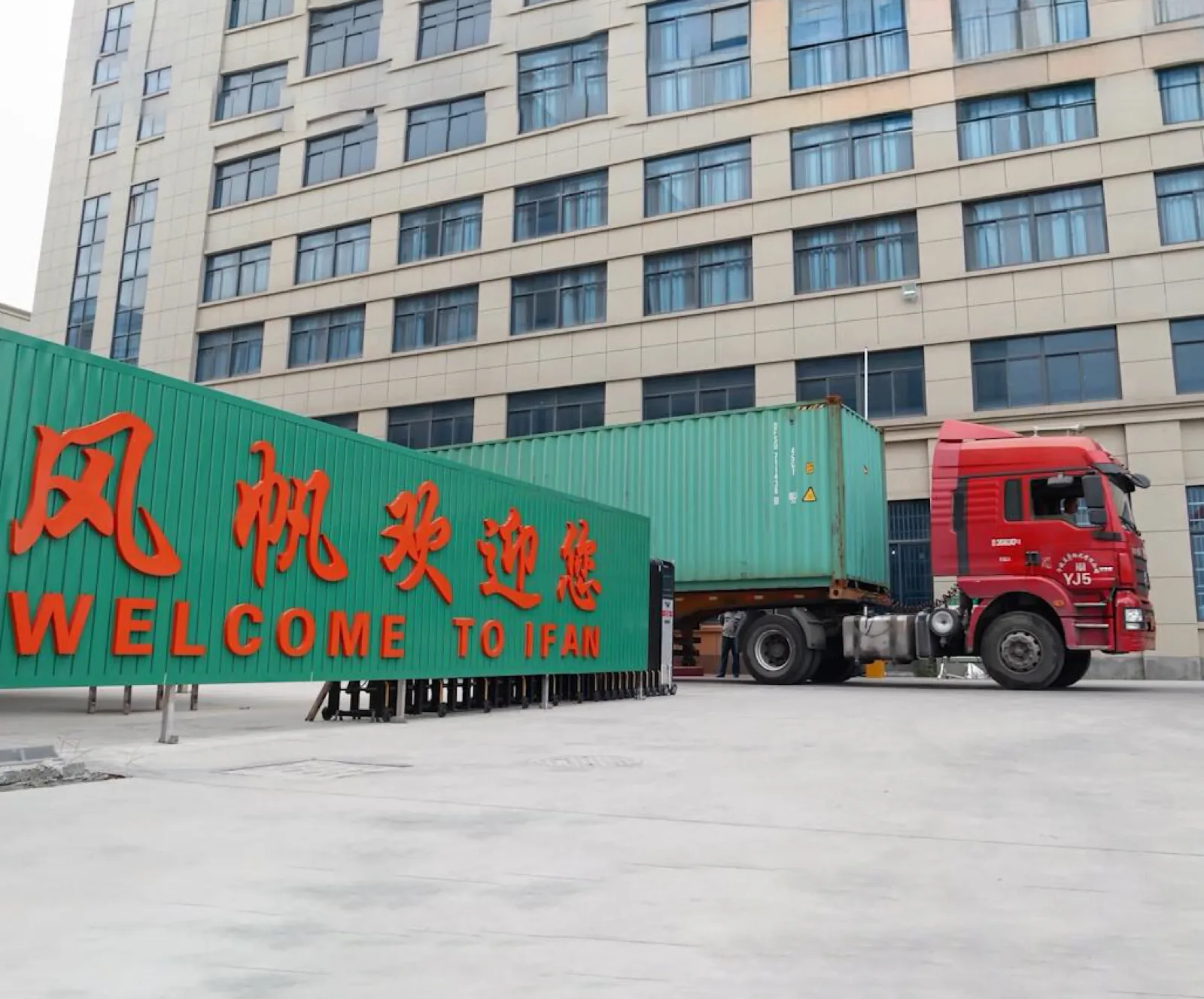
Are your pipes made in France? No. IFANNova is a French brand; the pipe is manufactured by Zhuji Fengfan Piping in Zhuji, Zhejiang, China. Nothing in our range is made in France, and the certificate of origin will say so.
Container selection is one of the few procurement decisions where the arithmetic is genuinely knowable in advance — but only against real quantities, not against a rule of thumb. Send your metres per diameter, your fittings list, the destination port and the delivery leg after it, and you will get back: which container type your order actually indicates, what the mixed-load balance looks like, and a straight “this is outside our range” on anything above Φ110.
A 4 m fixed length is a shipping decision as much as a product one.
Not a sales pitch for cutting out the middleman.
Both routes are legitimate.