When a contractor asks “should I buy from the local supplier or import directly?”, the answer usually offered is a price comparison. That framing is wrong in a way that costs money later.
These are not two prices for the same transaction. They are two transactions with different legal structures. In one, you buy goods that already exist and already cleared customs. In the other, you contract for goods that do not yet exist, agree on a point in the world where responsibility moves from a seller to you, and finance the gap. Almost every unpleasant surprise in direct importing traces back to a buyer who compared unit price and missed that the second structure moved risk, cash timing and legal responsibility onto their side of the table.
This page compares the two on the variables that decide the outcome: lead time and its variance, minimum order quantity, cash tied up and when, specification flexibility, and where liability attaches. The route-level overview of GCC sourcing options sits on our Middle East market page; this page goes underneath it, into the mechanics.
One disclosure first: IFANNova is a direct-import supplier. A French brand, manufactured by Zhuji Fengfan Piping in Zhuji, Zhejiang, China (per our catalogue), holding no local stock in your market. We have an obvious commercial interest in one side of this comparison, which is why what follows spends as much time on where direct import is the wrong choice as on where it is right.
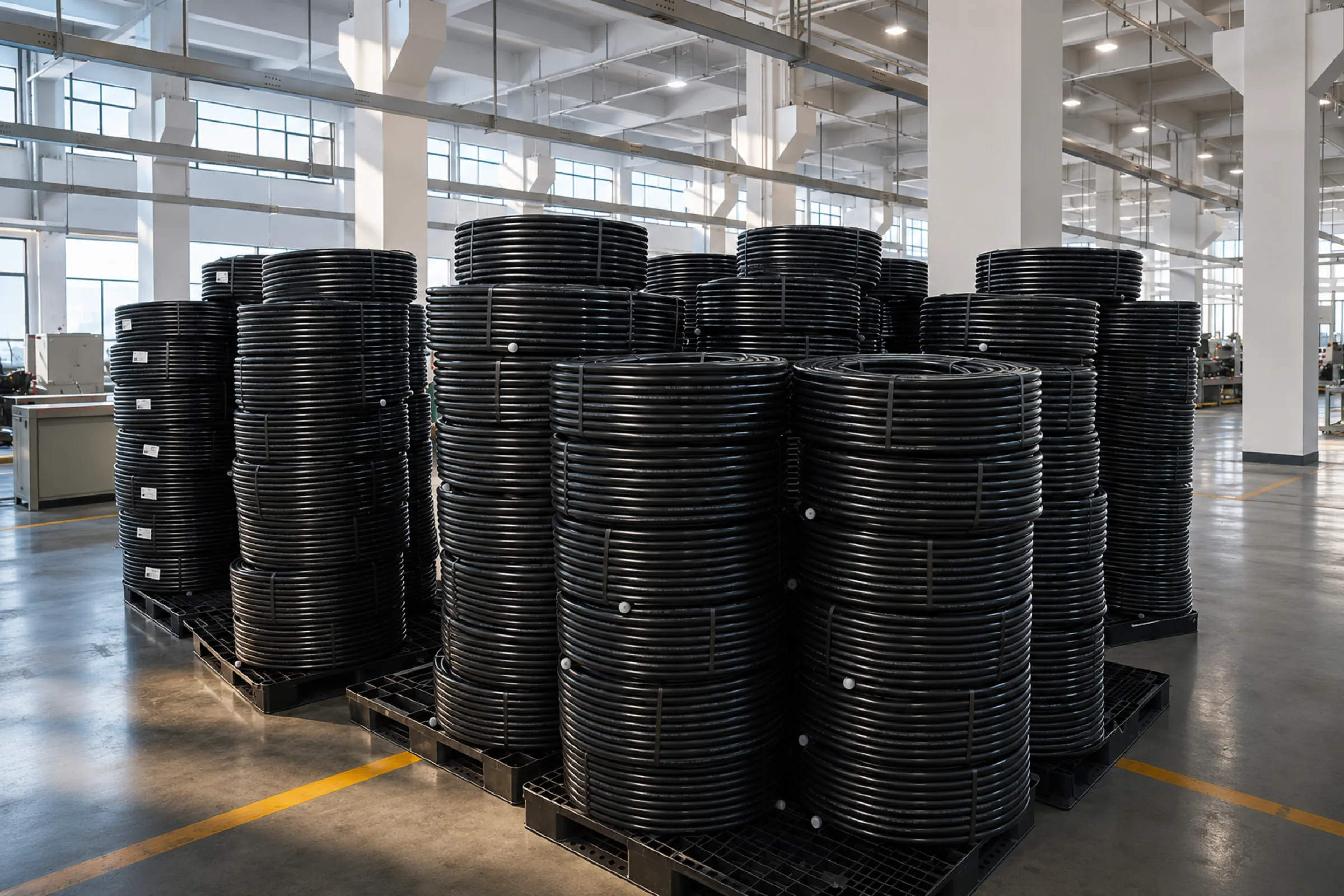
Buying from a distributor is a domestic sale of existing goods, already imported, cleared and duty-paid by them. If the goods are defective, your recourse runs against a company in your own jurisdiction, invoicing in your own currency.
Direct import has to answer questions the domestic purchase never raises. At what precise point does risk of loss stop being the seller’s and start being yours? Who contracts the ship? Who clears export and import? Who pays duty? Who is importer of record when a customs authority has a question?
The standardised answer set is the Incoterms rules published by the International Chamber of Commerce. Incoterms 2020 comprises 11 rules, divided into rules for any mode of transport (EXW, FCA, CPT, CIP, DAP, DPU, DDP) and rules for sea and inland waterway transport only (FAS, FOB, CFR, CIF); it entered into force on 1 January 2020, and all costs for a given rule are consolidated at article A9/B9 (ICC, iccwbo.org).
Those three letters in your purchase order are not a shipping preference. They are the clause allocating cost, risk and customs obligation — and in a direct import, the most consequential line in the contract after the specification.
The trap that catches more first-time importers than any other: the point where the seller stops paying is not the point where the seller stops being responsible.
Take CIF, common in building-materials trade and often chosen because buyers believe it means “the supplier looks after it until it arrives”. Under CIF the seller arranges and pays for port-to-port carriage and cargo insurance to the destination port, but risk still transfers to the buyer when goods are placed on board at the port of shipment — the cost point and the risk point are different (ICC Academy, academy.iccwbo.org). If cargo is damaged mid-ocean, it was damaged at your risk: you are the party with the claim, and you owe the invoice regardless.
This is not a CIF quirk but the defining feature of a whole family of rules. Under C rules (CIF, CFR, CPT, CIP) risk passes at origin when goods are handed to the carrier even though the seller pays carriage to destination; under D rules (DAP, DPU, DDP) risk transfers at the named place of destination (ICC Academy, academy.iccwbo.org). If what you want is “the supplier carries risk until goods reach me”, a C rule does not give you that; a D rule does.
The same applies to FOB, where the seller delivers and risk transfers once goods are loaded on board at the named port of shipment, the seller handles export clearance there, and the buyer contracts and pays the carrier for main carriage (ICC Academy, academy.iccwbo.org). The distributor purchase has no risk-transfer point to negotiate and no leg during which goods are yours but not in your possession — the distributor absorbed that before you saw the material, and it is priced into their margin.
FOB is a traditional maritime rule — it originated in the early 1800s, before containers existed, and ICC states it is to be used only for maritime or inland waterway transport, meaning port-to-port shipments; ICC also indicates FCA is the appropriate rule when goods move in containers or pallets and multiple transport modes are used (ICC Academy, academy.iccwbo.org). Plastic pipe and fittings move in containers, essentially always: the box is stuffed near the factory, trucked to the port, and handed over at a terminal days before it is loaded on board. Under FOB, risk nominally transfers on board — but the goods left the seller’s control at the container yard, and that gap is exactly the ambiguity FCA exists to close. Similarly, CIF is restricted to sea or inland waterway transport (ICC Academy, academy.iccwbo.org), so it cannot correctly describe a movement with road or rail legs on either end.
There is a second default worth knowing if you pick CIF for the insurance. Under Incoterms 2020 the default insurance level for CIF is Institute Cargo Clauses (C) — a limited or minimum cover — whereas CIP requires the higher Institute Cargo Clauses (A), one of the changes in the 2020 revision (ICC, iccwbo.org). Clauses (C) covers only certain defined risks, essentially loss or damage due to something happening to the carrying vessel, and is more appropriate to bulk goods and commodities (ICC Academy, academy.iccwbo.org). So a buyer selecting CIF believing they bought comprehensive cover has by default bought a named-perils policy aimed at vessel casualty — not at a container of manufactured fittings that could be crushed, wetted or pilfered without anything happening to the ship. It can be upgraded, but only if someone asks.
We will not tell you which rule to write — we are one party to that negotiation, not your advisor. But if your draft PO says FOB on a containerised pipe order, know that ICC’s own guidance points to FCA, and decide deliberately rather than by inheritance from a template.
DDP is the only Incoterms 2020 rule that is “duty paid” — all other ten rules are duty unpaid, meaning import duties and taxes are the buyer’s responsibility (ICC Academy, academy.iccwbo.org). If your landed-cost model took a quoted price and added freight but not duty, it is wrong under every rule except one.
DDP looks like the fix, and sometimes is: the seller carries out all customs formalities — export, import and any transit — and the buyer has no import obligation (ICC Academy, academy.iccwbo.org). But it is often unavailable, for a reason worth understanding rather than reading as reluctance: ICC commentary notes only that under DDP “the seller must import clear which usually has many difficulties” (ICC Academy). In our own experience the difficulty is usually registration: the seller may need to be a registered entity for import and VAT/GST in the buyer’s country, which is often not feasible, and where we cannot import-clear we would rather discuss DAP than promise DDP — that is our commercial position, not ICC guidance. A foreign manufacturer generally cannot be importer of record in your country without a registered presence and tax registration there.
What we will not tell you: your duty rate. We searched for the applied customs duty rate for HS 3917 plastic pipes in Saudi Arabia and the UAE and could not verify a product-specific figure from a primary source — the tariff lookup is an interactive query we could not run, and Saudi Arabia amended its tariff schedule in 2025. Any rate we published would be a guess dressed as a fact. Confirm your applied rate with your customs broker against your actual HS classification and destination, before you build it into a bid.
Buyers compare a distributor’s “two days” against a quoted production-plus-transit figure and plan around the difference. They have compared two averages. What breaks a programme is the tail.
A distributor’s lead time has low variance — the failure mode is binary and instantly visible: out of stock. A direct import’s lead time is a sum of independent, individually variable stages — production, inland haulage, terminal handling, ocean transit, congestion at discharge, customs release, inland delivery. They compound.
Some of it is measurable. Port congestion is growing globally: vessel waiting time rose to an average of 6.4 hours in developed countries and 10.9 hours in developing countries by March 2024, up from 5.2 and 10.2 hours respectively in December 2023; median time in port for container ships rose to 0.8 days by the end of 2024, reversing a prior downward trend (for comparison in 2024: dry bulk 2.7 days, dry breakbulk 0.9, tankers 1.5) — UNCTAD Review of Maritime Transport 2025, Chapter 4 (unctad.org).
Those are hours and fractions of days. The bigger variance is the ocean leg: global liner schedule reliability was 62.8% in December 2025, with average delay for late vessel arrivals of 5.04 days, across 34 trade lanes and 60-plus carriers (Sea-Intelligence Global Liner Performance report, sea-intelligence.com). Source tier stated honestly: Sea-Intelligence is a commercial analytics firm, not a standards body — industry evidence, not an authoritative statistic. Read practically, roughly one sailing in three arrives off-schedule, and the lateness is measured in days. Your planning question is not “what is the transit time” but “what does my programme do if this container is five days late, and how often am I willing to run that risk?”
A door-to-door total transit time. No authoritative source publishes a composed end-to-end figure of the form “X days haulage + Y days ocean + Z days customs + W days delivery” for a named lane. UNCTAD publishes median time in port only; ocean leg durations are carrier-specific and commercial. Any total you see is either from a specific carrier’s schedule — valid only for that service and date — or invented.
An average customs clearance time. The WCO Time Release Study measures time from arrival of goods to physical release — clearance is only one component of total border time (World Customs Organization, wcoomd.org). And WCO explicitly cautions that it is not meaningful to compare TRS results among different countries, since infrastructure, border procedures, IT development, resource availability and border agency capacity are rarely identical (WCO TRS Guide, Version 3, 2018, para. 39, wcoomd.org). Ask your broker about your route, not the internet about the average.
Our production lead time: Coming soon. It varies with order composition — a pipe-heavy order and a fittings-heavy order across 203 UPVC references do not schedule the same way — and with factory loading. A lead time you plan against and we then miss is worse than no number. Confirmed at quotation against your actual list.
For many buyers the whole decision collapses to one question: can you absorb the minimum quantity?
A distributor has already broken bulk — they bought a container and sell you a bundle, a pallet, sometimes a single fitting. Breaking bulk is their business model, and their margin is payment for it. A factory has not broken bulk and generally does not want to, because production-run and container economics both push towards larger, fuller, fewer shipments. This is why direct import is a planning decision, not a purchasing decision: you are not buying a cheaper price for the same quantity, you are choosing a different quantity, at a different price, on a different timescale.
The underestimated consequence is the long tail. Pipe volume follows drawn lengths and forecasts easily; the fittings tail does not — the reducer that turns out to be a special, the one reference in 203 that holds up a riser. On a distributor purchase you top that up in a week. On a direct import it waits for the next container or gets bought locally at spot price, quietly erasing the unit-price saving that justified importing.
Our MOQ: Coming soon. It is not one number — it varies by product family, by whether an order is pipe-led or fittings-led, and by how the order stuffs a container. We will not publish a figure we cannot hold across all those cases. Confirmed at quotation against your actual list.
The variable most often left out, and frequently the one that decides whether direct import was actually cheaper.
The distributor purchase is cash-light: small quantities, short cycle, often local credit, in your currency. The direct import is cash-heavy and cash-early — a larger quantity committed at order, money committed at or before shipment, goods uninstallable for the whole transit. That is working capital immobilised in a steel box on the water. How that exposure is structured depends on the payment instrument, and there are two families.
Bank-intermediated documentary credit. Letters of credit are governed by ICC’s UCP 600, approved on 25 October 2006, in force from 1 July 2007, containing 39 articles, reduced from 49 in the prior revision (ICC, iccwbo.org). They sit on a rules stack — UCP 600 as primary, ISBP 821 for document examination, URR 725 for bank-to-bank reimbursements — and a credit must state whether it is available by sight payment, deferred payment, acceptance or negotiation (ICC Academy, academy.iccwbo.org). Mechanically, an L/C has a bank make or guarantee payment to the exporter once delivery is confirmed through presentation of the appropriate documents, and an import L/C may include a “usance” period allowing the importer time before repaying the bank (BIS Committee on the Global Financial System, CGFS Papers No 50, bis.org). That usance mechanism is the cash-timing lever — the reason an L/C can be a working-capital tool and not only a security instrument.
Inter-firm credit. The principal alternative is inter-firm trade credit: open account, where goods ship in advance of payment, and cash-in-advance, where payment precedes shipment. It entails lower fees and more flexibility but leaves firms bearing more payment risk (BIS CGFS Papers No 50). Open account favours the buyer’s cash position and exposes the seller; cash-in-advance reverses it. Neither is “standard” — each is a position in a negotiation about who trusts whom.
For scale: the WTO states that some 80 to 90 per cent of world trade relies on trade finance, mostly short-term (WTO, wto.org). BIS estimates trade finance directly supports about one-third of global trade, with letters of credit covering about one-sixth of total trade; bank surveys put the bank-intermediated share at about 40%, some industry studies around 20% (BIS CGFS Papers No 50). So the L/C is a minority instrument globally — anyone insisting it is the only professional way to transact is stating a preference, not a norm.
Regional expectations differ sharply: Asia-Pacific accounts for more than half of L/C-related and overall trade finance exposures, Europe about one quarter, and North America, Latin America, Africa and the Middle East each around 5–10% (BIS CGFS Papers No 50). And a currency point a French-branded supplier should raise rather than hide: around 80% of letters of credit are denominated in US dollars, making trade finance even more dollar-denominated than global trade itself (BIS CGFS Papers No 50). Your payment instrument carries an FX position whether or not anyone names it.
L/C issuance cost as a percentage of invoice value, and typical usance tenor. BIS confirms the usance mechanism exists but publishes no fee percentages or standard tenors, and explicitly notes that visibility into trends in pricing is very limited. Bank fee schedules vary by bank and applicant risk. Ask your own bank — they quote against your credit standing, the only figure that would apply to you anyway.
The L/C versus wire-transfer split in the building-materials or piping trade specifically. BIS gives economy-wide and regional splits only. No authoritative source breaks trade finance instrument usage down by the construction-materials or piping category. Anyone quoting a sector-specific percentage is extrapolating.
Demurrage and detention free-time days and per-day charges. Set by individual carriers and terminals in commercial tariffs, not by any standards body — no customs, standards or ICC source publishes them. They are a real and sometimes large direct-import cost. Get the applicable tariff in writing before the container arrives, not after free time expires.
Having spent several sections on the costs of importing, here is where the structural advantage genuinely sits. A distributor sells what is on the shelf — a bet made months ago, concentrated on fast movers. The consequence is not that they lack range in the catalogue; it is that the slow-moving reference you need is the one they did not stock. A factory order is drawn from tooling instead: the constraint is what moulds exist and what can be scheduled. Per our catalogue, that base is 10,000+ moulds across a 120,000 m² facility, with 30+ years of operation, 1000+ employees, and shipments to 118+ countries.
Where this converts into value is the fittings tail. Per our catalogue, our fittings positions are 75 items in the PPR 1138 series and 203 items in the UPVC 1806 series. The point is not that the number is large — it is that a long tail ordered from tooling arrives on the same container as the mainline material, whereas the same tail ordered from a stockist arrives in whatever sequence their replenishment allows.
But that argument only helps if our range covers your scope. For many enquiries it does not, and that is more useful to you than a sales pitch.
Our pressure pipe stops at Φ110. Per our catalogue: PPR PN20 pipe in the 1103 series is offered in 20, 25 and 32 mm only, in 4 m lengths; UPVC 806 PN16 pipe in the WP55 range covers Φ20–110 in 4 m lengths; HDPE PN16 covers Φ20–110. PEX in the 2114/2121 series covers 16–32 mm, and brass in the 2405 series covers 1/4″ to 1″. The UPVC 806 heat-resistance figure and how it must be read are covered on our Middle East market page — it is a material property claim, not a continuous service rating, so we are not restating it here as a bare specification.
We cannot supply DN150–400 mains. We have no route to them and will not imply otherwise. If your bill of quantities contains large-diameter mains, that scope must come from elsewhere, and for those line items a regional manufacturer may well win outright.
One clarification we repeat because it is routinely misread: the Φ160 in our PVC 902 range is a 1902 fitting size — the 902 pipe itself stops at Φ110 — and the whole 902 series is non-pressure drainage (per our catalogue). The Φ160 there is not an exception to the Φ110 pressure ceiling — it is a different product for a different duty, and using a drainage fitting in a pressure application is a failure, not a workaround.
On our HDPE, a marking point stated precisely. The pipe body is marked “GERMANY STANDARD DIN8077/8078” (per our catalogue). We are reporting what is printed on the pipe and nothing more — we are not claiming conformity to those standards. Why a specifier should notice: DIN 8077/8078 are polypropylene standards, whereas the corresponding polyethylene documents are DIN 8074/8075. If your submittal turns on a named standard, raise this at enquiry stage rather than at approval stage.
Our certification list, per our catalogue, includes SKZ, CE, WRAS, DVGW, SGS, TSE, GOST-R, ISO 9001 and ISO 14001 among others. Certificate numbers, validity dates and exact scope coverage: Coming soon. We issue scanned certificates against your specific product list at quotation stage rather than publishing a summary you cannot audit. A logo on a website is not a certificate, and you should not accept one from us or anyone else.
Finally, stated actively rather than waiting to be asked: IFANNova is a French brand, not a French-manufactured product. Manufacture is by Zhuji Fengfan Piping in Zhuji, Zhejiang, China. If your tender requires European origin or a European certificate of origin, we are the wrong supplier for that line item, and we would rather tell you now than at document-submission stage.
Note how many cells resolve to “depends on your contract” rather than a number. That is the honest state of this comparison, not an evasion.
| Variable | Local distributor | Direct factory import | What actually determines it |
|---|---|---|---|
| Lead time — typical | Short; already in country | Production + transit + clearance | Our production time: Coming soon. Ocean leg: carrier schedule |
| Lead time — variance | Low; binary out-of-stock | Compounds across stages | 62.8% on-time, 5.04 days avg delay when late, Dec 2025 (Sea-Intelligence, commercial analytics) |
| Port time component | Not applicable | Median 0.8 days in port, container ships, end-2024 | Vessel waiting Dec 2024: 6.4 hrs developed / 10.9 developing (UNCTAD RMT 2025) |
| Customs clearance time | Not applicable — already cleared | Not quotable as a cross-market average | WCO: “not meaningful to compare TRS results among different countries” (TRS Guide v3, para. 39) |
| Minimum order quantity | Low; bulk already broken | Higher; production-run and container economics | Our MOQ: Coming soon — confirmed at quotation |
| Cash committed | Smaller, later, often local credit | Larger, earlier, immobilised through transit | L/C (UCP 600), open account, or cash-in-advance (BIS CGFS 50) |
| Deferred-payment option | Local credit terms | L/C usance period, if agreed | Mechanism per BIS CGFS 50; tenor and fees bank-commercial — no published figure |
| Currency exposure | Usually none | Real | ~80% of L/Cs are USD-denominated (BIS CGFS 50) |
| Risk of loss in transit | Distributor’s, before you buy | Depends entirely on the Incoterm | C rules: risk at origin, cost to destination. D rules: risk at destination (ICC) |
| Cargo insurance level | Not your concern | Default is minimum cover under CIF | CIF default = Clauses (C), named perils; CIP requires Clauses (A) (ICC) |
| Export clearance | Not applicable | Seller, under FOB | ICC Academy, FCA/FOB guidance |
| Import duty and taxes | Already paid, inside the price | Yours under 10 of 11 rules | DDP is the only duty-paid rule (ICC). Your rate: confirm with your broker |
| Importer of record | Distributor was | You, unless DDP | ICC: DDP import clearance “usually has many difficulties”. Our position: DDP needs seller import/VAT registration locally; we discuss DAP if not feasible |
| Breadth of simultaneous references | Limited to stocked lines | Drawn from tooling, not inventory | 10,000+ moulds; PPR 1138 series 75 items, UPVC 1806 series 203 items (per our catalogue) |
| Large-diameter mains (DN150–400) | Possible, depending on stockist | Not from us | Φ110 pressure ceiling (per our catalogue); the PVC 902 Φ160 is a 1902 fitting, non-pressure drainage only |
| Demurrage and detention | None to you | Real, potentially large | Carrier/terminal commercial tariffs; no standards body publishes them |
| Recourse if goods are defective | Domestic, same jurisdiction | Cross-border, against contract terms | Governing law and dispute clause — separate from the Incoterm |
Container damaged mid-ocean, CIF terms. Risk had already transferred to you at origin, even though the seller paid freight and bought insurance. You are the claimant — and if nobody upgraded the cover, it is a Clauses (C) named-perils policy oriented to vessel casualty, which may or may not respond. Your invoice obligation is unaffected either way.
Cargo damaged at the origin terminal, FOB terms. Goods handed over at the terminal, but risk transferring only on loading on board. If your PO says FOB on a container, you are relying on a port-to-port maritime rule for a movement ICC points to FCA for.
Customs assesses a higher duty rate than budgeted. Under any of the ten duty-unpaid rules, that is yours. Not a defect, not a supplier error, and generally not something the supplier can remedy — which is why the rate must be verified before bid, not after arrival.
Vessel arrives late and the programme slips. No Incoterm allocates programme delay. Incoterms allocate cost, risk of loss and customs obligation — not liquidated damages under your downstream construction contract. At 62.8% schedule reliability this is foreseeable, and the only real protections are float and buffer stock.
The pattern across all four: the Incoterm decides who bears cost and risk of loss. It does not decide quality, programme, or governing law. Those need separate clauses.
If you land on “hybrid” — large diameters locally, small-diameter distribution and the fittings tail imported — you have reached the same place most experienced Gulf buyers reach, and for the right reasons.
Is direct import always cheaper than buying locally?
No. It has a lower unit price and a higher total cost of ownership in cash, risk and administrative workload. A small top-up order is almost always cheaper from a distributor even at a higher unit price.
Which Incoterm should I use?
We are one party to that negotiation, so we will not advise you. Decide against the documented facts above, with your freight forwarder and insurer.
Can you quote DDP?
DDP requires the seller to be able to import-clear and typically to be VAT/GST-registered in your country. Raise it at enquiry stage and we will tell you honestly what is feasible for your destination rather than agreeing to something we cannot execute.
What is your MOQ and lead time?
Coming soon — confirmed at quotation against your actual list. We will not publish figures we cannot hold across every product family and order composition.
How long will customs take in my market?
We cannot tell you, and neither can anyone quoting a cross-market average. The WCO, which owns the measurement methodology, states it is not meaningful to compare Time Release Study results among different countries (TRS Guide v3, 2018, para. 39). Ask your customs broker about your route and your documentation.
Do you have stock in my market?
No. We ship from the factory. If you need material this week, a local stockist is the correct answer and we will say so.
Can you supply DN200 mains?
No. Our pressure range stops at Φ110 (per our catalogue). The PVC 902 range reaches Φ160 only in its 1902 fittings — the pipe stops at Φ110 — and is non-pressure drainage, not a substitute.
Is IFANNova pipe made in France?
No. IFANNova is a French brand; manufacture is by Zhuji Fengfan Piping in Zhuji, Zhejiang, China (per our catalogue). If your tender requires European origin, we are the wrong supplier for that line.
Everything on this page that could be sourced, was. What could not — your MOQ, lead time, duty rate, L/C cost, clearance duration — does not exist as a publishable general figure. It exists only against your actual order.
Send us the bill of quantities, the destination port, the named standard in your specification, and your submittal deadline. You will get back: what falls inside Φ110 and what does not, which documents we can issue for your certification route, and a price, MOQ and lead time against your real quantities. What you will not get is a price list, a stock claim we cannot honour, or a certificate number we have not verified.
Send your enquiry — and if the honest answer is that a local stockist serves you better on this particular order, we will tell you that too.
OEM keeps your design portable; ODM keeps the moulds with the factory.
Pipe is a volumetric cargo.
A 4 m fixed length is a shipping decision as much as a product one.