
Chilled-Water Insulated Hangers: Review the Exact Assembly
A chilled-water insulated hanger submittal is ready for the project’s release review only when the same support tag has matching evidence for pipe fit, applicable assembly load and insulation continuity. A strong insert cannot compensate for a missing vapour seal; a neat jacket drawing cannot establish load capacity. Record the unresolved item and its owner before the purchase instruction is issued.
This review is for an already-designed small horizontal PP-R terminal branch. Start with the approved support locations, functions and design reactions. The task here is checking the offered insulated assembly against those inputs, not designing its spacing or authorising installation. The register below produces a specific return-for-information or referral to the authorised project reviewer.
Key Takeaways
- Bind the pipe, insert, clamp and closure documents to one tag and revision.
- Use actual pipe outside diameter and the full insulated assembly envelope.
- A core compression test is not an allowable load for the assembled hanger.
- Check the insert-to-adjoining-insulation junction as well as the insert’s own seam.
- Keep unresolved load evidence separate from unresolved insulation details.
- IFANNova pipe and fitting enquiries do not constitute a support assembly offer.
Related video: insulated pipe support components
Armacell LLC explains its own pipe-support system. This third-party manufacturer example is general component context; it does not endorse or approve a PP-R branch selection or represent an IFANNova support offer.
Give every attachment the same identity
A folder full of plausible product sheets can still describe no buildable assembly. One attachment may show the selected pipe, another a nominal-size insert and another a clamp surrounding a different insulation thickness. Before comparing performance, require a marked section identifying the proposed components together. Record the pipe manufacturer and series, actual outside diameter, service conditions, insert reference and bore, insulation type and thickness, jacket, shield where applicable, clamp and available clearance. Preserve the manufacturer’s original size designation alongside the actual dimensions.
The reason is physical, not administrative. ASHRAE Fundamentals, chapter 23, “Insulating Pipe Hangers” explains that the hanger needs room for the insulation and that a shield spreads load. It also describes the thermal bridge and difficult vapour seal associated with a ring crossing the insulation. These principles justify checking the assembled section; they do not select a particular insert or transfer a saddle table to PP-R.
Ask the designer to resolve a section that fits only by reducing specified insulation thickness. Ask the support supplier to identify the offered assembly where the drawing and part list disagree. Do not silently substitute a nominal iron-pipe size for a metric PP-R outside diameter. A visually close bore is not documented compatibility.
First confirm that the pipe application itself is within the project-approved PP-R terminal-branch scope. For the separate pipe package, the IFANNova pipe and fittings enquiry desk can receive the branch specification for an availability and document check. It is not evidence that an insulated support fits, that another manufacturer’s support instructions apply, or that any support rating belongs to IFANNova.
Keep the design reaction and assembly rating separate
The designer supplies the required reaction and the support function for this location. The support package must then show an applicable allowable assembly load and its conditions, or provide a project-specific engineered determination through the authorised review route. A reviewer needs both sides of that comparison. An empty design-reaction field cannot be filled with the insert supplier’s maximum figure.
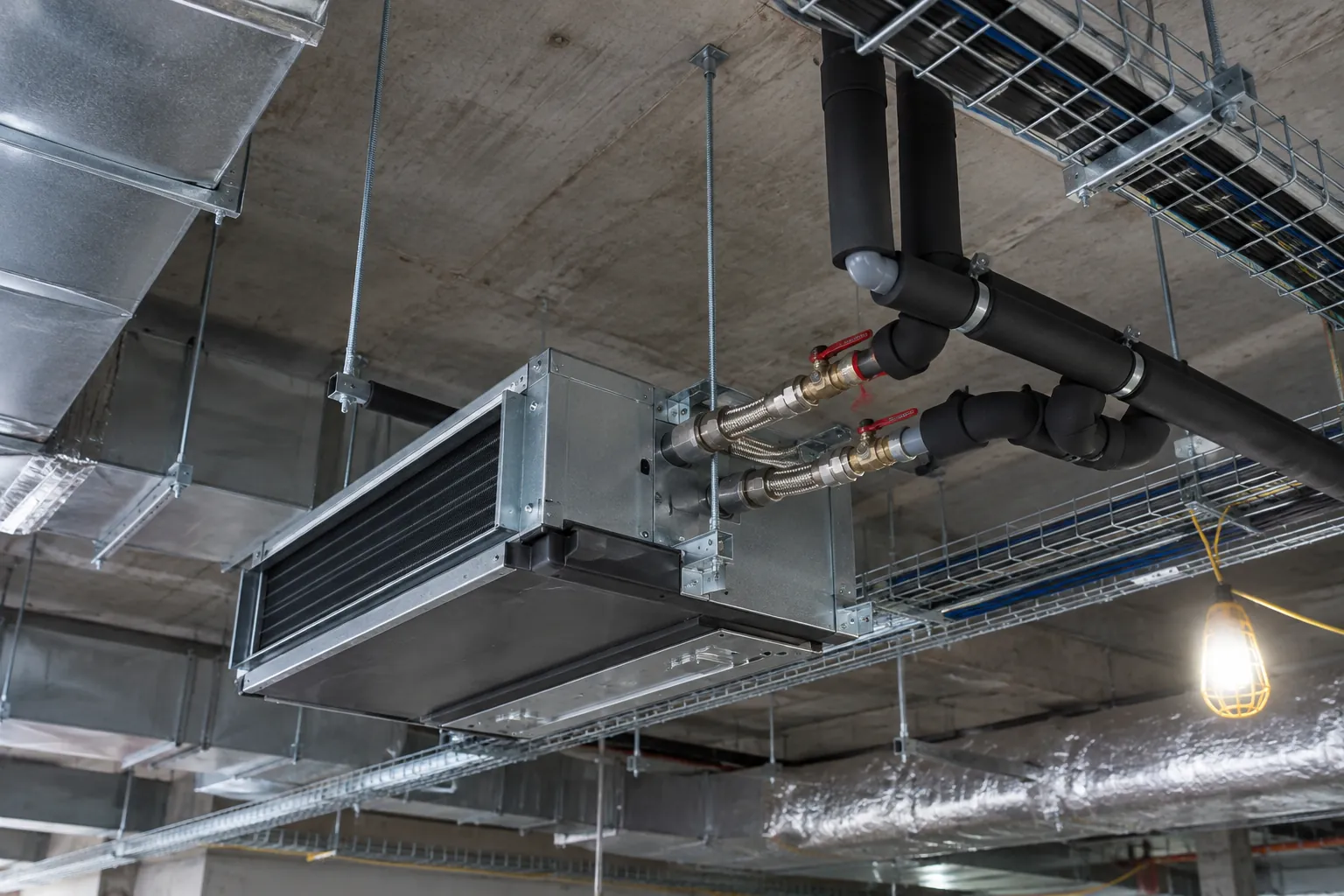
Use the K-FLEX 360 insulated pipe support datasheet as a document-reading example. It lists a perpendicular core compressive-strength test, describes a rigid core with insulation collars and an overlapping jacket, and states that hanger clamps are separate. The material test does not supply an allowable working load for every combination of insert, clamp, shield and attachment. No K-FLEX number, dimension or installation method in that sheet is adopted here as a selection for the PP-R branch.
Consequently, multiplying the core test value by an assumed contact area would answer a question the submitted document has not approved. The actual load path includes interfaces and components whose applicability still needs to be established. Return a core-only submission for the offered assembly’s load evidence, including the selected dimensions, service basis and compatible pipe application. If published evidence stops short of PP-R compatibility, obtain a project determination; metal-pipe documentation is not automatic permission.
This assumes the layout has already passed its own design checks. If it has not, return to the pipe-series and temperature support-spacing review. Neither that spacing result nor this register approves equipment loads, risers, anchors or movement geometry. An offered clamp that changes the specified support function returns to the designer rather than passing because its vertical rating looks adequate.
Follow the closure across the package boundary
The support can carry the required reaction and still leave an insulation-interface question open. Identify the detail connecting the load-bearing insert to the adjacent insulation on both sides. The submission should name the compatible insulation and jacket system, identify the closure materials, show the insert seam and adjoining joints, and state whose package completes each junction. “Insulated hanger included” leaves these interfaces undefined.
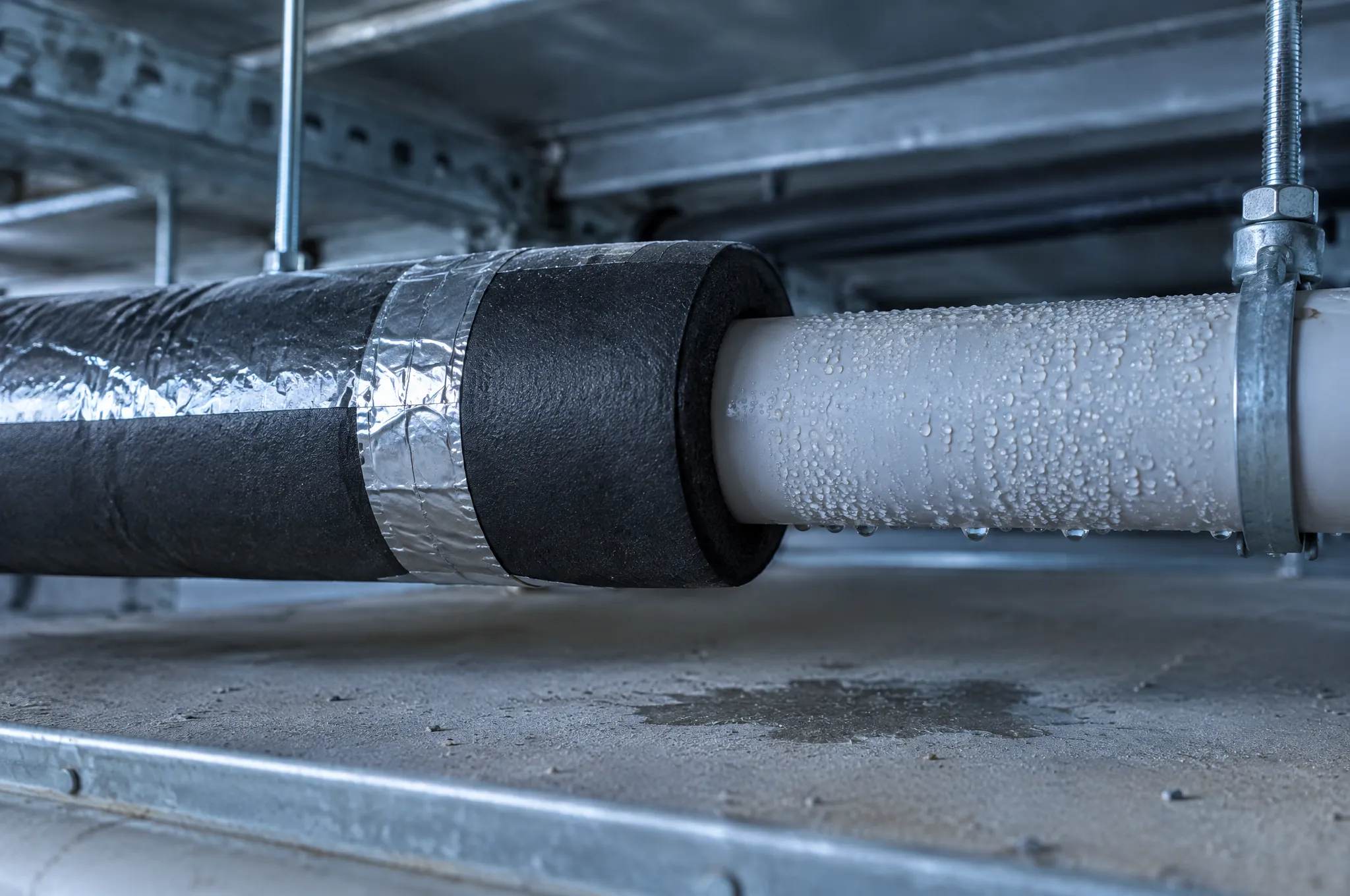
The K-FLEX document illustrates the distinction: its jacket overlap closes the support, while its collars connect to adjoining insulation. Those are separate interfaces in that named system. This is a reason to ask for the offered system’s own detail, not an instruction to apply its adhesive or geometry to another manufacturer’s assembly.
Compare the detail against the exact proposed insulation system and the approved project requirement. A drawing for another jacket cannot resolve the present junction merely because both are called vapour barriers. If the support vendor supplies an insert but the insulation contractor closes the adjoining joints, the main contractor must coordinate the shared detail and record an accountable owner. The support vendor’s completed delivery scope does not mean the installed envelope is complete.
The broader moisture mechanisms belong in the chilled-water vapour-barrier guide. Here, stay at the support tag: which drawing, which components, which junction and which responsible package? Do not replace a missing detail with a generic tape note.
Review an insulated hanger
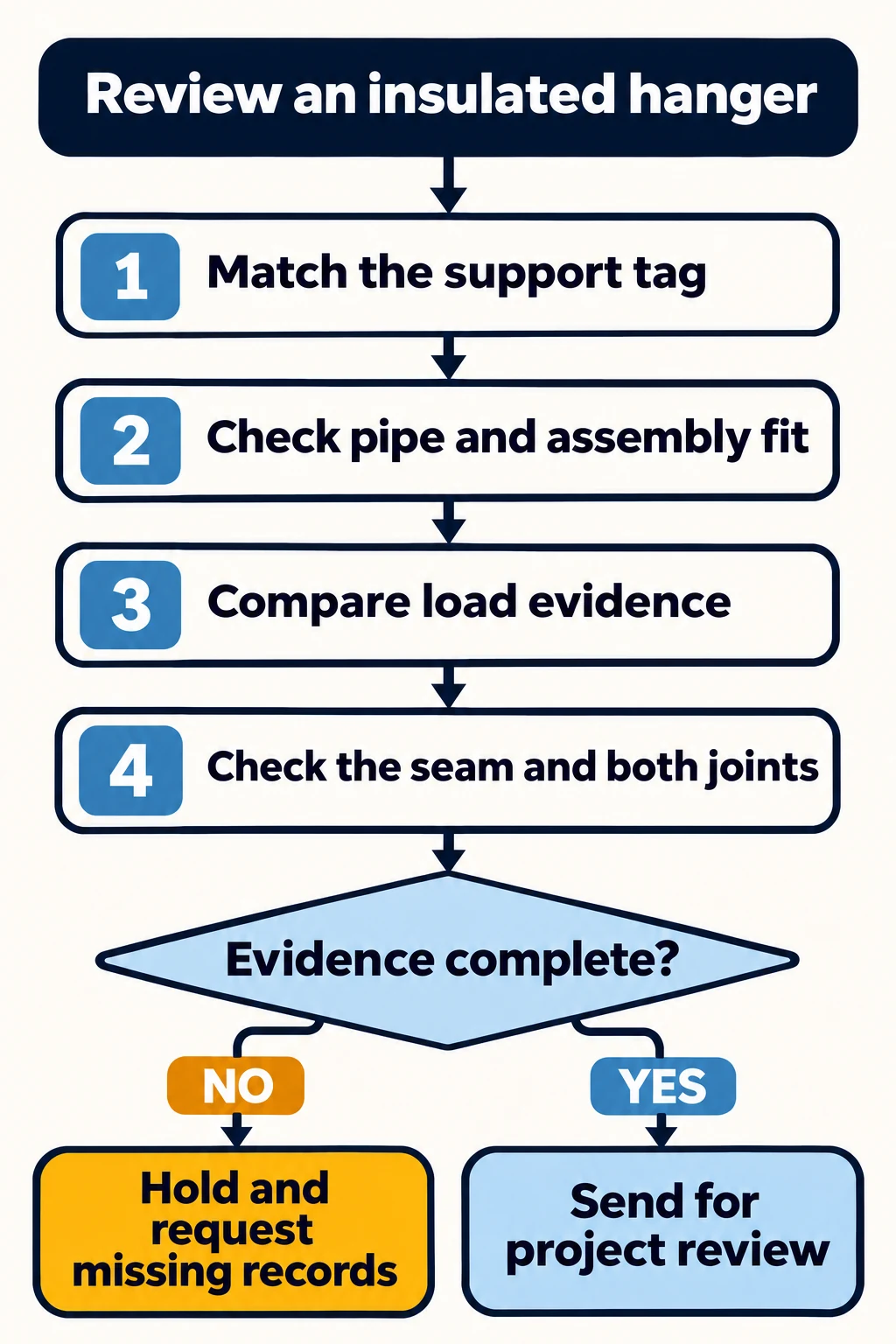
- Match the support tag
- Check pipe and assembly fit
- Compare load evidence
- Check the seam and both joints
Evidence complete? NO: Hold and request missing records. YES: Send for project review. The authorised project reviewer decides release.
Use a release-review register that separates the holds
Copy the following field groups into the project’s submittal register. Enter document identifiers and revisions, not just ticks. Record “not supplied” where necessary. The useful result is a specific disposition that another reviewer can reproduce.
| Field group | Required record | Question it resolves |
|---|---|---|
| Design identity | Support tag, drawing location/revision, function and engineer’s reaction reference | Which approved requirement is being checked? |
| Pipe and fit | Manufacturer/series, actual OD, duty; insert bore, insulation/jacket, clamp and full section dimensions; available clearance | Does the offered combination match the pipe and envelope? |
| Load applicability | Exact assembly references, applicable allowable load and conditions, PP-R applicability and review reference | Does the documented assembly meet the supplied design requirement? |
| Closure | Insert and adjoining insulation references, seam/junction detail and revision, compatible closure materials | Is the support-to-insulation connection defined? |
| Disposition | Open item, responsible package/person, required response and review status/revision | Who closes the gap before release? |
The next three rows are fictional document-review scenarios for the same already-designed branch. They contain no measured loads, selected hardware sizes or real approvals. “Documented” means the scenario assumes matching evidence exists; it is not a finding about any actual product.
| Illustrative tag | Evidence supplied | Gap and owner | Review disposition |
|---|---|---|---|
| BR-S1 | Approved design requirement, matching section and closure detail; core test only | Support supplier: applicable assembly allowable load and PP-R compatibility | HOLD load applicability. Retain the closure reference; do not infer capacity from core strength. |
| BR-S2 | Design requirement, matching fit and applicable assembly load; insert seam shown | Main contractor coordinating insulation/support packages: adjoining-joint closure detail | HOLD insulation interface. A load match does not close the missing junction. |
| BR-S3 | Matching design reference, fit, applicable assembly load and complete closure detail; accountable package owners | No missing item assumed within this register’s scope | Forward the complete package to the authorised project reviewer for release consideration. This row grants no approval. |
For BR-S1, a later rated assembly sheet closes the hold only if it applies to the exact proposed components and satisfies the engineer’s requirement. A sheet for a different bore or pipe application leaves the hold open. For BR-S2, receiving another load certificate changes nothing: the missing input is the adjoining-joint detail. This distinction prevents a supplier from answering the easier question while the purchase-critical gap remains.
If the insert changes after a row is closed, reopen the affected comparisons. Its geometry may alter the clamp fit, its load evidence may change and its jacket may require another closure system. Preserve the previous revision and record which comparisons were repeated. A purchase description should identify the reviewed revision rather than leaving the final selection to an unrecorded substitution.
For the separate pipe and fitting package, send your PP-R branch schedule for an availability and document check. Include project country, proposed pipe specification and actual OD, fluid and temperatures, fitting quantities and the required technical documents. Confirm availability and application suitability against the actual offer. No insulated-support supply, rating, certification, stock or delivery commitment is established here.
Conclusion
Attach one tagged section, one applicable load comparison and one complete insulation-interface detail to the release-review record. Assign a specific owner to every open item. Then send the coherent package through the project’s authorised review route. That produces a useful procurement decision without mistaking an editorial checklist for engineering approval.
Frequently asked questions
Does a high core compression value prove the hanger is adequate?
No. A material test does not establish the allowable load of the offered support assembly or its applicability to the selected PP-R pipe.
Can I use a metal-pipe insulated support detail for PP-R?
Not automatically. Confirm the actual outside diameter, compatible pipe application, assembly load evidence and approved insulation detail for the proposed combination.
Does this review choose hanger spacing?
No. It starts with the approved layout and engineer-supplied reactions. Spacing, movement design and equipment support remain separate design decisions.
Can IFANNova quote the insulated support from this register?
No support offer is established here. Use the linked enquiry desk for a separate branch pipe and fittings availability enquiry; coordinate the support package with its responsible supplier.