PC, Anti-Drain and Anti-Siphon Drippers. Match the Feature to the Irrigation Problem
By Justin
Choose pressure compensation for controlled emitter discharge within a documented pressure range. Choose an anti-drain feature when retained water between irrigation cycles matters. Specify anti-siphon protection where the emitter must resist contaminants being drawn inward. A product can combine all three functions. Its model-specific pressure limits still need a separate check against the selected dripline pipe and connections.
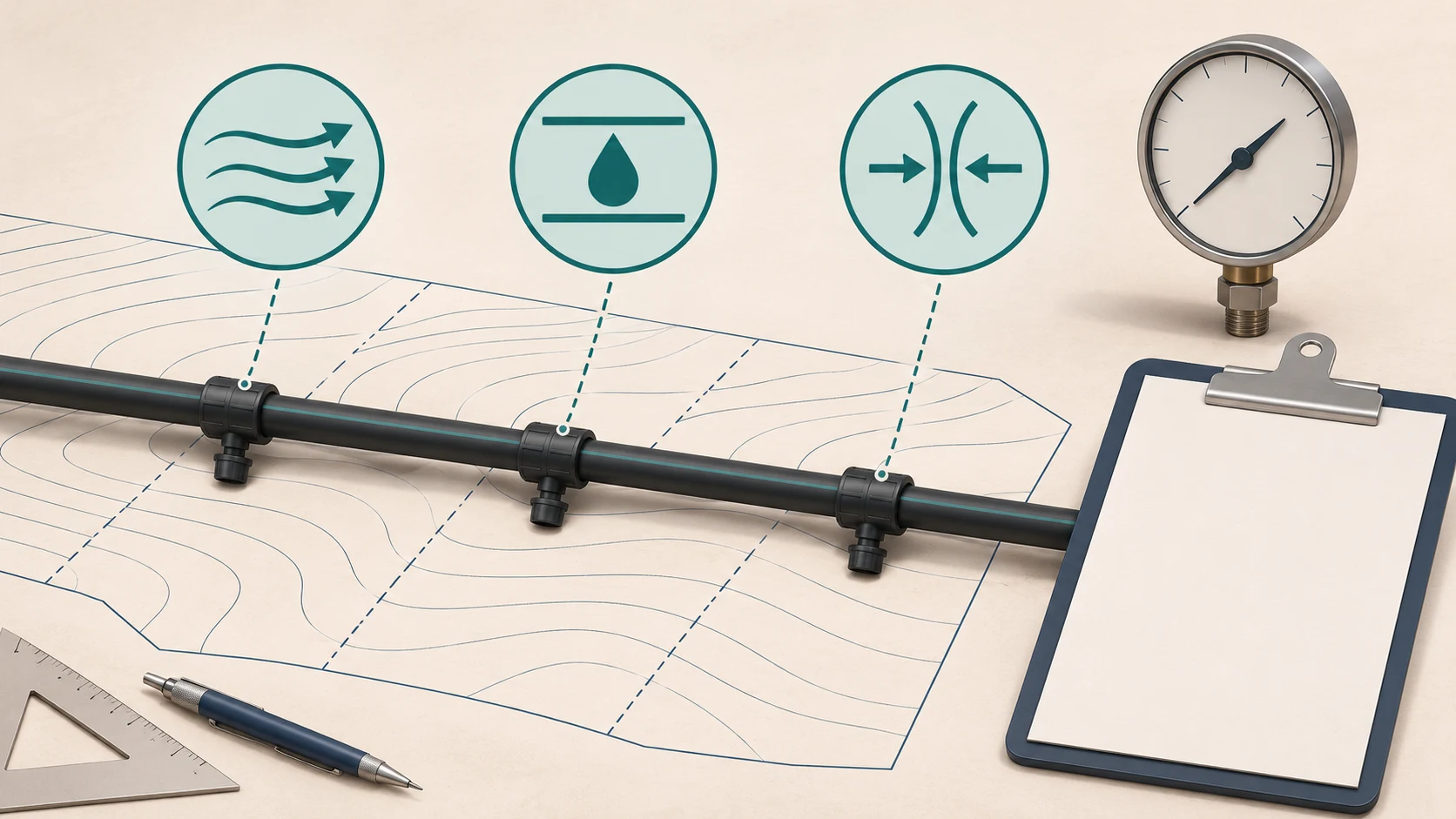
Begin with the event you need to control. Uneven discharge while a zone runs, drainage after shutdown and possible soil ingress during depressurization lead to different requirements. Recording that event before requesting a quotation helps prevent a buyer from accepting a familiar abbreviation while the actual problem remains unresolved. The following selection method produces a feature requirement, a pressure-screening result and a list of missing documents for the supplier or irrigation designer.
Key takeaways
- Match the required function to operation, shutdown or possible inward flow.
- Identify the exact dripper or integral dripline model, including its functional variant.
- Keep compensated operating pressure, anti-drain shutoff pressure and pipe maximum working pressure in separate fields.
- In the UniRam CNL example, the emitter range is 1.0–4.0 bar while the 16009 pipe maximum working pressure is 3.0 bar.
- Treat an unresolved model, pressure extreme or connection rating as an open selection item.
- Send distribution hardware enquiries with the selected emitter requirements and interface details.
Identify the event before choosing the abbreviation
A buyer describing “a slope problem” has not yet provided enough information to choose a dripper. The useful observation is what happens at the outlets and when it happens. Record whether discharge differs while the valve remains open, whether the lower outlets continue releasing stored lateral water after shutdown, or whether the concern is contaminants entering a buried emitter. These observations direct the next document check. They also give the designer something more precise to assess than a request for a better dripper.
Make the observation under a named zone configuration. Note which laterals are connected, which zone valves operate together and where the pressure readings were taken. A pressure recorded at the pump does not establish pressure at every emitter. If the layout or active zone combination changes, the original observation may no longer represent the proposed operating condition. Keep the test condition alongside the reading so that another person can interpret it.
| Observed event | Function to investigate | Evidence needed for the selection |
|---|---|---|
| Discharge uniformity during irrigation | Pressure compensation, PC | Exact emitter compensation range and expected pressure distribution in the operating zone |
| Water drains from lower outlets between cycles | Anti-drain or non-leakage function, often CNL | Exact variant, its declared shutoff behavior and the designer’s assessment of the layout |
| Concern about contaminants drawn inward at a buried emitter | Anti-siphon function, AS | Explicit manufacturer description for the selected emitter and intended installation |
| More than one of these events matters | A product with the required combination | Model-specific evidence for each required function and the complete pressure check |
This page develops that feature-selection decision. The broader irrigation pipe and fittings system guide covers the network tiers and already introduces regulated and non-leakage emitter terminology. Use that guide for the distribution specification. Here, the deliverable is a justified choice of emitter functions and a model-specific pressure screen.
Check each function on the exact product variant
Pressure compensation concerns discharge while the emitter operates within its declared range. The procurement question is whether the calculated or verified local pressures remain within that range for the proposed zone. A PC label alone leaves both endpoints unknown. Ask for the technical sheet that belongs to the quoted item, then retain the model identifier with the range. This makes a later substitution visible instead of allowing the range from the original selection to follow a different product.
Anti-drain selection addresses what happens as the lateral depressurizes. Netafim’s PC Online page identifies anti-drain functionality specifically for its LCNL and HCNL versions. That distinction matters when a quotation lists only a product family. Ask the supplier to resolve the variant and supply its documentation before comparing prices. A family name and a photograph can conceal a functional difference that changes the reason for buying the item. Netafim PC Online product information
For a buried application, ask separately whether the selected emitter has an anti-siphon mechanism intended to resist inward contamination. Netafim describes this feature on UniRam CNL in relation to contaminants entering the dripper. Keep that claim attached to the emitter. Any source-water backflow protection remains a separate design and approval question for the water supply connection. The emitter’s feature description provides no basis for selecting an upstream protection assembly. UniRam CNL technical product sheet
Once the functions are confirmed, write them as separate procurement requirements. For example, a project may require compensated discharge during operation and documented anti-drain behavior between pulses. Subsurface installation may add an explicit anti-siphon requirement. The supplier can then identify which proposed item meets each requirement, and the designer can see which performance question remains open. This is more actionable than treating PC, CNL and AS as interchangeable quality grades.
Keep three pressure entries separate
The UniRam CNL sheet provides a useful example because it gives both emitter data and dripline pipe data. Its stated pressure-compensated range is 1.0–4.0 bar. It also gives a CNL shutoff pressure of 0.14 bar. Those values describe different behavior. Enter them on separate lines in the review record so that a shutdown figure cannot accidentally become the target operating pressure. These numbers apply to the documented UniRam CNL product, and another emitter needs its own sheet. UniRam CNL specifications
Next identify the selected pipe model. In the same sheet, 16009, 16010 and 16012 have different wall thicknesses and maximum working pressures. The shared emitter specification therefore cannot be used as the working pressure permission for every pipe carrying that emitter. Keep the pipe identifier in the bill of quantities and in the pressure review. If the supplier proposes another wall specification, reopen that check before accepting the substitution.
| UniRam CNL dripline model | Wall thickness | Pipe maximum working pressure | Initial screen at an illustrative 3.5 bar local working pressure |
|---|---|---|---|
| 16009 | 0.90 mm | 3.0 bar | Exceeds the listed pipe maximum working pressure |
| 16010 | 1.00 mm | 3.5 bar | Equals the listed maximum, with no additional margin established by this comparison |
| 16012 | 1.20 mm | 4.0 bar | Below the listed pipe maximum, with the remaining system checks still open |
The model data in this table comes from the manufacturer’s dripline technical data. The 3.5 bar scenario is an editorial illustration. It demonstrates the comparison and provides no project operating recommendation. The same sheet also lists maximum flushing pressures separately. Keep that separate column out of the routine operating-pressure acceptance field. UniRam CNL pipe technical data
A useful review has a lower-pressure question as well as an upper-pressure question. An operating point below the documented compensation minimum leaves the intended PC performance unestablished. At the upper end, check the selected pipe, fittings and other connected components under their applicable conditions. Record the expected extremes and the basis for them. A single favorable gauge reading during one operating state is insufficient to close every entry in that record.
Walk the selection through two changed conditions
Consider a hypothetical buyer preparing an integral dripline enquiry for short irrigation cycles. The stated requirements are compensated operation and reduced drainage between cycles. The submitted sheet is UniRam CNL, and the proposed pipe is 16009. Assume that the designer’s supplied local working-pressure condition for this illustration is 3.5 bar. The emitter range accommodates that number, but the pipe table gives 16009 a 3.0 bar maximum working pressure. The selection remains unresolved because the pipe limit is exceeded.
The resulting action is precise. Return the pressure condition and model mismatch to the designer and supplier for a revised selection or hydraulic arrangement. Keep the reason on the enquiry record. Merely adding “PC dripper” to the purchase description would leave this conflict hidden. The functional requirement could be satisfied on paper while the submitted pipe specification fails the pressure comparison.
Now change only the pipe proposal to 16012 and retain the illustrative 3.5 bar condition. The direct comparison against its listed 4.0 bar pipe maximum no longer produces the same exceedance. That closes one screening question. It leaves the connection ratings, applicable service conditions, pressure extremes, emitter selection and layout assessment to be verified. A buyer can mark the specific comparison as completed without describing the whole irrigation installation as accepted.
A second change illustrates the lower end. Suppose the documented minimum pressure at an operating emitter is instead 0.8 bar. For this UniRam CNL example, that is below the stated 1.0 bar compensation minimum. A thicker pipe does not resolve the missing emitter operating condition. The record must return to the hydraulic design question. These changed conditions separate a pipe-pressure problem from an emitter-performance problem and show why the two fields must stay independent.
Resolve shutdown behavior without inventing a slope allowance
When anti-drain performance is the reason for the purchase, ask how the manufacturer and designer apply the selected model to the actual elevations and shutdown condition. Retain the relevant model-specific information with the layout. A shutoff pressure by itself does not establish that every outlet on an unspecified slope will retain water as intended. The useful output is a documented assessment of the proposed arrangement, with any required zoning or control changes identified by the responsible designer.
Separate continuing supply from release of stored lateral water in the observation record. Water seen at a low point after shutdown describes an event, but the person assessing the zone still needs to know whether the supply valve has isolated it. The site’s sprinkler drainage and leaking-valve guide addresses that diagnostic distinction for sprinkler systems. Its head-specific findings should remain with that task when preparing a drip-emitter selection.
Keep commissioning records equally specific. Flushing confirms a different part of the installation process from the function and pressure review described here. If outlet flushing is the missing item, use the dripline flushing outlet-flow guide for that measurement task. Record the result in the commissioning package alongside the selected emitter documentation, so that completing one check does not silently close another.
Complete the six-step selection record
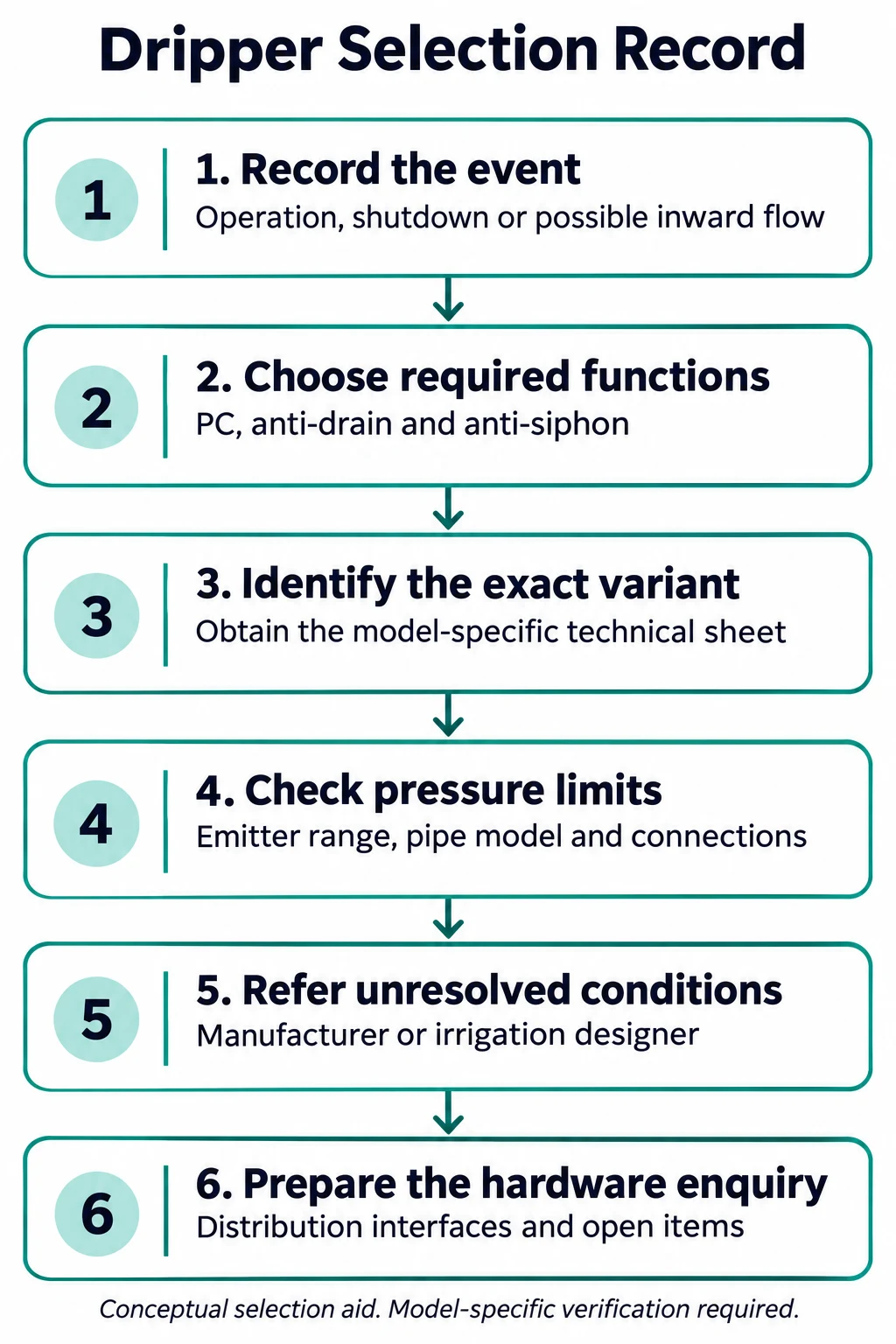
- Record the observed event and the operating or shutdown condition in which it occurs.
- Select the required PC, anti-drain and anti-siphon functions for that event and installation.
- Identify the exact emitter variant and obtain its current model-specific technical sheet.
- Compare expected local operating pressures with the emitter range and the selected pipe and connection limits.
- Refer unresolved shutdown, elevation or pressure conditions to the manufacturer or irrigation designer.
- Send the confirmed distribution interface requirements and open items with the hardware enquiry.
Keep one record for each materially different zone or component selection. Include the drawing reference, emitter model and variant, required functions, operating range, declared shutoff information, pipe model and wall, connection details and pressure-review basis. Name the person responsible for resolving each open item. This allows the buyer to request missing evidence without attempting to complete the designer’s work from a sales catalogue.
For distribution hardware, identify the interface between the selected emitter system and the proposed supply pipework. Include the project location, zone layout, flow requirements, pressure conditions, pipe material and dimensions, fitting types and quantities. Ask which requested items and documents are available for the proposed application. The NOVA irrigation guide distinguishes its distribution pipework role from drippers, driplines and filter stations. Retain that division when preparing a quotation request. NOVA irrigation pipework scope
Send the distribution pipework requirements to NOVA with the selected emitter documentation and unresolved interfaces. Request confirmation of applicable supply scope and documentation for the listed hardware. This gives the response a defined job and keeps the emitter manufacturer’s function and hydraulic decisions visible in the enquiry.
Related video
Related IFAN Group compression-connection video. Confirm the instructions for the selected NOVA hardware separately. This video establishes no dripper performance or compatibility.
Conclusion
A complete selection record connects each required function to the event it must address, then checks the exact emitter and pipe models against the pressure conditions. For an enquiry, prepare the feature requirements, model sheets, zone conditions and distribution interfaces together. Open items should carry a named next action before the selection advances to procurement.
Frequently asked questions
Does a PC dripper always include anti-drain protection?
Check the exact variant. Netafim identifies anti-drain functionality for LCNL and HCNL versions of its PC Online family.
Can UniRam CNL 16009 operate at 4 bar because its emitter range reaches 4 bar?
Its listed pipe maximum working pressure is 3.0 bar. The emitter range and pipe limit require separate checks.
Does an anti-siphon emitter establish source-water backflow protection?
The documented feature concerns contaminants entering the emitter. Source-water protection requires its own system-specific design and approval check.