
Drip Irrigation Filters: Choose for Sand, Algae or Precipitate
Choose a drip-irrigation filter for the contamination load and the emitter’s requirement. A screen or suitable disc can handle relatively clean water with suspended particles. Heavy sand may need upstream separation. Algae-rich surface water usually needs an organic-load treatment stage such as media filtration. Finer mesh alone cannot remove dissolved salts or prevent every chemical or biological blockage.
A fine filter can be doing its job and still be the wrong system. If it captures a pond’s algae but needs cleaning before the irrigation zone finishes, buying another fine element does not remove the loading problem. The comparison has to include what reaches the filter, what the emitter needs, and whether the filter can operate and clean within the available water supply.
Key Takeaways
- Match the filtration train to suspended mineral solids, organic loading or a chemical/biological blockage mechanism.
- Screen and disc are both useful; neither makes heavy source-water loading disappear.
- Algae-rich pond water needs attention upstream of the final emitter-protection filter.
- Use the emitter manufacturer’s filtration requirement rather than one universal mesh number.
- Operating pressure loss and the cleaning duty can rule out an otherwise suitable element.
- Keep a pipe-and-fitting availability enquiry separate from an unconfirmed filter-system offer.
Choose for what is clogging the system
Start with the material being trapped, not the housing colour or connection size. Mineral grit, organic matter and dissolved substances produce different problems. A screen that catches sand can work well on a relatively clean source but blind rapidly when loaded with algae. A more expensive disc element may collect more material before cleaning, yet it still has a finite dirt-holding capacity.
The University of Florida’s screen-filter guidance makes the source-water distinction explicit: mineral particles may suit screening, heavy sand can justify a separator upstream, and high organic loading calls for more than a lone screen. An intake screen protects against larger source debris; it is not automatically the final filtration required by the drippers.
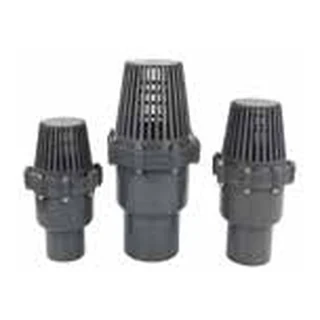
Keep dissolved chemistry separate. A mechanical opening captures particles; it does not remove a dissolved salt simply because the salt might later precipitate. Nor does capturing incoming particles prevent every biofilm from forming downstream. Penn State’s commercial drip-irrigation guidance recommends checking water quality for precipitates and other contaminants. Where that mechanism is suspected, water and blockage analysis must inform an appropriate treatment plan. This comparison supplies no acid, disinfectant or fertilizer-mixing recipe.
There is a useful diagnostic distinction here: a loaded filter and blocked emitters can coexist, but they are not necessarily caused by the same material. A screen covered in sand proves that it has captured sand. It does not prove that sand caused a downstream deposit. Identify the captured material and the emitter blockage separately before treating them as one failure.
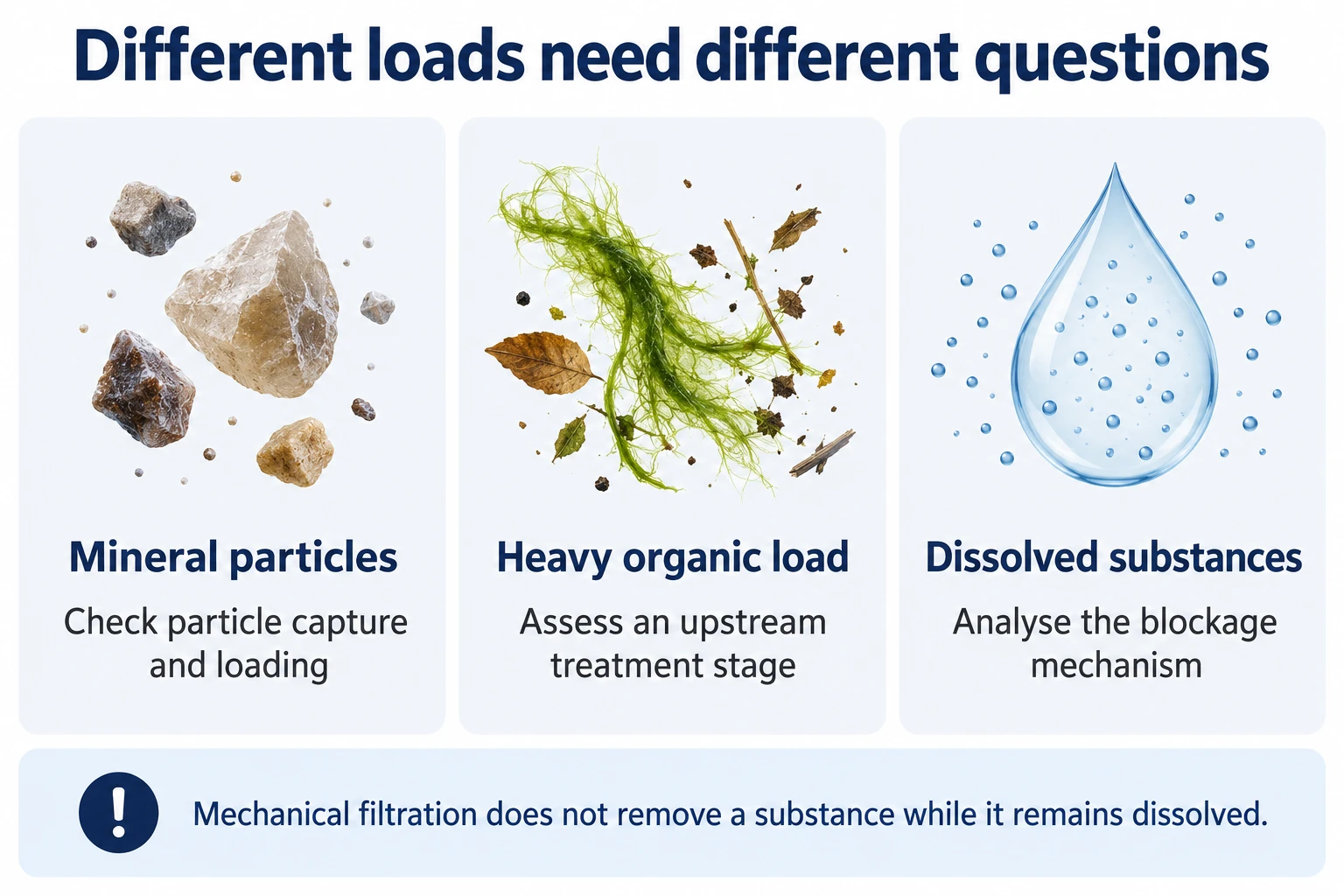
- Mineral particles: check particle capture and loading.
- Heavy organic load: assess an upstream treatment stage.
- Dissolved substances: analyse the blockage mechanism. Mechanical filtration does not remove a substance while it remains dissolved.
Screen, disc or media: which fits the water?
A screen provides a defined filtering surface. A disc stack creates intersecting passages through grooved elements. A media bed provides filtration through a larger depth of material. These mechanisms help explain the options, but the type name alone cannot establish capacity, cleaning efficiency or a required filtration grade for a particular product.
| Approach | Best fit | Main limit | Verdict |
|---|---|---|---|
| Screen | Relatively clean water with a manageable suspended mineral-particle load | A small filtering area or heavy organic loading can demand frequent cleaning. | A sensible simple choice when source loading and cleaning interval fit. |
| Disc | Water whose suspended load can be handled by the selected disc element and cleaning system | A disc is not a universal answer for heavy algae or organic loading. | Compare the actual product’s capacity and cleaning duty, not only its mesh label. |
| Media plus appropriate downstream protection | Surface water with substantial organic matter, where the treatment stage is designed for that load | Needs space, backwash capability and protection against downstream media carryover. | Consider it before repeatedly replacing a fine element on dirty pond water. |
| Sand separator before final filtration | A source carrying enough heavier sand to overload the final element | Does not replace fine emitter protection or solve dissolved chemistry. | Remove the heavy load upstream, then meet the emitter’s final requirement. |
Basis: University of Florida WI009 and Penn State Extension. These are conditional category choices, not verified model capacities.
Choose the simplest approach that meets both loading and operating requirements. A clean well does not automatically justify a media installation. Equally, changing a heavily loaded pond filter from screen to disc is not a complete design decision. The question is whether the replacement can retain and release the actual load for the required operating period.
Automatic cleaning changes who performs the cleaning and when. It does not turn an undersized filter into an adequately sized one or guarantee that the available pressure and flow can clean the element. Manual and automatic versions of the same broad type can therefore have different practical suitability for an unattended irrigation zone.
The filter must work while it is dirty and while it cleans
The emitter requirement establishes the final particle-protection target. Use the exact emitter manufacturer’s requirement and the selected filter manufacturer’s corresponding grade. A bare mesh number is incomplete without its opening specification: the Florida guidance describes mesh together with wire size and opening dimensions. Avoid assuming every screen or disc carrying the same mesh label has identical passage geometry.
Then test the hydraulic fit. A filter whose clean pressure loss is acceptable may develop excessive loss before the planned cleaning point. The University of Florida explains that excessive flow relative to filtering surface increases pressure loss and cleaning frequency. Connection diameter alone cannot settle that relationship.
| Check | Inputs to compare | Decision |
|---|---|---|
| Emitter protection | Emitter requirement; actual filter opening/grade; contaminant character | Reject an element that does not meet the emitter’s documented requirement. |
| Operating duty | Zone flow; product pressure-loss data; expected loading; pressure needed downstream | Keep enough downstream pressure throughout the permitted loading cycle. |
| Cleaning duty | Required backwash/cleaning pressure and flow; clean-water source; operation during cleaning | Select a model and cleaning arrangement the supply can actually support. |
Compare each product’s documented values at the relevant duty. No universal pressure-loss limit or backwash flow is implied.
Use upstream and downstream pressure readings at a comparable operating flow to track the filter’s pressure difference. Penn State recommends gauges on both sides for this purpose. Increasing differential can indicate a loading element, but a general fall in supply pressure is a different observation. Record both pressures rather than describing every weak dripper as “the filter losing pressure.”
Readings also need a clean baseline. If zone flow changes between observations, some change in pressure loss may be hydraulic rather than new blockage. If the filter differential remains small while emitter discharge deteriorates, do not assume a finer replacement element is the answer. Examine downstream deposits, leaks, pressure regulation and distribution conditions as applicable.
The pond case: a finer disc is not the first answer
A public commercial-garden question describes algae rapidly blocking an existing fine disc filter on a pond supply. The operator asks whether a different inlet or automatic filter would help. The account establishes a real selection problem; its diagnosis and proposed solutions are not treated as technical test evidence.
Illustrative decision using that situation: assume the captured material has been confirmed as a heavy organic load and the final element meets the emitter’s documented filtration requirement. Choose an upstream organic-load handling stage, with media filtration as a candidate, rather than making “finer disc” the first purchase. Retain appropriate final protection and check the treatment/cleaning duty against the source and zone demand.
That is already a useful decision before an exact model is chosen. The final disc is catching material but cannot carry the load for the required period. Upstream load reduction addresses the reason it fills. Automation may reduce manual attendance after the hydraulic and cleaning requirements are satisfied; it does not replace those checks.
| Condition | Preferred starting point | What would change it? |
|---|---|---|
| Confirmed heavy algae loading from a pond | Organic-load pretreatment/media concept plus final emitter protection | Actual water analysis, retained material and cleaning capability define the final train. |
| Relatively clean well water with manageable mineral particles | Correctly rated screen or suitable disc | Heavy sand can justify an upstream separator; chemical deposits need a separate response. |
| Little captured debris but deposits forming in emitters | Investigate the blockage mechanism before changing filter grade | Evidence of precipitation, biological growth or passing particles leads to different treatment decisions. |
Illustrative conditions, not three measured IFANNova installations.
Now change only the water source to a relatively clean well with a manageable mineral-particle load. A screen or suitable disc can become the more appropriate starting point. The pond recommendation should not follow the buyer to every site. The correct choice depends on what must be removed, not a hierarchy in which media is always “premium” and screen is always “budget.”
Specify the filtration duty and the pipe connections separately
A usable filter enquiry states the water source and known contaminants, emitter filtration requirement, zone flow, available operating pressure, and cleaning arrangement. For the pond example, record “heavy organic source loading; pretreatment/media stage to be sized; final emitter protection retained.” That is a different decision from “disc filter failed, buy a finer one.” This tells a filtration specialist what decision has been made and what must still be calculated.
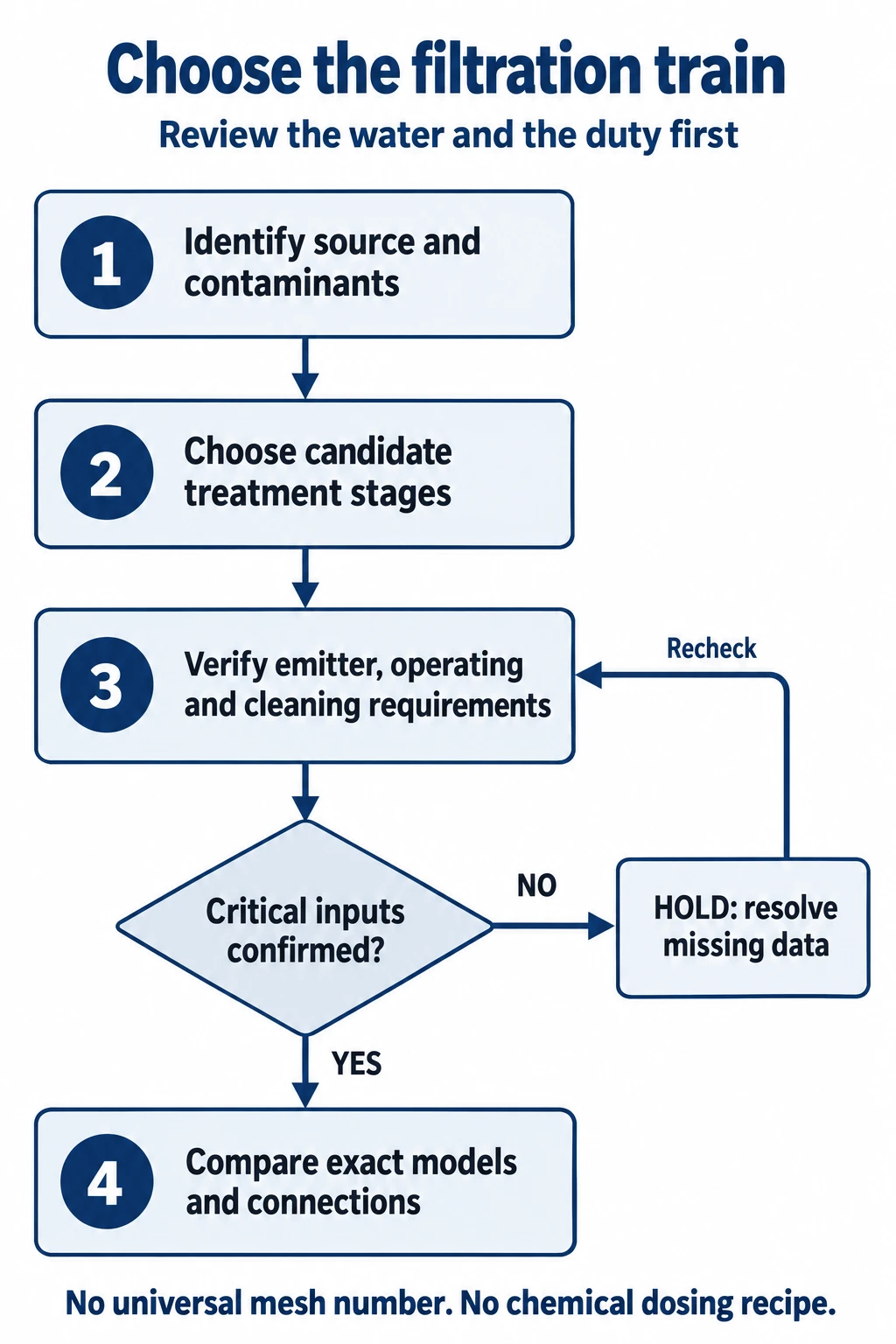
- Identify the water source and contaminant mechanism.
- Choose candidate filtration stages for the actual load.
- Verify the emitter, operating and cleaning requirements.
- Compare exact models and pipe connections only when critical inputs are confirmed.
Keep the pipe connection specification alongside that duty: actual pipe outside diameter and material, connection type, pressure/service conditions and required access. A technically suitable filter still needs a compatible connection arrangement. IFANNova’s HDPE compression-fitting category concerns that pipe-and-fitting side of the system. It is not evidence that a complete screen, disc or media-filtration package is offered.
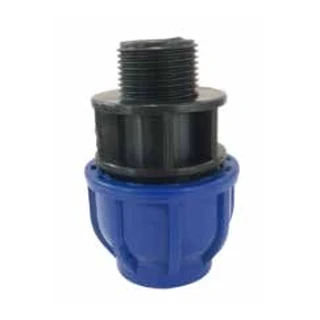
For a contractor’s pipe-and-fitting enquiry, Check pipe and fitting availability. Include the pipe dimensions, connection specification, quantities and destination; confirm availability before requesting an offer. No IFANNova filter model or filtration-design service has been established here.
Conclusion
Choose the filtration train from the loading mechanism, then verify emitter protection, operating loss and cleaning duty. A finer filter can capture more material while making an overloaded system harder to run. On dirty pond water, reducing the incoming organic load is the decision to resolve before treating a screen-to-disc swap as the solution.
Frequently Asked Questions
Is a disc filter always better than a screen?
No. Compare source loading, emitter requirement and the actual products’ operating and cleaning data. Relatively clean water can suit a correctly sized screen; heavy organic loading may need a different upstream stage.
Does a filter remove dissolved salts?
An ordinary screen or disc captures suspended particles. It does not remove a substance while that substance remains dissolved.
Can automatic backwashing fix an undersized filter?
It can reduce manual cleaning, but the filter and supply still need enough operating and cleaning capacity for the actual contaminant load.
Can IFANNova supply the filter selected here?
No specific filter model or complete filtration-system offer has been confirmed. The enquiry link is for checking pipe-and-fitting availability.