Repeated PVC Pump-Connection Failure: Can the Next Replacement Be Released?
After repeated PVC pump-connection failures, a higher pressure class or a metal stub does not justify return to service. Accept the replacement construction and clear the pump operating fault as two separate decisions. With the reported observations alone, both remain open: keep the system out of service pending responsible inspection and the actual equipment requirements.
Start with what the failed installation actually tells you
The owner in a public irrigation repair question described two related problems. After earlier inlet blow-outs and replacement, PVC between the pump and an elbow had expanded, while the pipe beyond the elbow looked normal. On the outlet, replacing the section up to a stop valve with galvanized pipe had not ended failure: PVC after that valve still blew out. These are reported observations from one installation, not a tested failure analysis.
The owner also challenged a simple overheating explanation: the pump was fed from an irrigation canal, and the controller reportedly went to sleep shortly after pressure rose. Keep those observations in the incident record. Removing them makes the case appear more conclusive than it is. Available inlet water describes the supply; it does not document the actual flow through the running pump during the event. A sleep observation describes a reported control response; it does not establish the whole sequence before the failure or the condition of the damaged assembly.
A useful handover therefore has three separate entries: what was seen, what someone suspects, and what the responsible investigation has established. Write “expanded between pump and elbow” in the first entry. Put “possible heating or another operating problem” in the second only as a question. Leave the third unresolved until there is applicable evidence. Do not promote the appearance of PVC, or the fact that metal was added, into a diagnosis.
The failed metal-to-PVC substitution matters because it shows that the previous change did not resolve the reported incident. It does not prove that all metal connections are unsuitable, that the remaining PVC has the wrong class, or that a different polymer would cure the fault. Those conclusions each need evidence beyond the reported sequence. The immediate result is a hold on an unexplained repeat failure, with the original observations preserved for inspection.
Record the operating finding separately from the repair
There is a real operating hazard worth investigating without declaring it the actual cause. In Pentair manual P15006, dated 02-01-2023, printed page 7 warns that continuous running at no flow, with discharge shut or without priming, can boil water and lead to pipe rupture, fitting blow-off or failure at pump ports. This warning belongs to the listed Flotec and Simer pumps. It supports taking an unresolved operating condition seriously; it supplies neither a diagnosis for the unidentified canal pump nor a safe interval for running it.
Ask the responsible pump specialist to identify the actual equipment and document the operating finding against its requirements. The record should connect the reported event to the assessed flow path, control response, temperature condition and damage findings. An acceptable finding needs a basis: which equipment and condition were assessed, what was established, what corrective work was required, and what remains outside the assessment. “The pump stopped” is too narrow when it leaves the failure sequence unexplained.
This is evidence planning, not a direction to recreate the failure. Do not restart a damaged assembly to see whether it heats, run with a closed discharge, choose a trial no-flow duration or adjust controls from this article. The applicable equipment procedure and responsible specialist determine any inspection, corrective action and return-to-service work. There is no numerical temperature or pressure threshold here that converts an unidentified system into an approved one.
The Irrigation Association publication’s pump-myths article already explains deadheading and PVC damage around pumps. Its explanation is useful context. The practical issue here is what evidence closes an operating hold after repeated failure. Reading a plausible mechanism does not establish that the mechanism occurred, and a suggested protective device in another arrangement is not a selection instruction for this pump.
Accept a connection against the actual pump requirements
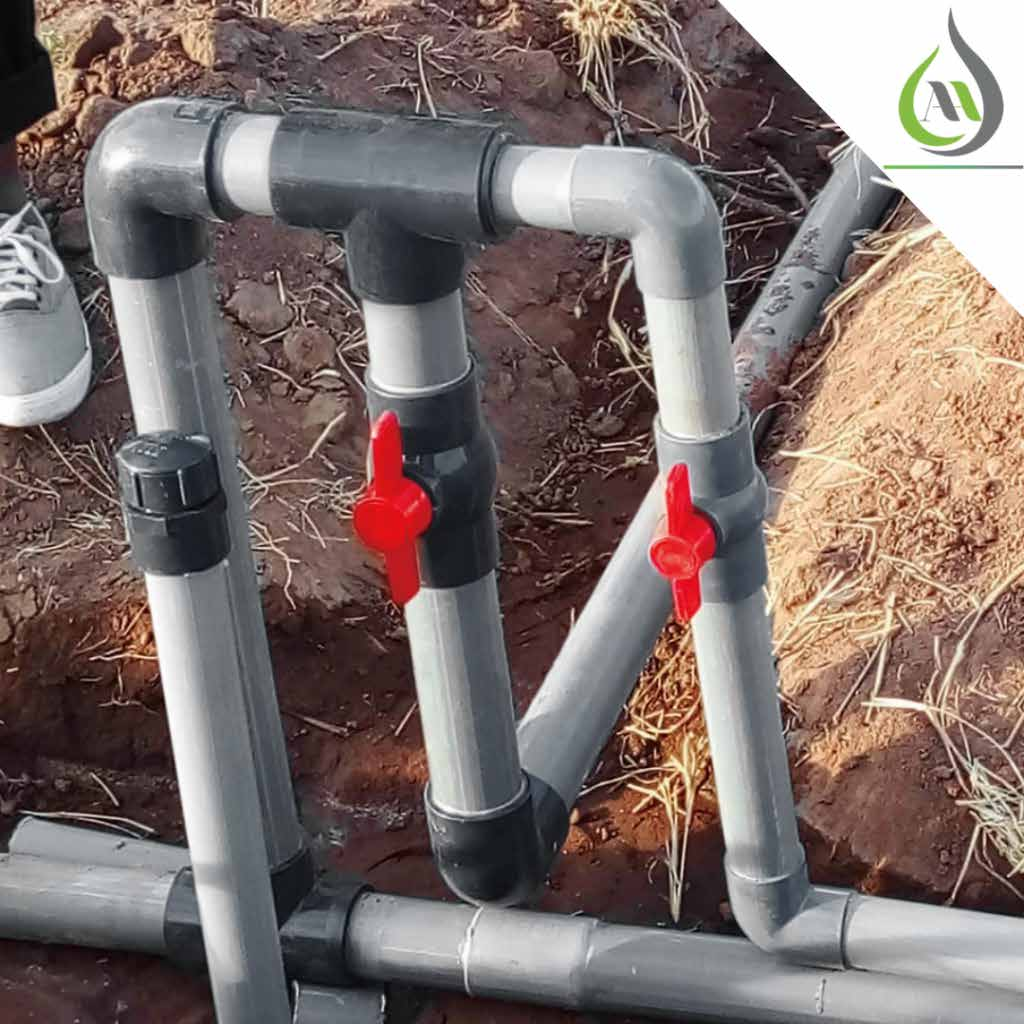
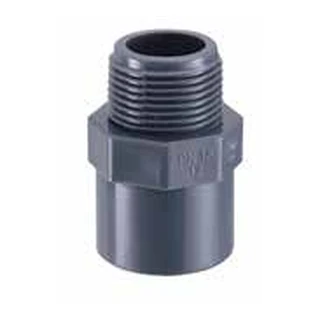
Build a separate connection acceptance record. It answers whether the proposed assembly matches the actual service and installation requirements. It does not answer whether the pump’s unexplained fault has been corrected. A pipe delivery note can identify purchased material while leaving port compatibility unresolved; a correct port adapter can still leave the joint method or independent support undocumented. Treat each omission as a particular open item rather than describing the whole repair as either good or bad. An acceptance record should also identify which revision of the requirement and product documents the reviewer used, so a later substitution returns to review instead of inheriting an earlier acceptance.
| Evidence item | What it must resolve | Responsible evidence source |
|---|---|---|
| Pump identity and port | Exact model, port specification and matching installation arrangement | Actual nameplate and applicable OEM documents |
| Pipe and fitting identification | Material, dimensions, standard and service pressure/temperature suitability | Specified product documentation and design requirement |
| Joint and support | Applicable assembly instructions and supported piping arrangement | Installer record and applicable manufacturer instructions |
| Inspected damage | Which components require disposition before acceptance | Responsible inspection and equipment requirements |
P15006 provides a useful identity check. Printed page 5 contains support, sealing and joint instructions, plus a particular priming-tee requirement for a described arrangement. With an unknown pump, those details cannot be borrowed simply because both installations use irrigation water. A similar photograph, matching nominal pipe size or familiar brand name does not establish that the manual applies. The actual model must be among those listed, and the relevant arrangement must match.
Now change only the identification input: suppose the pump is confirmed as an exactly listed P15006 model and the documented arrangement matches its relevant instructions. That change permits a bounded review of construction against those instructions, including the applicable support and connection provisions. It does not make every installation detail universal, explain why the earlier pipe failed, or release operation. Keep the construction identity result in its own record; keep fault clearance open unless independently supported.
For pressure-class and temperature education, use our existing PVC pressure-class guide. Its material-selection discussion remains the reference for that task. In this incident review, the selected class and temperature basis are inputs to construction acceptance. A stronger nominal class does not supply the missing operating findings, and a catalogue heat-resistance statement does not establish the service rating of the exact replacement assembly.
Two completed checks can still produce different holds
The following examples are decision illustrations, not NOVA customer cases or findings about the forum installation. In each one, “documented” means the responsible reviewer has evidence meeting the actual equipment and service requirements for that particular record. It does not mean that someone has ticked a box after looking at the pipe. The distinction makes the outcome change when one input changes, without inventing a commissioning procedure.
| Construction record | Operating record | Disposition |
|---|---|---|
| Documented acceptable | Unresolved | Hold return to service for operating investigation. |
| Unresolved | Documented acceptable | Hold connection acceptance and return to service for construction evidence. |
| Unresolved | Unresolved | Both decisions remain open; no release from substitution alone. |
| Documented acceptable | Documented acceptable | Responsible release may be considered under actual equipment requirements; this article grants none. |
Replacement documented; operation unknown. Suppose the reviewer accepts the exact pipe and fitting identities, service compatibility, port match, joint record, support and damaged-component disposition. The new connection can be recorded as acceptable construction. But there is still no established explanation or acceptable disposition of the reported operating event. Record the outcome as “construction accepted; return to service held for operating clearance.” Buying the correct replacement has resolved one question, and its receipt cannot resolve the other.
Operation documented; replacement unknown. Change the evidence in the opposite direction. Suppose the responsible specialist has established and documented acceptable operating conditions and dealt with the operating fault under the applicable equipment requirements. The proposed replacement still lacks a verified thread specification or material identity. The operating finding stays valid within its scope, but connection acceptance remains on hold. Obtain the missing product/port evidence and compare it with the accepted requirement; replace or revise the proposal if it does not match.
For the actual public question, neither complete record is available. Canal supply and quick sleep cannot substitute for the operating assessment; the description of replaced PVC and galvanized sections cannot substitute for construction evidence. The defensible outcome is therefore the third row. This is a usable incident disposition even though the cause remains unknown: it names the two unresolved decisions and prevents a purchasing action from being mistaken for repair release.
Use a seven-step handover without turning it into a restart test
Use this sequence to organize the handover among the owner, installer, pump specialist and pipe supplier. It is an administrative decision sequence: it contains no energized test, control-setting adjustment or permission to open a hot or pressurized component. Each step should leave a record another responsible person can understand without relying on a verbal assurance that the repair “looks fine.”
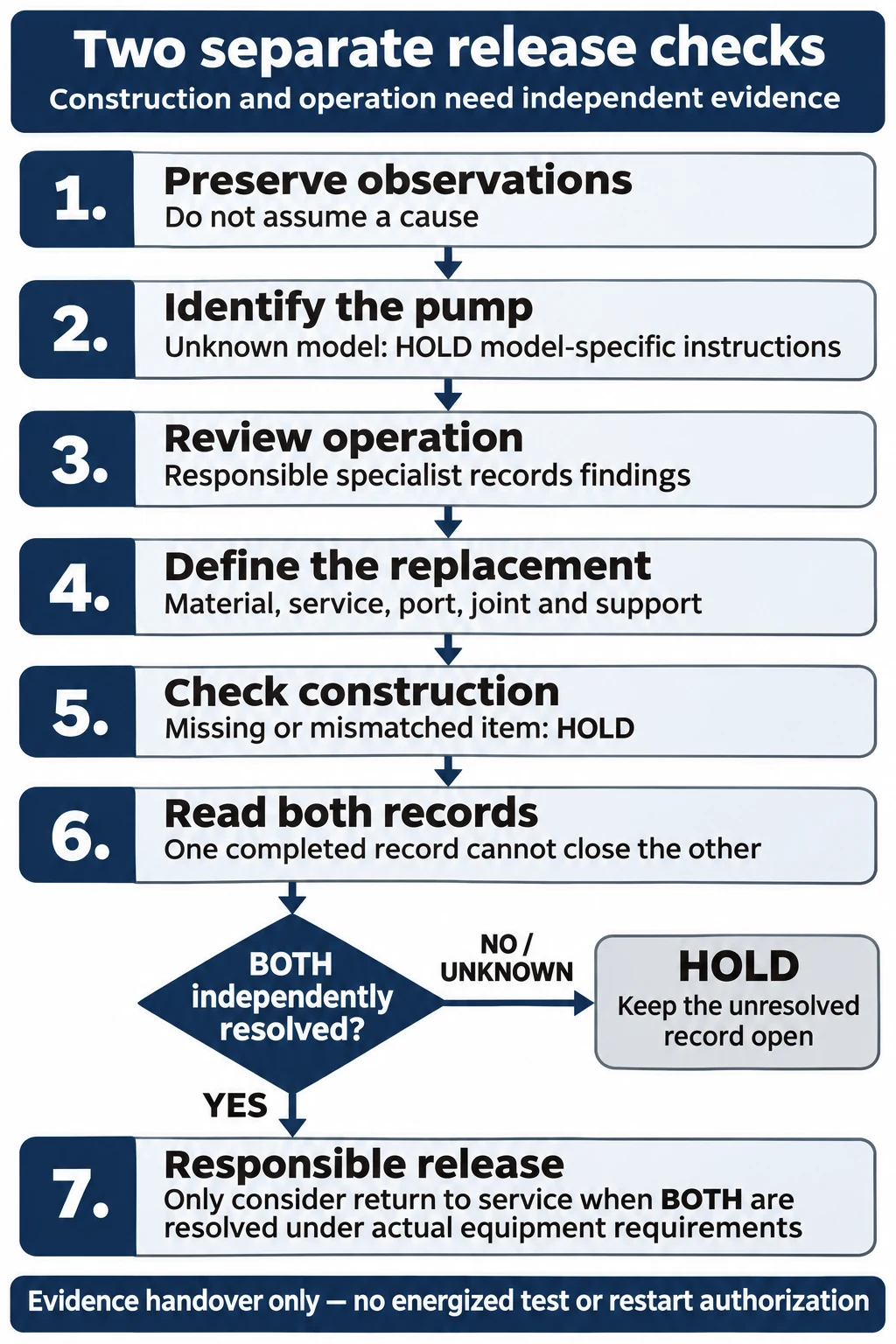
Open the incident handover flowchart at full size.
- Preserve the incident observations. Keep the repeat-failure locations, prior changes, canal-water statement and reported sleep response together; do not relabel them as a proven cause.
- Identify the pump. Obtain the exact model and applicable manual. Stop model-specific construction prescriptions if identity or arrangement is missing.
- Separate the operating investigation. Have the responsible specialist document the event, acceptable operating disposition and remaining damage concerns under the actual equipment requirements.
- Define the replacement requirement. Record material, dimensions, standard, service pressure and temperature, port specification, joint and support requirements.
- Compare construction evidence. Match the proposed assembly and installation record against that requirement. Hold acceptance for a missing or mismatched item.
- Apply both independent decisions. Use the matrix: a completed construction record cannot close an operating hold, and an operating finding cannot accept an unidentified assembly.
- Handover for responsible release. Only after both records are satisfactorily resolved can the responsible party consider return to service under the applicable equipment requirements.
Record who owns each remaining action and what will close it. For example, “supplier to confirm thread” is incomplete if nobody has identified the required port thread. A better open item ties the missing product evidence to the actual port requirement and says that a mismatch returns the proposal for revision. Likewise, an operating report should identify its scope rather than silently accepting the pipework. These small distinctions stop responsibility disappearing between an inspection report and a purchase order.
Turn an accepted requirement into a bounded supply enquiry
Once the operating assessment and replacement requirement are established, the pipe buyer can make a focused enquiry. NOVA’s documented offering includes the 806 UPVC/CPVC pipe category and 1806 fittings, with a stated diameter range of Φ20–110. That category information is a starting point for checking supply scope. It does not establish a matching threaded pump adapter, a particular service-temperature rating, availability or compatibility with the unidentified installation.
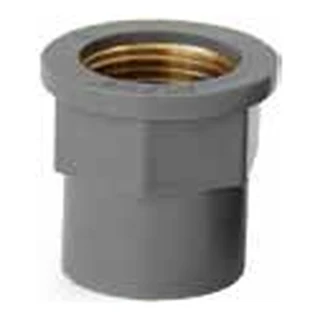
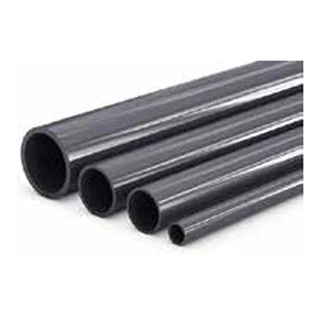
Send the actual material, dimensions, required standard, service pressure and temperature, pump model and port specification, and joint/support requirements. Keep the operating findings with the responsible equipment specialist; NOVA’s pipe enquiry does not offer pump or control repair. Do not replace a pressure requirement with a drainage-series product or treat a different material as an automatic cure. The useful commercial outcome is a clear match, mismatch or still-unverified supply response against an already defined requirement.
Send the accepted connection specification for a supply-scope check. Exact product suitability and supply remain to be verified; no stock, price, certification, warranty or lead-time commitment is made here.
Conclusion
Repeated pump-connection failure creates two acceptance questions. Construction evidence establishes whether the replacement meets the defined service and installation requirements. Operating evidence establishes the responsible disposition of the fault and the equipment’s return-to-service conditions. Solving one can leave the other open. Keep both visible, preserve contradictory observations, and let applicable equipment requirements govern the final release.
FAQ
Does canal water rule out an operating problem?
No. Available inlet water does not document flow through the pump during the failure event. Keep the canal-supply observation, but leave the operating finding open until the responsible assessment establishes it.
Does quick controller sleep approve the replacement?
No. A reported sleep response does not establish the complete failure sequence or accept the connection’s material, port match, joint and support.
Can I apply the Pentair instructions to another pump?
Only use that manual’s specific instructions after confirming an exactly listed model and the matching arrangement. Identifying the correct instructions does not establish the fault cause or authorize restart.
Can NOVA confirm a replacement from a photograph?
A photograph alone does not establish supply compatibility. Submit the accepted material, dimensions, standard, service pressure and temperature, pump-port specification, and joint/support requirements for a scope check.