
Excavated Soil Around PVC Pipe: Check the Zone Before Reusing It
Excavated soil is not automatically suitable beside a buried PVC pipe simply because it came from the same trench. Separate the pipe’s bedding and surrounding embedment from the remaining trench backfill. Reuse needs to satisfy the actual pipe instructions, project material specification and placement requirements for the zone. Unsuitable clods, hard inclusions or material that cannot provide the specified support cannot be accepted by calling it “native soil.”
This guide helps a contractor or project buyer review a proposed fill material. It gives a conditional material-review result, rather than a universal sand requirement, a geotechnical design or approval to enter an excavation. The useful question is where the material will go, what it must do there and what evidence establishes its suitability.
Key Takeaways
- “Backfill” is too broad a description for material touching or supporting the pipe.
- A material acceptable higher in the trench is not automatically suitable in the pipe embedment.
- Screening out visible rocks does not by itself establish grading, compactability or compliance.
- Imported material also needs a defined specification and acceptance basis.
- Keep material acceptance separate from placement and compaction acceptance.
- Use the approved project detail and actual pipe instructions to resolve missing limits.
Name the zone before selecting a material
A pipe installation has several different material functions. The support below the barrel, the material worked around its sides and the material immediately above it form the pipe-supporting region. The remaining trench fill has a different location and may have different acceptance requirements. A proposal saying only “reuse excavation” hides those distinctions.
The Iplex PVC Pressure Pipe and Fittings Technical Guide returned by this link is Version 1.0, December 2025. Section 9.2 discusses bedding, side support and overlay together as embedment, then treats the remaining backfill separately. Use the applicable system and installation section when assessing the proposed material.
That manufacturer guidance is a worked reference for understanding the distinctions. It does not approve an IFANnova pipe installation or establish the governing requirements for an unrelated site. The project designer and responsible installer must identify the applicable instructions and approval route.
| Proposed location | Function to confirm | Review consequence |
|---|---|---|
| Below the pipe barrel | Continuous support at the required alignment and grade | Resolve weak spots, hard points and unsuitable excavated ground |
| Beside and immediately around the pipe | Specified side support and protection | Check material suitability and achievable placement |
| Remaining trench fill | Required reinstatement and surface performance | Apply that zone’s specification and loading conditions |
These are functional descriptions, not a universal dimensioned trench detail. Obtain the actual drawing’s zone boundaries and requirements. A quoted depth from another pipe system or authority is not a substitute for identifying the detail that applies to your installation.
What the native-soil question leaves unanswered
A real Home Improvement Stack Exchange question asks whether soil removed during a PVC septic-pipe repair can be reused or whether gravel should be placed around the pipe. The discussion contains conflicting practical advice. It is evidence of the reader’s decision, not the technical authority for a particular pressure line or drainage installation.
The question becomes answerable when “the same dirt” is replaced with a material description and location. Does it contain clods, debris or hard fragments? Can it be placed around the pipe without leaving unsupported areas? Does it meet the specified grading and compaction requirements? Who is authorised to accept it for the proposed zone?
In its own pressure-pipe guidance, Iplex excludes soil clods and temporary brick or timber supports from contact with the pipe. It also states that unsuitable excavated material must be replaced with suitable imported embedment when it is not granular or friable, or does not meet the project specification. Those are conditions to verify, not evidence that every excavated material fails.
A native sandy material and a wet, clod-forming excavation are therefore not interchangeable merely because both were dug on site. Conversely, “imported sand” is not a complete acceptance description. It identifies a supply source and a broad material category but does not establish compliance with the actual grading, cleanliness or placement requirements.
Material approval and installation approval are different
U.S. Plastic’s underground PVC and CPVC guidance calls for uniform, continuous support on firm, stable material and rejects intermittent blocking to establish grade. Its stated scope is solvent-cemented PVC and CPVC piping. That scope is relevant to the named jointing method; do not silently apply every detail to another pipe or connection system.
The practical distinction is that a compliant material can still be placed badly. A delivery ticket does not prove that material has reached beneath the pipe sides or that the specified compaction has been achieved. Material approval answers what may be used; installation inspection answers whether the approved material was placed as required.
Likewise, a neat-looking trench does not establish material compliance. Compaction, support and cleanliness are not interchangeable with appearance. The acceptance record should connect the material information, the applicable detail and the actual inspection or testing required by the project.
For procurement, this means keeping separate line items or responsibilities where necessary. Identify who supplies the material, who accepts it, who places it and who verifies the specified result. If the pipe buyer and civil contractor are different organisations, make those interfaces explicit rather than assuming the pipe order includes an approved embedment method.
Work through three material-review outcomes
Illustrative assumptions, not actual site records: first consider excavated material proposed beside a PVC pipe. The project has an approved embedment specification, the material has been assessed against it, and the responsible reviewer accepts its use. The placement method can achieve the specified support and compaction. Under those assumptions, retaining the material as an accepted candidate is justified; its on-site origin is not a reason by itself to import something else.
Now change a condition. The same pile contains hard debris and clods, and no compliant processing or acceptance evidence is available. The earlier result no longer follows. Hold its use in the embedment and obtain a conforming material or an approved processing-and-verification proposal. Do not bury the uncertainty beneath the label “screened native fill.”
In a third case, the contractor has an imported material quotation but the project detail and acceptance criteria are missing. Buying it does not close the decision. Obtain the applicable zone specification, then compare the proposed material and placement method with it. This prevents a fast purchase from becoming an unsupported technical approval.
| Known condition | Result now | What resolves the next step |
|---|---|---|
| Material and method meet the applicable requirements and are accepted | Candidate accepted for the stated zone | Retain the acceptance basis and verify actual placement |
| Clods, debris or other specified exclusions remain | Use in the affected zone is not established | Conforming replacement or approved processing with verification |
| Only “native soil” or “imported sand” is specified | Hold the material decision | Identify the zone, material criteria and acceptance authority |
| Material accepted but placement cannot achieve the detail | Hold the method | Resolve access, sequence and verification with the responsible team |
The result is deliberately conditional. It does not prescribe a universal compactor, layer depth, particle limit or cover. Those inputs change with the project and system. A useful review identifies which input is missing and what comparison becomes possible once it is supplied.
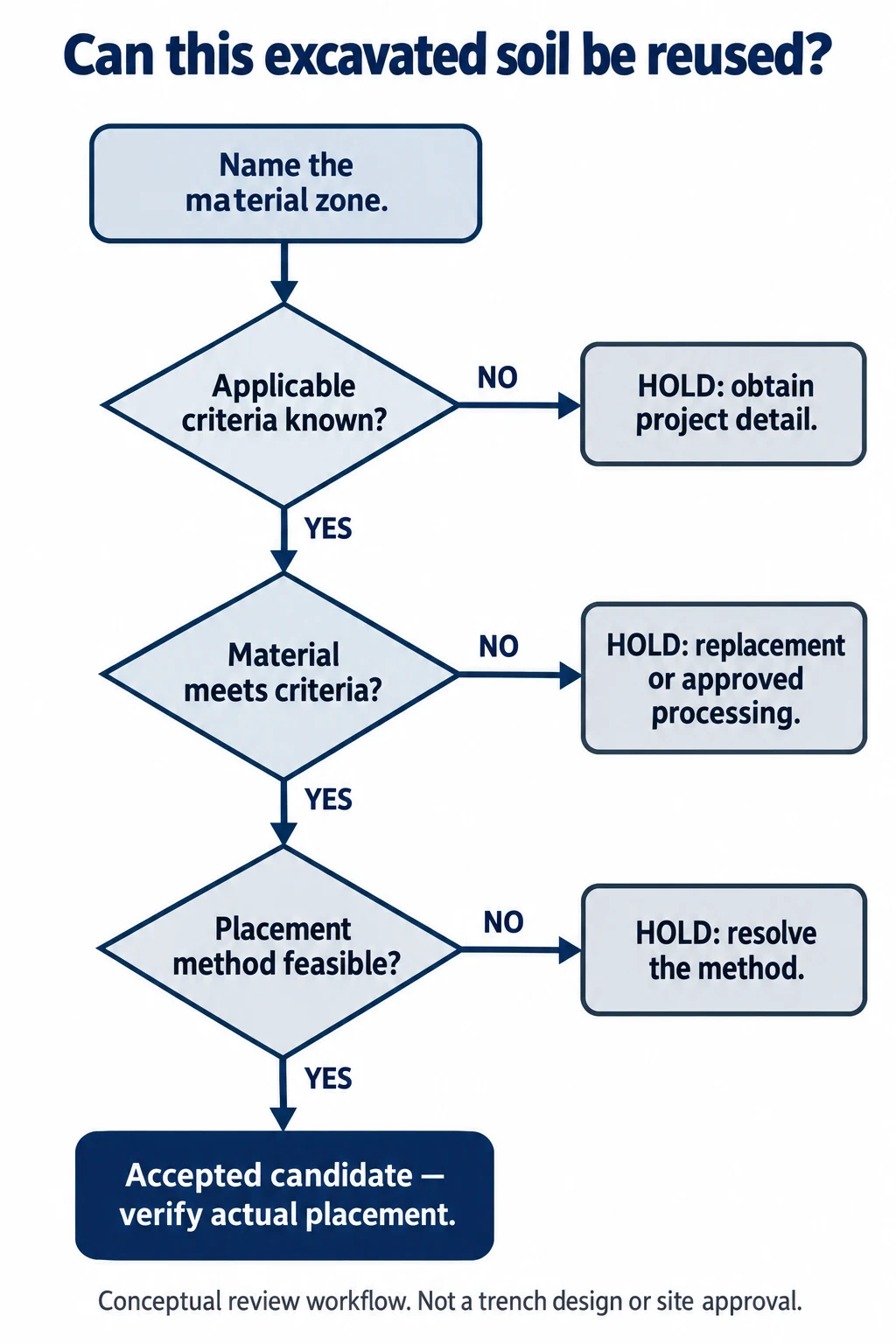
- Name the proposed material zone and obtain its applicable criteria.
- If the criteria are unknown, hold the material decision and obtain the project detail.
- Compare the material with those criteria. If it fails, hold for conforming replacement or approved processing and verification.
- Confirm a feasible placement method. If it cannot achieve the detail, hold the method for resolution.
- Retain an accepted candidate for its stated zone and verify actual placement.
Do not repair a design gap with a stronger pipe label
A pipe’s nominal pressure rating is not a blanket approval for arbitrary embedment, surface loading or trench conditions. Iplex’s installation section connects performance with embedment quality, compaction and native-soil conditions. U.S. Plastic also treats the anticipated loads and local installation requirements as part of the buried-pipe assessment.
Consequently, substituting a higher pressure class does not answer an unresolved bedding question. It may change one pipe property while leaving the missing support, unsuitable material or incomplete reinstatement design untouched. Return the unresolved condition to the relevant design or installation review rather than treating the printed class as a replacement for that review.
Keep separate unknowns visible. If groundwater or unstable ground has not been addressed, accepting a material grading alone does not resolve the ground condition. If the surface will carry traffic, the final fill and cover assessment must reflect that loading. This guide does not supply a ground-stabilisation or traffic-loading design.
Build a short acceptance record before ordering
Record the actual pipe material and jointing system, the zone where reuse is proposed, the drawing and specification references, the proposed material description and the person or role responsible for acceptance. Attach the required grading or other verification information. Then identify the placement and inspection basis separately.
A useful request reads: “Please assess this excavated material for the side-support and overlay zones under the referenced detail; confirm any processing, testing and acceptance requirements before use.” A request for “approval of the dirt” leaves the location and required result undefined. The more precise record lets the reviewer answer the actual question.
For an IFANnova pipe enquiry, the published 806 UPVC/CPVC product page lists the relevant product family and dimensional information. Confirm the actual PVC grade and proposed application rather than transferring a CPVC heat-resistance statement to UPVC. Provide the pipe specification and project requirements for a product availability check.
Send the pipe requirement to IFANnova with country, application, dimensions and governing specification. Obtain embedment acceptance from the responsible project team. This article does not offer soil testing, civil design, local installation approval or a verified supply of bedding material.
Conclusion
Reuse is a zone-specific material and method decision. Identify what surrounds and supports the pipe, compare the proposed material with the applicable requirements, and keep actual placement acceptance separate. Native origin neither approves nor automatically rejects a material. Imported origin does not remove the need for evidence.
Frequently Asked Questions
Is imported sand always required?
No universal sand requirement is established here. Use the actual project and pipe-system requirements to determine the acceptable material and approval route.
Can material acceptable at the top of the trench touch the pipe?
Not automatically. The pipe-supporting and surrounding zones can have different requirements from the remaining fill. Check the stated zone before reuse.
Does a higher PN rating fix poor embedment?
It does not resolve an unsupported installation method. Pipe properties, ground conditions, support and loading still need the applicable assessment.