If your crew is preparing PVC-U solvent-cement joints on a 45°C day, start with the cement label, not a shorter cure-time estimate. An ambient reading does not establish permission to apply a particular product. Check the actual product’s application window, the joint conditions and the coverage of its cure schedule before opening the can.
A joint can become difficult to assemble quickly while still needing a separate wait before pressure testing. Those are different decisions. If the manufacturer’s table does not cover the conditions, obtain product-specific guidance or move the work into a covered condition; do not calculate an unlisted 45°C timing from a cooler-weather row.
Key Takeaways
For a general preparation and assembly demonstration, TEACH Construction Community Education’s PVC Process lesson reaches solvent welding at 5:12. This is not a cement-specific cure chart or approval for 45°C work.
The temperature check needs three separate entries: ambient conditions, the pipe/socket condition and the cement’s stated application range. A product’s resistance after curing is not its allowed installation temperature. Keep the values on the work record alongside the product name and datasheet revision so the next crew does not inherit an unexplained “hot weather” instruction.
The manufacturer-hosted Tangit PVC-U PLUS datasheet dated September 2017 lists an application range of 5–35°C. A 45°C application lies outside that stated range. This is evidence about that named product, not a prohibition or permission covering every PVC-U cement. Its figures must not be transferred to a different Tangit regional product or an IFANNova-labelled can.
Oatey’s timing explanation, published August 7, 2026, distinguishes working time for assembly, set time for handling and cure time before testing or service. A socket that feels firm only answers the handling question. It does not establish the pressure release.
Write three separate hold points on the job sheet. First, can the crew seat the socket while the cement remains usable? Second, when may that assembled joint be moved? Third, when may the specified water test begin? Using a single “dry time” field makes it easy for an instruction about one stage to be applied to another.
Confirm PVC-U, pressure or drainage duty, outside diameter and socket compatibility before comparing cement grades. “Heavy body” describes a product characteristic, not an approval for every large socket or hot condition. The applicable diameter, primer requirement and assembly method belong to the exact cement and pipe/fitting instructions.
For an IFANNova distribution-line enquiry, identify the WP55 pipe and 1806 fitting system rather than asking for generic PVC. The catalogue records the UPVC 806 system as PN16, with the matched range running from 20 to 110 mm. This product range does not supply a missing cement application limit. Keep the cement’s TDS and the component specification together.
Do not use the catalogue’s CPVC heat-resistance wording to authorize a UPVC installation. Material selection and operating-pressure assessment remain separate from the assembly window; the UPVC Class 16 application discussion addresses that distinction.
The Tangit PVC-U PLUS sheet gives the following open-time examples for a 1 mm adhesive film. They show why the condition belongs beside the number. They do not offer a 45°C point, a universal temperature equation or an IFANNova cure schedule.
Use the example to audit a work instruction. If it merely says “three minutes,” it has lost both the named product and the temperature condition. If it says “halve the time at 45°C,” it has added a rule the cited table does not contain. Remove that unsupported instruction before it becomes a crew target.
| Temperature (°C) | Approximate open time (min) | Decision boundary |
|---|---|---|
| 20 | 3 | Named product and film condition only |
| 25 | 2 | Named product and film condition only |
| 30 | 1 | Do not extrapolate a 45°C value |
The sequence below combines product checks with Oatey’s published preparation and assembly guidance in a pre-work and release framework. It does not replace the selected manufacturer’s detailed preparation or assembly instructions. Assign someone to make the go/stop decision before cement application, while replanning is still possible.
The Weld-On solvent-welding guide, page 11, describes shade storage, cooler work periods and wet/fluid assembly. It also describes damp-rag cooling followed by drying. These measures help plan the work; they do not extend a different product’s published application limit. Follow the selected system’s instructions on primer and insertion technique.
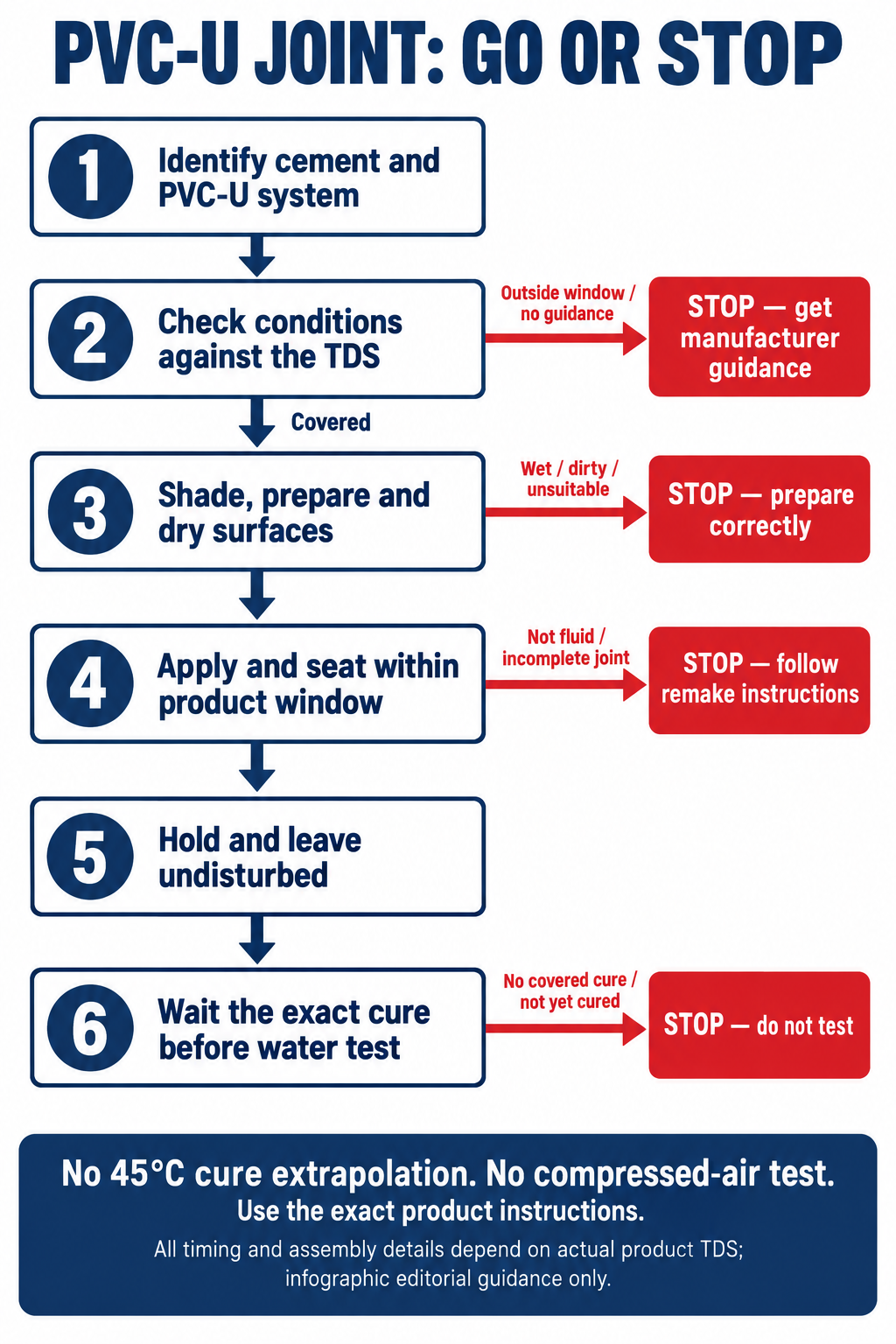
Record pipe diameter, intended test pressure, temperature during assembly and curing, humidity, product and the time of the last joint. A scheduler who only receives “finished at noon” cannot distinguish completion of assembly from completion of the cure hold.
Weld-On’s page 18 general cure table has a warm row of 60–100°F and a relative-humidity condition of 60% or less. The guide adds 50% cure time in damp or humid weather. That is a bounded manufacturer schedule, not a 45°C row. Do not take a hotter site reading as permission to shorten a listed wait.
Treat an uncovered condition as an evidence gap. Ask the cement manufacturer for the appropriate schedule, or reschedule into a condition it covers. Keep the response with the joint record. The guide also excludes compressed-air or gas testing of these systems; the pressure-release plan must use the applicable water-test procedure.
Send a joint schedule rather than a request for “fast glue”: pipe material and series, outside diameters, fitting/socket details, design and test requirements, measured conditions, chosen cement and TDS revision. Separate any proposed substitute so compatibility can be checked before supply approval.
Ask for the exact cement’s current label, application limits, diameter coverage and cure guidance for your conditions. Then ask which quantities are stocked, the MOQ or minimum pack for each consumable, and the confirmed dispatch and delivery basis. Required-on-site date, destination and mixed component quantities belong in the same enquiry; a generic delivery estimate cannot establish whether the whole matched schedule arrives together.
IFANNova’s cement-specific TDS, product approval and supply timing have not been verified for this guide. A quotation should resolve those items instead of treating the public examples above as evidence for its own can. For the wider environmental assessment, use the hot-climate pipe guide alongside the joint-specific record.
See the IFANNova matched pipe and fitting range.
No. Handling strength and cure before pressure are different hold points. Use the applicable product schedule for the intended test.
Its body alone cannot establish permission. Check the exact product’s application range, permitted pipe size and assembly guidance.
Only if the manufacturer explicitly makes it applicable. Product names, formulation, diameter, pressure and climatic conditions must remain attached to the timing.
No. The examples are attributed public manufacturer guidance; the supplied cement’s current TDS and batch-specific product details must be checked separately.