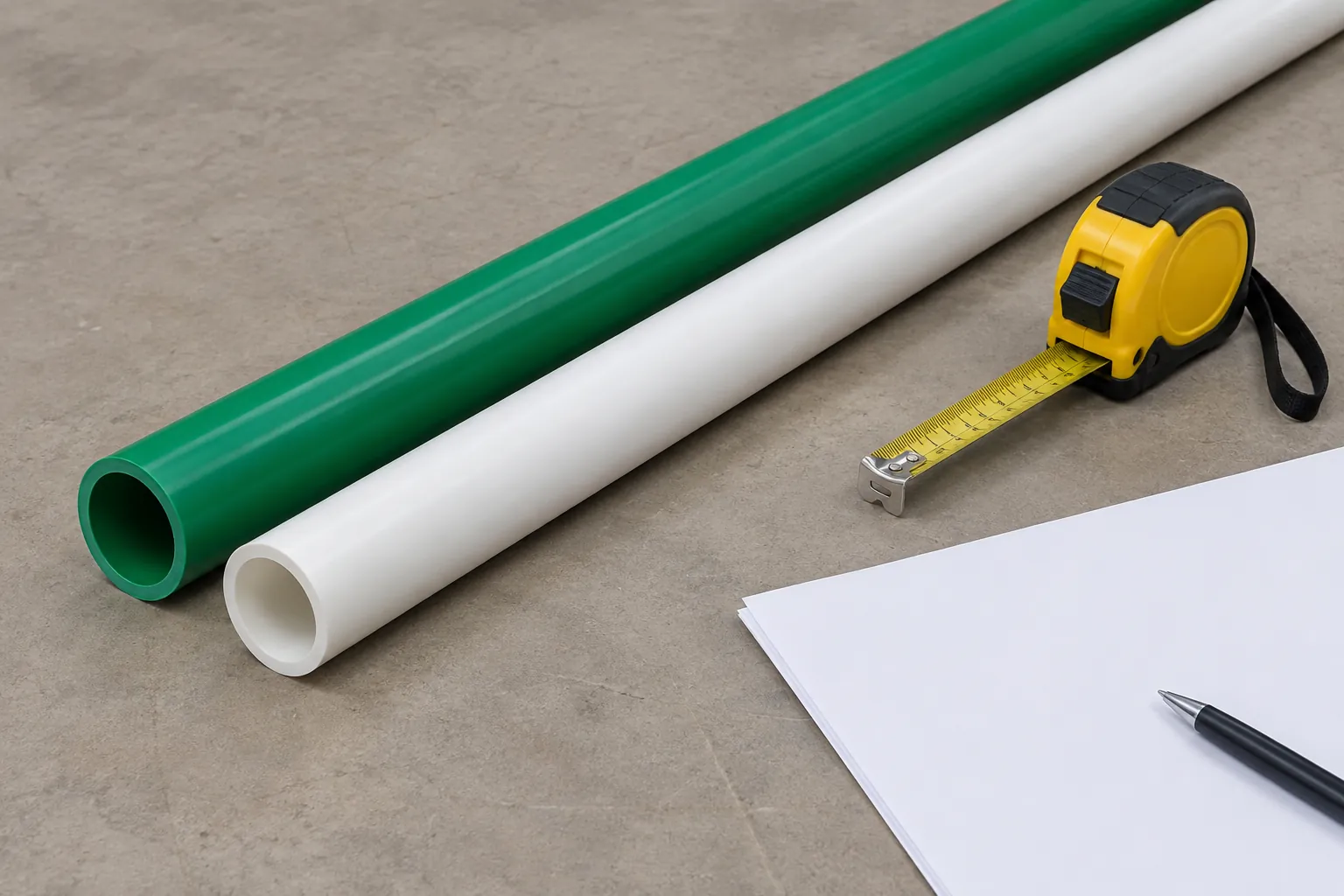
A pipe colour code identifies the service inside a line, using the scheme specified for that installation. Under BS 1710:2014, water uses green as its basic identifier; code colours distinguish source and use. Under ISO 14726, the water family uses blue. Read the full band sequence and service label against the approved legend. A green PP-R pipe body alone does not establish that the installed line contains drinking water.
Which pipe colour code governs the project?
Start with the project specification, rather than a colour chart downloaded from another job. BSI lists BS 1710:2014 as current and describes identification of fluid services above and below ground. It also explains that the 2014 revision removed ship systems, which are covered by BS ISO 14726. That boundary matters when a building-services team and a marine contractor share drawings.
ISO 14726:2008 covers service identification on ships and marine structures and permits use on land installations. Its scope excludes medical gases, industrial gases and cargo. Being an international standard does not make it the specified scheme for every water project. For a land installation using it, record that choice in the project legend.
For a UAE or other Gulf project, obtain the approved consultant or owner identification schedule and any applicable authority requirements. The examples below explain two named schemes; they do not establish local acceptance. If drawings, marker artwork and the written specification disagree, resolve that discrepancy before procurement. A marker supplier cannot settle a design conflict by choosing the most familiar colour.
Water bands: the same colours can mean different services
The comparison below keeps each sequence attached to its source. The BS examples come from Water Regs UK’s April 2021 guidance on BS 1710:2014. The ISO examples come from DIN Media’s explanation of ISO 14726. These are selected water services, rather than an interchangeable chart for all fluids.
| Specified scheme | Service example | Sequence | Decision before use |
|---|---|---|---|
| BS 1710:2014 | Potable, public supply | Green / auxiliary blue / green | Confirm the source is the public supply. |
| BS 1710:2014 | Potable, alternative source | Green / flint grey / green | Identify the actual alternative source. |
| BS 1710:2014 | Non-potable, public supply | Green / auxiliary blue / black / auxiliary blue / green | Retain the non-potable distinction. |
| ISO 14726:2008 | Potable water | Blue / green / blue | Use only within the selected ISO scheme. |
| ISO 14726:2008 | Condensate | Blue / yellow / blue | Do not interpret the centre band through a BS legend. |
Sources: Water Regs UK, April 2021, Table 2 (BS 1710); DIN Media, ISO 14726 overview. Selected examples only; use the complete specified scheme.
For contractors specifying a PP-R branch line, compare the pipe dimensions in the IFANNova PP-R catalogue with the separate project identification schedule.
A source code and a service description answer different questions. “Public supply” does not by itself tell the maintenance team whether a particular downstream line is potable. Keep the source and end use in the service schedule. For a fire-water line, resolve water quality and the fire-system designation in the complete specified scheme rather than improvising from the potable-water row.
What a plastic pipe print line does and does not tell you
Treat the pipe print line as product information, and the installed identifier as service information. Manufacturer, material, size and any declared product classification can help trace what was supplied. They do not tell the operator which tank feeds a line after installation. Ask to see the intended legend and the marking artwork together, rather than assuming an extrusion colour carries every service distinction.
Plastic is not a reason to omit identification. Choose a marking method compatible with the actual substrate and the project requirements. Nor is a white pipe automatically unsuitable for a green-based identification scheme: the specified identifier can be applied separately. Our green-versus-white PP-R discussion addresses the different buying question of pipe body colour. This page addresses the operational band sequence.
For an insulated riser, put the readable identifier on the finished, accessible surface in the approved layout. A correctly marked bare pipe becomes hard to identify when its lettering is buried under insulation. Check the final appearance after the insulation contractor has finished. Retain product traceability records even when the installed label is the only information visible from the walkway.
Check the identifier where someone will operate the line
Water Regs UK places identifiers at junctions and on both sides of valves and wall penetrations. It ties band width to service diameter and calls for supplementary information to remain visible from the normal viewing position. Confirm the dimensions in the standard and project schedule; a single strip width chosen for every pipe is not a specification.
Use a handover walkdown as a practical check. Stand where an operator will read the service, compare the label with the drawing, and check the arrow against the documented flow. If a covering hides the identifier, agree an additional visible identifier. Record the service name, drawing reference and location of any correction. Have the project team resolve the service before changing a doubtful label.
For hazardous-fluid pipework, identification colours do not replace hazard communication. HSE L64, paragraphs 54–61 discusses relevant hazard pictograms and durable, visible labels; it states that the Safety Signs and Signals Regulations do not cover pipe colour coding. Keep that hazard assessment separate from this water-band comparison.

Put identification and supply dates on the same ordering brief
Issue the pipe schedule and the identification schedule together, but make their approval responsibilities explicit. The pipe supplier confirms the offered product; the project team approves what the installed service identifier must say. Our PP-R pipe and fittings range lists the product system. The first-party catalogue data covers 20, 25 and 32 mm PP-R pipe, with respective wall thicknesses of 2.8, 3.5 and 4.4 mm and a 4 m supplied length. Confirm suitability against the actual duty rather than selecting it by colour.
| Ordering item | Write in the brief | Decision it controls |
|---|---|---|
| Pipe | Material, outside diameter, wall, duty and quantity | Product selection, separate from marker colour |
| Identifier | Named scheme and edition, approved legend, wording and arrows | Artwork approval |
| Exposure | Substrate, surface condition, outdoor exposure and service environment | Evidence for the chosen marker material |
| Lead time | Stock status, approval deadline, production date and dispatch date | Whether pipe and markers arrive before installation |
Source: IFANNova procurement checklist; pipe dimensions are listed on our public PP-R pipe and fittings page. No delivery date is asserted.
No verified IFANNova lead-time figure is available for this article. Ask for the stock or production basis and a written dispatch date against your size list. Ask the marker supplier whether artwork approval changes its delivery date. Compare both dates with the planned insulation and commissioning sequence; a pipe delivery date alone does not close the labelling work package.
For exposed roof pipework, request marker-material evidence for the specified environment and surface. Do not assume one temperature limit applies to every tape, ink or adhesive. Set the inspection and replacement requirement in the handover plan, so a label that becomes unreadable has an owner and a correction route.
Final check before accepting the line
Do not sign off a water line from its body colour or a photograph of one band. Verify the adopted scheme, the complete identifier, the service record and its visibility on the finished installation. Where they disagree, record and resolve the discrepancy before accepting the identification. Colour communicates a defined service; it does not prove water quality, pipe suitability or a completed commissioning test.
Frequently asked questions
Does green always mean drinking water?
No. In BS 1710, green is the basic identifier for water services. The code colours and service information distinguish the source and use.
Is ISO 14726 the same colour chart as BS 1710?
No. DIN Media’s ISO 14726 example uses blue / green / blue for potable water; the BS public-supply example uses green / auxiliary blue / green.
Can a white plastic pipe carry a water-service identifier?
Yes. Select a compatible, visible marking method under the approved project scheme. Do not confuse the pipe body colour with the complete service identifier.
Does this chart confirm acceptance on a Gulf project?
No. Use the approved project identification schedule and applicable authority requirements. These examples explain the two named standards.